

A little-known interstate agreement adopted by Vermont more than a decade ago could fundamentally change how the state participates in presidential elections—and, if activated before 2028, could result in Vermont awarding its electoral votes to a candidate rejected by most Vermont voters.
The agreement is called the National Popular Vote Interstate Compact (NPVIC), a multi-state pact designed to ensure that the winner of the national popular vote becomes president of the United States.
Under the compact, participating states agree to award all of their electoral votes to the national popular vote winner, regardless of how their own state voted.
The compact, however, comes with a condition: it does not take effect until participating states collectively control at least 270 electoral votes—the number required to win the presidency.
As of April 2026, the compact includes 18 states plus Washington, D.C., totaling 222 electoral votes after Virginia joined the agreement this year. That leaves the compact 48 electoral votes short of activation.
If enough additional states join before the 2028 election, the system would activate immediately.
And if it had already been active during the 2024 election, the results would have looked dramatically different.
🍁 Make a One-Time Contribution — Stand Up for Accountability in Vermont 🍁
A Different 2024 Outcome
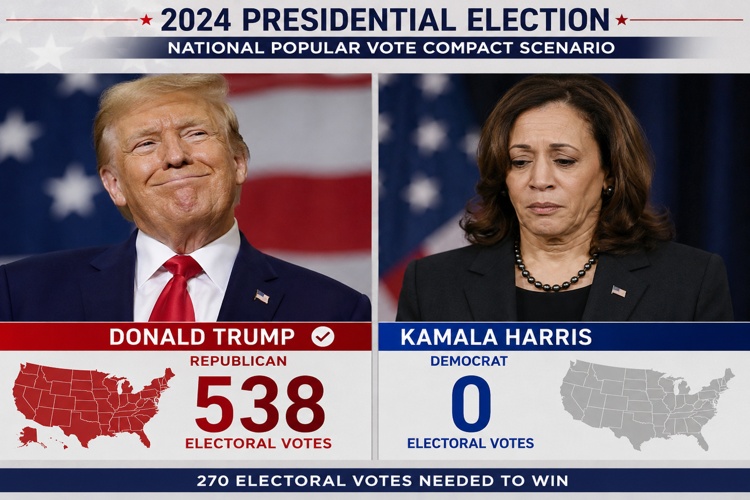
Donald Trump won both the Electoral College and the national popular vote in 2024.
Under the current system, Trump received 312 electoral votes while Vice President Kamala Harris received 226, reflecting the outcome of individual state elections.
Under a fully activated national popular vote compact, however, the Electoral College map effectively disappears as a meaningful state-by-state contest.
Every participating state would be required to award its electoral votes to the national popular vote winner.
In a full hypothetical scenario where all states operated under the compact model, Trump would have received all 538 electoral votes.
That means states such as Vermont, California, New York, Massachusetts, and Illinois—all of which voted for Harris at the state level—would nevertheless have awarded their electoral votes to Trump because he won nationally.
Even Nebraska’s split electoral system, which currently awards one electoral vote by congressional district, would become irrelevant under the compact. All five Nebraska electoral votes would instead go to the national winner.
The same would apply to New Hampshire.
The result would have been a unanimous 538–0 Electoral College outcome despite deep political differences between states.
Vermont Joined in 2011
Vermont entered the compact in 2011 after the Democratic-controlled legislature passed S.31 (Act 10 2011) and Gov. Peter Shumlin signed it into law.
The law itself does not eliminate presidential elections in Vermont. Vermonters would still cast ballots for president. Those votes would still be counted.
But once the compact activates, Vermont’s statewide result would no longer determine how Vermont’s three electoral votes are allocated.
Instead, Vermont votes would simply be added into a nationwide tally, and Vermont’s electors would then be awarded to whichever candidate wins nationally.
In practical terms, that means Vermont voters could strongly support one candidate while Vermont’s electoral votes go to another.
Supporters of the compact argue that this creates a fairer system by ensuring that the presidency always goes to the candidate receiving the most votes nationwide.
Critics argue the compact removes states as independent political units in presidential elections and weakens the role of smaller states.
A Shift Away from State-Based Elections
The modern movement behind the compact gained momentum after two presidential elections in which Republican candidates won the Electoral College while losing the national popular vote: George W. Bush in 2000 and Donald Trump in 2016.
Rather than pursue a constitutional amendment abolishing the Electoral College outright—a politically difficult process—the compact relies on states’ constitutional authority to determine how their electors are awarded.
The Constitution allows state legislatures to decide how presidential electors are appointed.
The compact uses that authority to coordinate states into acting collectively.
If the compact reaches 270 electoral votes, member states would no longer use their own state-level presidential outcomes to allocate electors. Instead, those electoral votes would be tied to the national result.
For Vermont voters, the distinction is significant.
Currently, a presidential vote cast in Vermont contributes to determining how Vermont’s electors are awarded.
Under the compact, a Vermont vote would instead become part of a national aggregate, with no direct role in determining Vermont’s own electoral outcome.
A Conditional Principle
The compact also raises a political question beyond the mechanics themselves.
If awarding electoral votes to the national popular vote winner is the correct principle, why does the compact only activate once enough states join to guarantee the outcome?
Participating states are not immediately awarding their electoral votes based on the national popular vote. Instead, they continue using traditional state-based allocation methods unless and until the compact reaches 270 electoral votes.
That condition is central to how the agreement works.
Without the 270 threshold, a state acting alone could end up awarding its electoral votes to a candidate rejected by its own voters while other states continued operating under the existing system.
By waiting until enough states join to guarantee the national popular vote winner becomes president, the compact avoids that risk.
Supporters argue the threshold is necessary to prevent fragmented or conflicting outcomes.
Critics argue it reveals something else entirely: a willingness to change the system only once the change becomes decisive.
As additional states consider joining ahead of the 2028 election, Vermont voters may eventually face a broader question beyond party politics:
Should Vermont’s presidential electors be determined by Vermont voters—or by the national popular vote?
Dave Soulia | FYIVT
You can find FYIVT on YouTube | X(Twitter) | Facebook | Instagram
#fyivt #VermontPolitics #ElectoralCollege #NationalPopularVote
Support Us for as Little as $5 – Get In The Fight!!
Make a Big Impact with $25/month—Become a Premium Supporter!
Join the Top Tier of Supporters with $50/month—Become a SUPER Supporter!


 Subscribe to RSS





Leave a Reply