

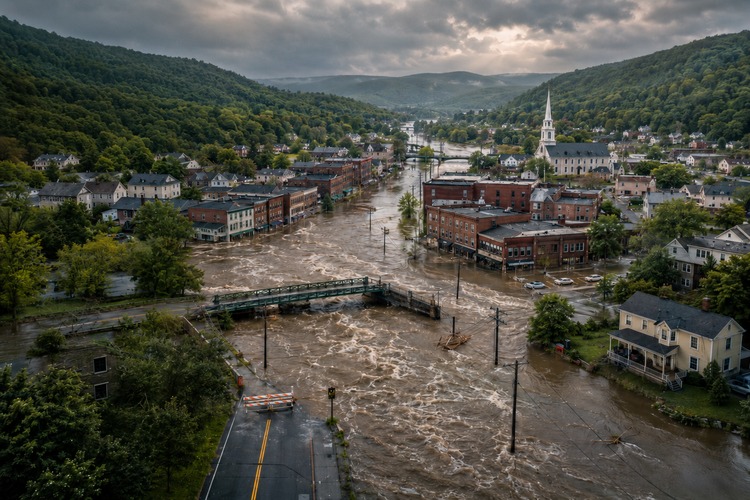
Vermont’s housing policy is making a calculated bet: put more people where roads, sidewalks, sewer, water, shops, schools, jobs, and public services already exist.
That is the logic behind Act 181, the state’s 2024 land-use law. The law pushes future development toward existing downtowns, village centers, and planned growth areas by creating Tier 1A and Tier 1B designations where Act 250 review is reduced or, in some cases, eliminated. The stated goal is to increase housing supply by steering development into existing centers rather than scattering new homes across farm fields, forests, and back roads.
But in Vermont, many existing centers were built where they were for one reason: rivers.
🍁 Make a One-Time Contribution — Stand Up for Accountability in Vermont 🍁
The Rivers That Built the Towns
That is where the mills were. That is where the roads followed the valleys. That is where commerce grew. That is where the villages took shape. The same rivers that built many of Vermont’s towns are also the rivers that have repeatedly damaged them.
That creates a problem Act 181 does not fully answer.
The issue is not simply whether a new apartment building sits inside a mapped FEMA floodplain. That is too narrow a question. A building can remain dry while the town around it fails. Its residents may still depend on roads that wash out, bridges that close, utilities that go down, sewer systems that back up, downtown employers that flood, grocery stores that cannot open, pharmacies that cannot be reached, and emergency services that are suddenly stretched across broken infrastructure.
Vermont’s flood risk is not just inundation. It is isolation.
Floods Break Systems, Not Just Buildings
That distinction matters. During Tropical Storm Irene and again during the July 2023 floods, many Vermont communities did not merely experience water in basements. They experienced road failures, bridge losses, power outages, damaged downtowns, severed access routes, overwhelmed municipal services, and long recovery periods. Some residents were not necessarily underwater themselves, but they were trapped inside the larger disaster because the systems around them stopped working.
Act 181’s preferred-growth model assumes that existing centers are the logical places to build because they already contain public infrastructure. That is the planning theory — until the infrastructure those centers depend on fails. The street grid that makes a village walkable can become impassable. The bridge that connects residents to work, school, medical care, and supplies can become the failure point. The downtown that anchors the community can become the damage zone.
“Walkability” is the selling point. But walkability is not much comfort when the street is under brown water.
The Tradeoff Is Real
None of this resolves the broader compact-growth debate. Vermont’s old development pattern — one house at a time spread across rural roads and hillsides — has real costs. It consumes land, increases driving, raises municipal maintenance burdens, fragments forests, and makes public services more expensive. Nor is hillside development cost-free. It brings its own risks: stormwater runoff, erosion, culvert failures, long driveways, road washouts, and higher infrastructure costs.
But Vermont should not pretend the only choice is between village centers and careless sprawl.
There is a third question the state needs to ask more directly: should some future growth be compact, serviced, and connected to existing communities, but placed on higher ground outside the most obvious flood-disruption zones?
That question is not anti-housing. It is basic risk accounting.
Flood Rules Do Not End the Question
Act 181 includes flood-related safeguards. Tier 1A and Tier 1B designations require municipalities to address flood hazard areas and, in some cases, river corridors through local bylaws, exclusions, or regulation. Those provisions exist. But they do not eliminate the larger concern, because flood disasters do not follow parcel lines. A town can comply with floodplain rules and still concentrate more people inside a community whose road network, utilities, emergency access, and commercial core are vulnerable during major storms.
That is where the policy discussion needs to move.
More Growth Means More Consequence
If Act 181 succeeds, Vermont’s historic centers will gain more housing. More residents will move in. Businesses may expand to serve them. More vehicles, customers, workers, renters, children, elderly residents, pets, medications, fuel needs, and emergency obligations will be concentrated in those places. That may increase housing supply and local commerce in normal times.
But when the next major flood hits, the consequences may also be larger.
That does not mean the new housing caused the flood. It means public policy increased the amount of life, property, commerce, and public obligation exposed to the disruption. Climate may affect the hazard. Land-use policy affects the exposure.
Those are different things, and Vermont needs to stop blending them together.
Blaming the Sky Is Easier
After the next disaster, officials will point to heavier rainfall, climate change, aging infrastructure, and federal flood maps. Some of that may be true. But it will not be the whole truth. Disaster losses also rise when more people and assets are placed in communities already known to fail under flood conditions.
Blaming the sky is easier than explaining the zoning map.
The hard question is not whether Vermont should abandon its downtowns. That is not a serious option. These places are the civic, commercial, and cultural centers of the state. Their future matters. So does an honest accounting of their flood exposure.
The hard question is whether Vermont should automatically treat historic settlement patterns as safe settlement patterns.
They are not the same thing.
A Bet Vermont Should Name Clearly
Vermont built its towns along rivers because rivers made those towns possible. Act 181 now asks many of those same towns to absorb more of the state’s housing future. That may still be the right bet. But it is a bet, and the state should be honest about what is being wagered.
A building can sit outside the floodplain and still be inside the disaster.
That is the flood-risk question Act 181 has to answer.
Dave Soulia | FYIVT
You can find FYIVT on YouTube | X(Twitter) | Facebook | Instagram
#fyivt #Vermont #Act181 #FloodRisk
Support Us for as Little as $5 – Get In The Fight!!
Make a Big Impact with $25/month—Become a Premium Supporter!
Join the Top Tier of Supporters with $50/month—Become a SUPER Supporter!


 Subscribe to RSS







Leave a Reply