

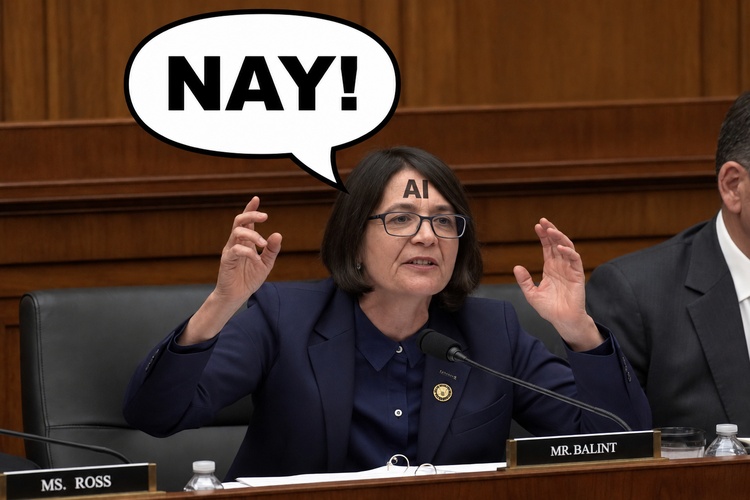
The Quote Was Parody. The Vote Was Real.
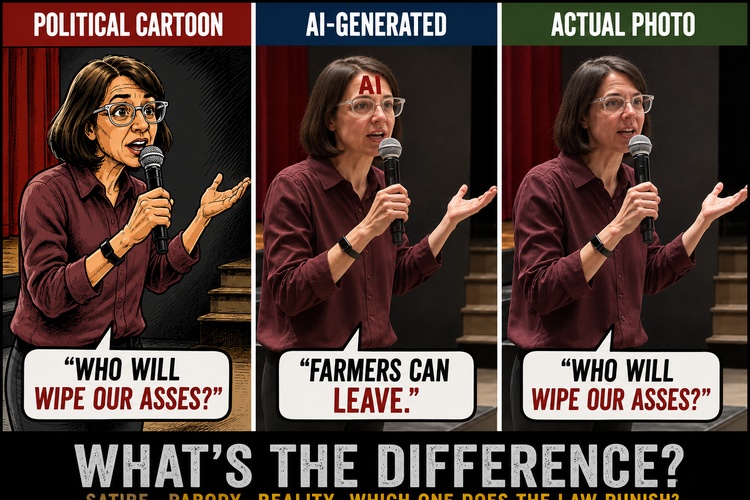
A parody artificial intelligence video that depicted U.S. Rep. Becca Balint dismissing Vermont farmers with the line “the farmers can leave” has stirred political attention in Vermont. There is no evidence Balint actually said those words.
But Balint did vote against final passage of H.R. 7567, the Farm, Food, and National Security Act of 2026 — the House Republican farm bill — which passed the U.S. House on April 30 by a vote of 224-200.
The bill is now the House-passed version of the 2026 Farm Bill. It would reauthorize and modify federal agriculture, nutrition, conservation, rural development, forestry, crop insurance, horticulture, trade, and related USDA programs through 2031.
Balint, Vermont’s lone member of the U.S. House, was listed as a “Nay” vote.
What Balint Said
After the vote, Balint said she opposed the bill because it “locks in cuts to SNAP that take food assistance away from millions,” while failing to provide meaningful relief for small and midsize farmers facing rising costs.
She also said the bill cut conservation funding, undermined investments in rural communities, and left out two affordable-housing amendments she had offered.
Those amendments, according to Balint’s office, would have invested in the Housing Choice Voucher homeownership program, USDA Section 502 Direct Loans, and USDA rural rental housing preservation programs.
Balint’s opposition centered on SNAP, conservation, rural housing, and whether the bill did enough for smaller farm operations.
🍁 Make a One-Time Contribution — Stand Up for Accountability in Vermont 🍁
What Was In The Bill For Farmers
The bill itself contains a long list of farm and rural programs, including several that match the kinds of agriculture found in Vermont.
One of the clearest examples is the Local Farmers Feeding Our Communities Program. The bill authorizes $200 million per year from fiscal years 2027 through 2031 — $1 billion over five years, if fully appropriated — for cooperative agreements that allow eligible entities to buy local food.
The program specifically covers unprocessed or minimally processed local foods, including seafood, meat, milk, dairy products, eggs, produce, and poultry. It also requires at least 25 percent of the total annual value of products purchased under the program to come from small-size producers, mid-size producers, beginning farmers or ranchers, or veteran farmers or ranchers.
Under the bill, a small-size producer is defined as one with annual gross cash farm income below $350,000. A mid-size producer is defined as one with annual gross cash farm income of at least $350,000 but less than $999,999.
That provision is directly relevant to Vermont’s small and mid-sized dairy, meat, egg, vegetable, and local food producers.
Dairy, Maple, Organic, Meat, And Specialty Crops
The farm bill also included several provisions tied to sectors important in Vermont.
For dairy, the bill extended dairy-related programs through 2031, added mandatory reporting of dairy product processing costs, and amended dairy nutrition incentives by expanding beyond fluid milk to include covered dairy products such as cheese and yogurt. It raised one dairy nutrition authorization from $20 million to $50 million.
For maple, the bill extended the Acer Access and Development Program through 2031 and required USDA to solicit input from maple syrup industry stakeholders before setting research and education priorities.
For organic dairy, the bill required USDA to collect and publish cost-of-production data for organic milk, including feed costs, organic milk prices, prices received for organic dairy cows, and regional data from the six regions with the greatest organic dairy production.
For livestock producers, the rural development title includes new, mobile, and expanded meat processing and rendering grants, a provision aimed at processing capacity — a persistent barrier for small livestock farms in rural states.
The bill also created a Specialty Crop Emergency Assistance Framework for producers affected by adverse events, including economic crises or market disruptions. Payments would be based on prior specialty crop sales multiplied by a payment factor determined by USDA, subject to available funds.
Conservation Was More Complicated
Balint’s conservation claim has more support than some of her other objections, but it requires context.
The bill contained an entire conservation title, including reauthorization or changes to the Conservation Reserve Program, Environmental Quality Incentives Program, Conservation Stewardship Program, agricultural easements, watershed programs, soil health grants, forest conservation, and regional conservation partnerships.
It also included $100 million per year from fiscal years 2027 through 2031 for state and Tribal soil health grants.
However, the Congressional Budget Office found that the bill would reduce direct spending for EQIP-related provisions by $786 million over the 2026-2036 period, while increasing spending in other conservation areas. CBO estimated the overall conservation title would reduce direct spending by only $1 million over that same period.
In other words, the bill did not eliminate conservation funding. It shifted it, with a significant reduction in EQIP-related spending.
SNAP Was The Central Dispute
Balint’s strongest political objection was SNAP.
Her office said the bill locked in cuts to food assistance. The text of H.R. 7567’s nutrition title includes SNAP administrative changes, retailer provisions, EBT security, online purchasing authority, emergency food programs, and some expanded eligible foods, including hot rotisserie chicken.
The deeper dispute is that the House bill followed earlier federal budget reconciliation changes affecting SNAP. Balint’s “locks in” language appears to refer to leaving those prior changes in place, rather than H.R. 7567 itself creating a new, standalone SNAP benefit cut in the farm bill text.
That distinction matters. It does not erase Balint’s policy objection, but it narrows what the bill itself did.
Current Status
H.R. 7567 passed the House and was engrossed as the House-passed version of the Farm, Food, and National Security Act of 2026. As of the Congressional Research Service’s latest summary, the Senate Agriculture Committee had not marked up its own farm bill during the 119th Congress.
That means the bill is not law. It is the House’s farm bill position.
For Vermont farmers, the political question is now narrower than the AI parody line. Balint did not say “the farmers can leave.” But she did vote against a farm bill that included money and programs for dairy, maple, organic dairy, local food purchasing, specialty crops, meat processing, conservation, rural development, and small and midsize producers.
Her position was that the bill’s SNAP, conservation, rural housing, and rural investment flaws outweighed those farm provisions.
The record now shows both sides of that equation.
Dave Soulia | FYIVT
You can find FYIVT on YouTube | X(Twitter) | Facebook | Instagram
#fyivt #VermontPolitics #BeccaBalint #ArtificialIntelligence
Support Us for as Little as $5 – Get In The Fight!!
Make a Big Impact with $25/month—Become a Premium Supporter!
Join the Top Tier of Supporters with $50/month—Become a SUPER Supporter!


 Subscribe to RSS





Leave a Reply