

A recent immigration-enforcement incident in South Burlington has reignited debate in Vermont over public safety, immigration policy, and the role of law enforcement.
But beneath the political arguments surrounding the Dorset Street incident lies a broader question increasingly shaping modern public discourse:
At what point did the law-enforcement response itself become viewed as the primary problem, rather than the conduct that triggered the enforcement action in the first place?
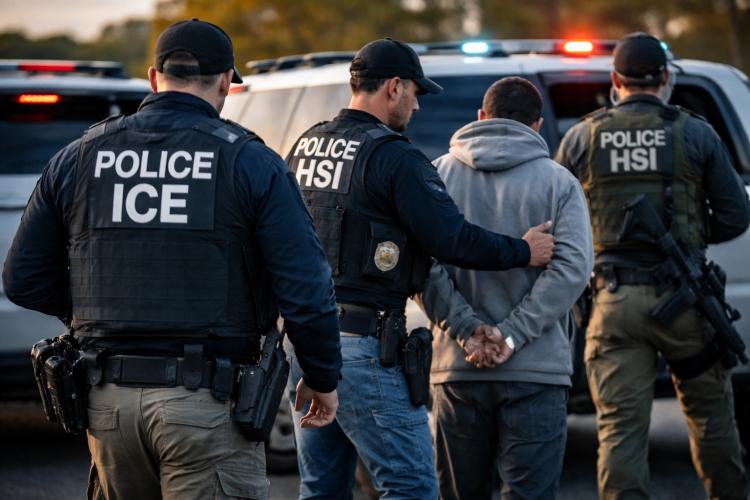
The incident involved federal immigration agents attempting to detain an unlawfully present individual who had previously been charged with driving while intoxicated in Middlebury. During the attempted apprehension in South Burlington, the suspect allegedly fled, reportedly driving through or near public areas during morning hours as school traffic and commuters moved through the city.
Public reaction afterward focused heavily on the conduct and visibility of federal immigration enforcement officers, including criticism of tactics, operational safety, and the presence of masked agents.
What received comparatively less attention was the earlier chain of events that preceded the encounter itself.
🍁 Make a One-Time Contribution — Stand Up for Accountability in Vermont 🍁
The Earlier Public Safety Question
The individual involved had previously faced a DWI-related charge in Vermont before federal authorities later attempted to take him into custody.
Critics of Vermont’s current immigration-enforcement posture argue that incidents like the Dorset Street case illustrate a broader structural problem: dangerous situations may become more likely when earlier opportunities for coordination or detention are not pursued.
Supporters of Vermont’s current approach generally counter that local police should not function as federal immigration agents and that public safety is not improved by turning routine state-level policing into an immigration-enforcement pipeline.
That debate has intensified as lawmakers simultaneously consider S.227, a bill involving immigration protocols in Vermont schools that would limit certain forms of cooperation and information-sharing related to immigration enforcement.
While S.227 focuses specifically on school settings, the broader public conversation increasingly centers on a larger issue: whether modern political culture places greater scrutiny on enforcement itself than on the underlying conduct that led to enforcement.
The Precautionary Principle Problem
The debate also exposes a growing philosophical inconsistency critics say appears across multiple policy areas.
In recent years, Vermont lawmakers and policymakers have repeatedly justified preventative laws and restrictions using precautionary logic.
Gun-control debates often invoke phrases such as “if it saves one life” when discussing restrictions intended to prevent rare but catastrophic acts of violence.
Public-health mandates during the COVID era similarly relied on preventative frameworks designed to reduce potential harm even when risks could not be eliminated entirely.
Critics of Vermont’s immigration policies argue the same preventative logic is applied differently when immigration enforcement is involved.
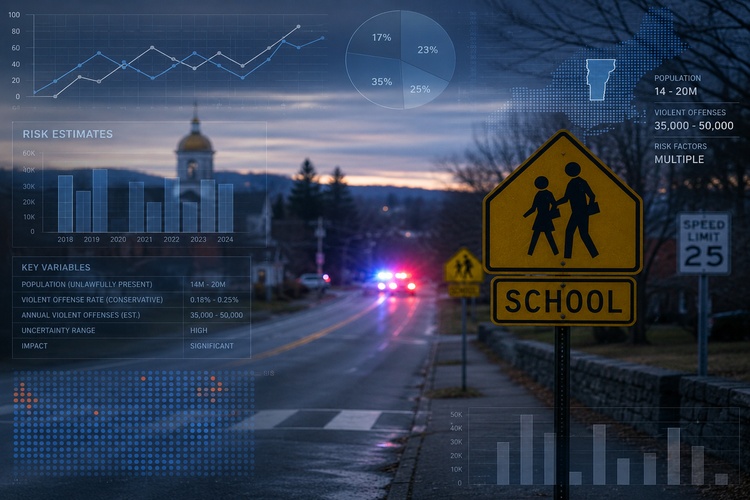
Using intentionally conservative assumptions, an FYIVT analysis estimated that even relatively low violent-offense rates within a population of 14 to 20 million unlawfully present individuals could still translate into tens of thousands of violent offenses annually nationwide.
The analysis assumed unlawful immigrants commit violent offenses at only half the rate of the general U.S. population. Even under that assumption, the article estimated roughly 35,000 to 50,000 violent offenses annually nationwide within a population estimated between 14 and 20 million unlawfully present individuals.
The article’s argument was not that most unlawful immigrants are violent offenders.
Rather, it argued that even relatively low violent-offense rates become significant when applied to populations numbering in the millions.
Optics Versus Outcomes
The modern immigration debate increasingly revolves around two competing ways of measuring harm.
One side often focuses on:
- enforcement visibility,
- fear within immigrant communities,
- children witnessing enforcement activity,
- and the psychological impact of federal operations.
The other side focuses on:
- downstream public-safety consequences,
- uncertainty surrounding unlawful entry,
- violent edge cases,
- and preventable victimization.
That divide has become especially visible in debates surrounding schools.
Supporters of immigration-related restrictions on law-enforcement access argue schools should remain stable educational environments free from fear and intimidation.
Critics counter that schools do not exist outside broader public-safety realities and that dangerous individuals have, in documented cases nationally, entered or remained within school systems while unlawfully present in the country.
Cases involving MS-13 gang affiliates, adult individuals posing as teenagers in schools, and violent offenders later identified as unlawfully present have all fueled those concerns.
The Core Policy Divide
At its core, the debate is no longer simply about immigration.
It is increasingly about how society weighs uncertainty, risk, and the role of preventative enforcement.
Critics of Vermont’s current direction argue the state increasingly treats enforcement visibility itself as the primary social harm while discounting the conduct, uncertainty, and accumulated risk that lead to enforcement actions in the first place.
Supporters argue broad cooperation with immigration enforcement creates its own societal harms and risks undermining trust in schools, institutions, and local communities.
The Dorset Street incident has become a flashpoint because it encapsulates that larger divide.
One side sees a dangerous federal operation.
The other sees a dangerous situation made more likely by earlier policy decisions that reduced cooperation with enforcement before the situation escalated.
And underneath both positions remains the same unresolved question:
What level of public-safety risk should policymakers be willing to tolerate in exchange for limiting immigration-enforcement activity inside communities and institutions?
Dave Soulia | FYIVT
You can find FYIVT on YouTube | X(Twitter) | Facebook | Instagram
#fyivt #vtpoli #immigration #publicsafety
Support Us for as Little as $5 – Get In The Fight!!
Make a Big Impact with $25/month—Become a Premium Supporter!
Join the Top Tier of Supporters with $50/month—Become a SUPER Supporter!


 Subscribe to RSS




Leave a Reply