

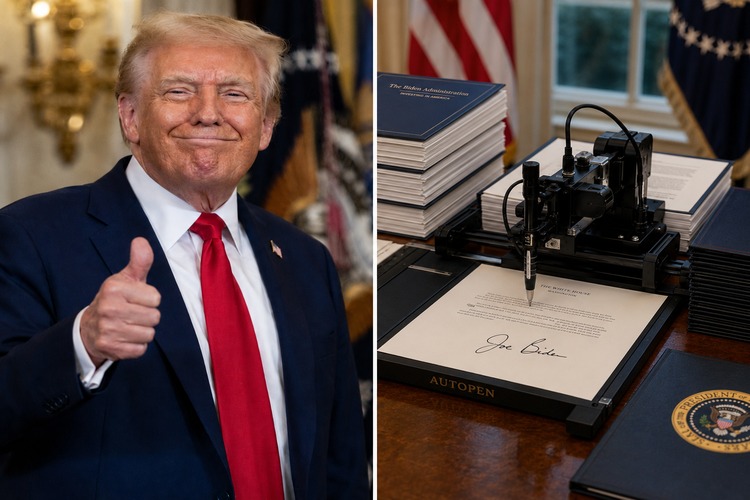
Two recent presidential controversies have raised legitimate questions about power, accountability, and whether the justice system is being used as a shield for political allies. One involved President Joe Biden issuing sweeping preemptive pardons in his final hours in office. The other involved President Donald Trump settling a lawsuit against the IRS after an illegal leak of his tax information.
Both deserve scrutiny. But they are not the same kind of outrage.
Biden’s action was unilateral. Trump’s was transactional. Biden used the pardon power to protect selected people from potential prosecution for acts that may or may not have occurred. Trump dropped pending legal claims arising from a real government abuse: the illegal disclosure of private tax information by former IRS contractor Charles Littlejohn.
That distinction does not make the Trump settlement beyond criticism. It does, however, make the comparison more complicated than the usual cable-news morality play.
🍁 Make a One-Time Contribution — Stand Up for Accountability in Vermont 🍁
Biden’s Preemptive Pardons
On his final day in office, Biden issued preemptive pardons for Dr. Anthony Fauci, retired Gen. Mark Milley, members and staff of the House Jan. 6 committee, and several police officers who testified before that committee. He later issued pardons for members of his own family, including Hunter Biden, James Biden, Sara Jones Biden, Valerie Biden Owens, John Owens, and Francis Biden.
Biden said the pardons were not admissions of wrongdoing. That is legally important and politically explosive. These were not ordinary pardons after conviction. They were protective pardons issued before charges, before trial, and in some cases before any known criminal allegation had been tested in court.
The justification was fear of retaliation by the incoming Trump administration. Biden argued that investigations themselves could impose reputational and financial harm even if no charges were ultimately brought. That argument may be sympathetic to Biden supporters, but it also creates a dangerous precedent. A president leaving office can now point to political hostility, declare allies or family members at risk, and grant broad legal protection without any adjudication.
That is not a small thing. It is a constitutional power, but it is also a blunt one. Used this way, it can look less like mercy and more like legal insulation.
Trump’s IRS Settlement
Trump’s controversy begins from a different factual foundation.
Trump, Donald Trump Jr., Eric Trump, and the Trump Organization sued the IRS and Treasury after Littlejohn illegally obtained and disclosed private tax information. Littlejohn’s leak was not theoretical. It was a criminal breach of taxpayer privacy. Whatever one thinks of Trump, the IRS cannot be allowed to become a political opposition-research bureau.
The settlement agreement says Trump and the other plaintiffs received no direct monetary damages. Instead, they received a formal apology, agreed to dismiss the case, and withdrew related pending administrative claims. DOJ also announced an Anti-Weaponization Fund intended to compensate others who claimed they were targeted by government “lawfare” or “weaponization.”
That is where the controversy grows.
The fund was announced at $1.776 billion. Its members would be appointed by the Attorney General, with presidential removal power. The settlement allowed the fund to set its own procedures and did not require full public disclosure of how claims would be handled. Critics immediately raised concerns that the structure could become a taxpayer-funded vehicle for political allies.
Then came the more explosive addendum: language purporting to bar the IRS from pursuing claims or audits tied to Trump’s prior tax returns and related entities. That shifted the debate from settlement compensation to whether the government had granted a sitting president unusually broad protection from tax enforcement.
The Caliber of the Two Outrages
Biden’s pardons are easier to describe. They were open, unilateral, constitutionally broad, and politically self-serving. The family pardons were especially damaging because they directly protected the president’s own relatives without requiring any reciprocal public benefit.
Trump’s settlement is harder. It arose from a real injury caused by illegal government conduct. Trump had live claims, including a major IRS lawsuit, and he dropped them. That gives the settlement a contractual character Biden’s pardons did not have.
But that does not end the issue. The question is whether the government gave Trump relief proportional to the claims he surrendered, or whether a legitimate IRS leak case became the vehicle for broader protection of Trump, his family, and his business interests.
In plain terms: Biden’s move looked like a last-minute shield. Trump’s looked like a hard-nosed settlement that may have included too much.
The Media Question
Mainstream coverage treated the two events very differently in temperature.
Biden’s pardons were reported, but much of the framing emphasized protection from possible Trump retaliation. The dominant presentation was defensive: Biden was shielding public servants, committee members, and family from politically motivated investigations.
Coverage of Trump’s IRS settlement has carried a sharper institutional alarm. That may be partly because the settlement involved taxpayer funds, DOJ action, IRS enforcement authority, and a sitting president’s private legal interests. Those are serious issues.
But the asymmetry remains hard to ignore. When Biden used raw executive power to pardon allies and family for possible offenses before any prosecution occurred, the dominant media tone was not that democracy itself was under attack. When Trump settled a lawsuit arising from an actual IRS crime and obtained disputed protection from future tax action on past returns, the coverage quickly moved toward corruption and abuse-of-power framing.
Both stories involve presidents using power to protect their own side. Biden did it through clemency. Trump did it through litigation leverage and settlement authority. Biden’s action was cleaner legally but uglier as naked self-protection. Trump’s action was more defensible at the starting point, but more complicated and potentially more troubling in the details.
That is the real comparison. Not one outrage versus no outrage. Two outrages, different tools, different legal footing, and very different media heat.
Dave Soulia | FYIVT
You can find FYIVT on YouTube | X(Twitter) | Facebook | Instagram
#fyivt #PresidentialPower #JusticeSystem #MediaBias
Support Us for as Little as $5 – Get In The Fight!!
Make a Big Impact with $25/month—Become a Premium Supporter!
Join the Top Tier of Supporters with $50/month—Become a SUPER Supporter!


 Subscribe to RSS





Leave a Reply