

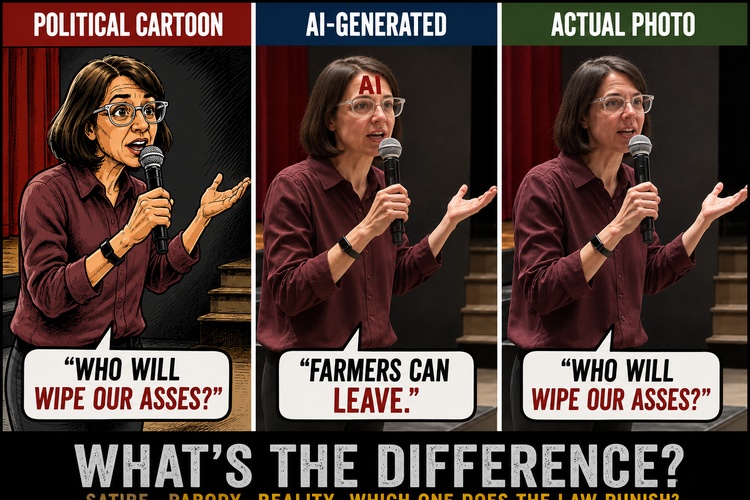
An AI-generated parody video targeting U.S. Rep. Becca Balint has become one of the first public tests of Vermont’s new synthetic-media law — and may offer Vermonters an early glimpse into how far lawmakers intend to go in regulating political speech.
The controversy began after an AI-generated video posted on the Planet Hank platform depicted Balint making controversial statements while Republican congressional candidate Mark Coester was portrayed as her political opponent.
Balint denounced the video as deceptive and dangerous.
“This ad is offensive and a dangerous example of what happens when AI is used to deceive voters,” Balint said in a statement reported by Seven Days. “Fabricating my voice and image to put words in my mouth is a new low.”
Readers can judge the video for themselves:
The debate that followed has exposed something larger than a single campaign video. It has put both Vermont’s new AI-election law and Balint’s support for a federal AI-likeness bill under the microscope.
🍁 Make a One-Time Contribution — Stand Up for Accountability in Vermont 🍁
Judge For yourself
Vermont Already Passed A Law
In March, Governor Phil Scott signed S.23 into law.
The legislation requires disclosures on certain AI-generated election communications within 90 days of an election. Supporters argued that rapidly advancing AI technology could make it difficult for voters to distinguish authentic campaign material from fabricated content.
The law was promoted as a safeguard against deception.
It also contains exemptions for satire and parody.
That exemption may soon become important.
WCAX reported this week that the Vermont Attorney General’s Office is aware of the Balint video and is reviewing the matter.
The obvious question is whether a video that many viewers immediately recognized as satire is precisely the sort of speech the law was supposed to leave alone.
The Quote Everyone Heard
The timing of the controversy is notable.
Just days before the AI video appeared, Balint faced criticism over comments made during a Newport town hall discussion regarding immigration and labor shortages.
During that event, Balint stated:
The remark quickly spread online and generated national attention.
Balint later characterized the language as “sloppy and insensitive” while defending her broader argument.
Unlike statements attributed to her in the AI video, the “wipe our asses” quote is real, documented, and widely reported.
The Quote We Could Not Verify
The AI video depicts Balint saying:
“If those farmers don’t like it, they can leave.”
FYIVT was unable to locate any recording, transcript, interview, social media post, public appearance, or news report showing Balint made that statement.
That does not prove such a statement was never made.
It does mean that despite extensive reporting on the controversy by WCAX, Seven Days, Vermont Daily Chronicle, and others, no evidence has been produced showing the quote originated from an actual Balint appearance.
Readers can watch the video and draw their own conclusions.
Balint’s Federal Bill
The Vermont controversy arrives as Balint supports the federal NO FAKES Act.
The proposal would create a federal legal right over a person’s voice and likeness and allow legal action against unauthorized AI-generated digital replicas.
Supporters argue the bill is necessary because AI-generated impersonations are becoming increasingly realistic.
Critics argue the proposal risks creating a new mechanism for policing political speech, parody, criticism, and satire involving public officials.
Ironically, the legislation itself contains carve-outs for commentary, criticism, parody, and satire — an acknowledgment that those forms of speech occupy a special place under the First Amendment.
Three Newsrooms, Three Different Stories
One of the more interesting aspects of the controversy is how differently Vermont media outlets interpreted the same video.
WCAX focused primarily on election law, AI regulation, and free speech concerns.
Seven Days framed the incident as an AI-generated attack on Balint and emphasized the congresswoman’s objections.
Guy Page at Vermont Daily Chronicle focused on the larger constitutional question: whether AI is simply the latest technological tool being used for political satire.
All three outlets viewed the same video.
All three described it differently.
The Question Lawmakers Still Haven’t Answered
Political cartoons have been putting fictional words into politicians’ mouths for centuries.
Television comedians impersonate elected officials nightly.
Satirical newspapers built entire business models around fabricated quotes and fictional news stories involving public figures.
None of that is new.
Artificial intelligence is new.
The question facing Vermont lawmakers is whether AI changes the constitutional equation or merely changes the tool used to create political commentary.
If a cartoonist draws a politician saying something outrageous, it is generally recognized as satire.
If an AI generator creates a politician saying something outrageous, lawmakers increasingly seem interested in regulating it.
Why?
That question remains largely unanswered.
The Balint controversy may ultimately become less about one video and more about whether government can regulate emerging technology without regulating protected political speech along with it.
For now, the video remains online, the Attorney General is reviewing it, and Vermonters are left with a simple question:
What exactly is the difference?
Dave Soulia | FYIVT
You can find FYIVT on YouTube | X(Twitter) | Facebook | Instagram
#fyivt #VermontPolitics #BeccaBalint #ArtificialIntelligence
Support Us for as Little as $5 – Get In The Fight!!
Make a Big Impact with $25/month—Become a Premium Supporter!
Join the Top Tier of Supporters with $50/month—Become a SUPER Supporter!


 Subscribe to RSS





Leave a Reply