

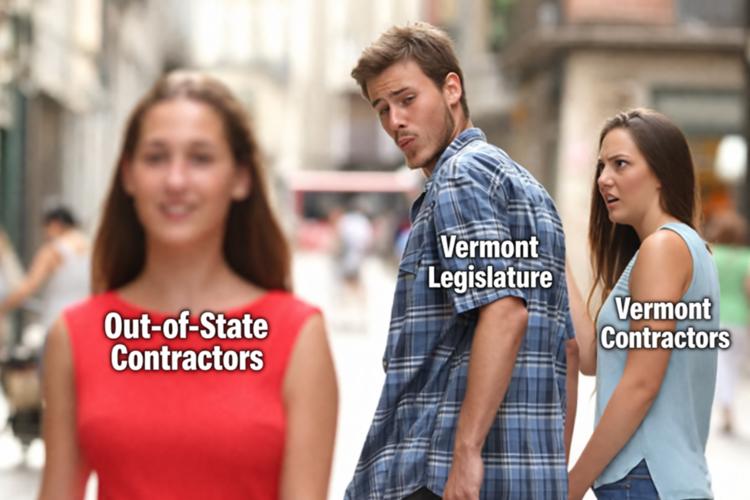
The Vermont Senate is advancing S.328, a wide-ranging housing bill aimed at increasing development and easing regulatory barriers. But one of its most controversial elements—a proposal to grant zoning density bonuses to projects using union labor—has been removed for now, following internal disagreement within the very committee that introduced the bill.
The bill, as passed out of the Senate Committee on Economic Development, Housing and General Affairs in mid-March, focuses on several core changes: requiring municipalities to plan for housing targets, expanding by-right zoning for duplexes and small multiunit housing, increasing state-backed financing capacity, and directing funding toward housing programs such as VHIP.
Missing from that version, however, is a provision that had appeared in earlier drafts: a density bonus of up to 20 percent for residential developments using union labor.
🍁 Make a One-Time Contribution — Stand Up for Accountability in Vermont 🍁
A Provision Removed — Not Rejected
That proposal did not quietly disappear. It was actively debated—and deliberately removed—during a March 13 committee meeting.
Committee Chair Sen. Alison Clarkson ( D – Windsor District ) acknowledged the decision directly, describing the provision as “out for now, but not forever,” signaling that the concept remains alive even if it did not survive the immediate legislative push.
Sen. Kesha Ram Hinsdale ( D – Chittenden-Southeast District ), also a member of the committee, pushed back on removing the language, calling it “a valuable part of the bill” and expressing concern about cutting substantive policy in order to move the bill forward.
The reason for its removal was not a decisive rejection of the policy itself, but a lack of consensus—and timing. Lawmakers were under pressure to move the bill through committee before crossover deadlines, and questions remained about whether the incentive would meaningfully increase housing production.
In practical terms, the provision was set aside to move the bill—not resolved on the merits.
The Economics Behind the Fight
A density bonus is not symbolic. It allows developers to build more units on the same parcel of land, which can significantly improve project economics. In markets where land, permitting, and financing costs are high, the ability to increase unit count can determine whether a project moves forward at all.
That is what made the proposal consequential. It would not have mandated union labor, but it would have made projects using it potentially more profitable under local zoning rules.
Developers respond to margins. If one approach allows more units—and therefore more revenue—on the same footprint, that incentive can shift how projects are structured and who is positioned to build them.
The committee discussion reflected uncertainty about whether the 20 percent bonus would be sufficient to offset higher labor costs in practice. Without clear agreement on that point, the provision lacked the support needed to remain in the bill at that stage.
Industry Pushback: “Tilting the Scale”
Outside the committee room, opposition to the idea had already been building.
In written testimony, Richard Wobby Jr. of the Associated General Contractors of Vermont warned that such incentives would “tilt the scale toward one business model over another in a small, rural state.”
Wobby argued that Vermont’s construction workforce is overwhelmingly non-union and that tying zoning advantages to union labor could reduce competition, raise costs, and favor larger or out-of-state firms better positioned to meet those requirements.
Those concerns go directly to market structure. If most local contractors operate outside union frameworks, an incentive tied to union labor does not simply reward behavior—it can reshape who is competitive for certain projects.
Labor Advocates Push Back
Labor representatives who participated in the March 13 discussion challenged the assumption that union labor necessarily increases costs, arguing that structured agreements can provide efficiencies and predictability on larger projects.
From that perspective, the incentive was not about restricting the market but about encouraging a model that supporters argue can deliver consistent outcomes at scale.
The committee did not resolve that disagreement. Instead, it deferred it.
A Broader Policy Context
The removal of the union provision comes as Vermont prepares for a statewide vote on Proposal 3, a constitutional amendment related to collective bargaining. While the amendment is separate from S.328, both reflect ongoing debates about the role of organized labor in state policy.
S.328, even without the union-linked incentive, still represents a significant shift in housing policy. It expands by-right development, increases planning requirements, and strengthens state involvement in financing and guiding housing growth.
The earlier inclusion of a labor-linked zoning incentive shows how far that policy direction was being considered.
Not Gone — Just Delayed
For now, S.328 moves forward without the union-density provision. But the committee record makes clear that the idea remains under active consideration.
Clarkson’s statement that the provision is “not forever” suggests it could return in future legislation or later stages of the current bill.
That leaves a key question unresolved: whether housing policy in Vermont will be used solely to increase supply, or also to influence how—and by whom—that housing is built.
For stakeholders across the construction and development landscape, that question is not theoretical. It goes directly to competitiveness, project viability, and who ultimately participates in the state’s housing market.
And based on the committee’s own discussion, it is a question that is far from settled.
Dave Soulia | FYIVT
You can find FYIVT on YouTube | X(Twitter) | Facebook | Instagram
#fyivt #VTPolitics #HousingCrisis #Act250
Support Us for as Little as $5 – Get In The Fight!!
Make a Big Impact with $25/month—Become a Premium Supporter!
Join the Top Tier of Supporters with $50/month—Become a SUPER Supporter!


 Subscribe to RSS





Leave a Reply