

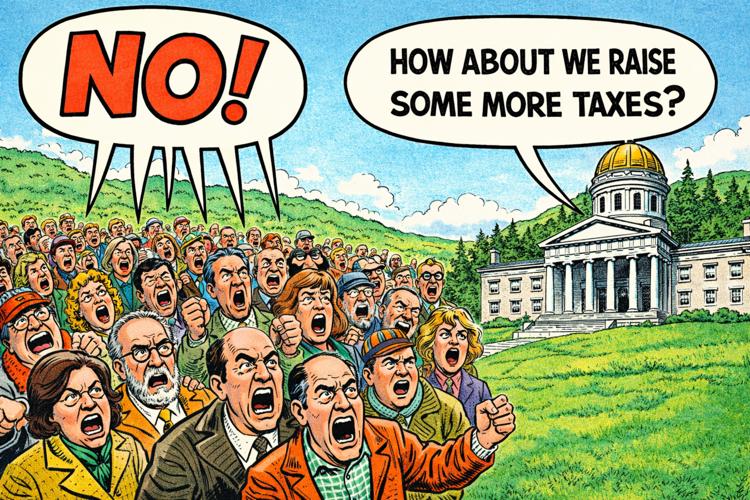
The Vermont Joint Fiscal Office’s Fiscal Facts 2026 report provides a detailed breakdown of how the state could increase revenue, laying out a range of options without endorsing any specific policy direction.
The document frames the issue in straightforward terms: if lawmakers need more revenue, there are three primary levers available—raising existing tax rates, expanding what is taxed, or creating entirely new taxes.
What follows is essentially a menu. Some options are incremental. Others would represent broad structural changes to how Vermont collects taxes.
🍁 Make a One-Time Contribution — Stand Up for Accountability in Vermont 🍁
Three Core Approaches to Revenue Growth
At the highest level, the report organizes potential revenue strategies into three categories:
- Increasing existing tax rates
- Expanding existing tax bases
- Creating new taxes
This framework reflects how most modern tax systems evolve. Governments can either charge more on what they already tax, apply taxes to new categories of activity, or design entirely new revenue streams.
The report focuses primarily on the first two—rate increases and base expansion—because they can be modeled using existing data.
Raising Existing Taxes: Largest Immediate Impact
The most direct path to new revenue is increasing current tax rates. The report provides estimated yields for several hypothetical 1% increases.
A 1% increase in the personal income tax stands out as the largest single option, generating an estimated $287 million annually.
That reflects the size of the income tax base in Vermont, which accounts for a significant share of non-property tax revenue.
Other rate increases would produce smaller but still notable gains:
- Sales and use tax: approximately $108.5 million
- Meals and rooms tax: about $29.1 million
Beyond those, the report includes smaller adjustments such as fuel taxes, cigarette taxes, and corporate tax surcharges. These generate comparatively modest amounts—often in the low millions—but could be combined for incremental revenue growth.
The structure here is simple: rate increases scale with the size of the underlying tax base. Larger taxes produce larger returns from small percentage changes.
Expanding the Sales Tax to Goods
A second major strategy is expanding the sales tax base to include goods that are currently exempt.
Applying Vermont’s 6% sales tax to groceries alone would generate an estimated $146.8 million annually.
Other categories include:
- Clothing and footwear: $46.2 million
- Candy: $4.0 million
These categories are currently excluded from the general sales tax, meaning any change would represent a shift in policy rather than a rate increase.
From a structural standpoint, expanding the base spreads taxation across more transactions rather than increasing the burden on existing ones.
Services Represent a Large Untaxed Base
The report makes clear that one of the largest potential revenue opportunities lies in taxing services—particularly professional and technical services that are currently exempt.
Estimated annual revenues from applying the 6% sales tax include:
- Computer systems design: $43.6 million
- Architectural and engineering services: $28.5 million
- Management and consulting services: $26.9 million
- Legal services: $19.7 million
- Accounting and payroll services: $12.9 million
These sectors represent a substantial portion of modern economic activity. Unlike goods, which are already broadly taxed, many services remain outside Vermont’s sales tax structure.
Expanding taxation into these areas would significantly broaden the base without changing the existing rate.
Health Care and Personal Services
Another major category identified in the report is healthcare and personal services.
Applying the sales tax to these services could generate:
- Physician services: $61.9 million
- Outpatient care centers: $35.9 million
- Dental services: $22.1 million
Additional services—such as chiropractic care, optometry, and therapy services—are also included in the broader analysis.
Beyond healthcare, the report lists a wide range of additional service sectors that could be taxed, including:
- Administrative and support services
- Real estate-related services
- Repair and maintenance services
- Personal care services
Taken together, these categories illustrate how much of the service economy currently sits outside the sales tax system.
Scope of Potential Changes
One of the more striking aspects of the report is the sheer breadth of categories analyzed.
The options range from small adjustments—like a few cents added to fuel taxes—to sweeping changes, such as taxing large portions of the service economy or applying sales tax to essential goods like groceries.
This highlights a fundamental policy tradeoff: narrow changes tend to generate smaller amounts of revenue, while broader changes can produce significantly larger returns but affect more sectors of the economy.
Revenue Estimates Come With Caveats
The Joint Fiscal Office emphasizes that all revenue figures are preliminary and based on static estimates.
They do not account for behavioral responses, such as reduced consumption, changes in business activity, or cross-border purchasing.
The report notes that actual revenue collections are likely to be somewhat lower than the “simple yield” estimates presented, with effective yields typically falling between about 90% and 100% depending on the tax and economic conditions.
Factors such as competition from neighboring states, the size of the tax increase, and the type of good or service being taxed all influence how much revenue is ultimately realized.
A Reference Tool, Not a Policy Proposal
The report stops short of recommending any specific course of action.
Instead, it functions as a technical reference, giving lawmakers a clear picture of what different choices could produce in terms of revenue.
By laying out both rate increases and base expansions in detail, the Fiscal Facts 2026 report provides a structured overview of the state’s fiscal options.
As Vermont policymakers continue to navigate budget pressures, the analysis offers a grounded look at the scale—and consequences—of potential revenue changes.
Dave Soulia | FYIVT
You can find FYIVT on YouTube | X(Twitter) | Facebook | Instagram
#fyivt #VermontPolicy #TaxPolicy #StateBudget
Support Us for as Little as $5 – Get In The Fight!!
Make a Big Impact with $25/month—Become a Premium Supporter!
Join the Top Tier of Supporters with $50/month—Become a SUPER Supporter!


 Subscribe to RSS




Leave a Reply