

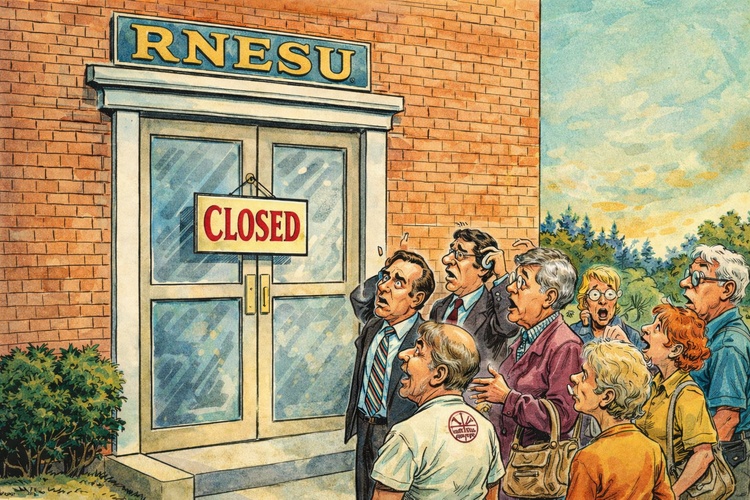
The Rutland Northeast Supervisory Union board approved its FY27 central office budget on Wednesday afternoon in a 2:00 p.m. “retreat and meeting” that was listed as a 5:30 p.m. event in that morning’s Rutland Herald community calendar.
The time discrepancy, combined with the board’s own written schedule showing evening meetings, is raising questions about whether the public had a fair chance to attend a key vote in a year of steep projected education tax increases.
Rutland Northeast Supervisory Union Board Meeting — Board documents and details for virtual participation can be found at www.rnesu.org from 5:30–6:30 p.m. RNESU Central Office (virtual option available), 49 Court Drive, Brandon. 802-247-5757.
— Rutland Herald community calendar, Dec. 17, 2025
Paper says 5:30 p.m., board meets at 2 p.m.
In the Herald’s December 17 “Events” column, the RNESU “board retreat and meeting” is listed for 5:30 p.m. at the RNESU Central Office and online. But the agenda posted on the RNESU website warned the same “Board Retreat and Meeting” for 2:00 p.m. at the central office, with “FY27 Budget – Review and Approve” listed under the board’s governance items.
According to that agenda, the board was scheduled to adjourn by 3:00 p.m.
RNESU’s own “2025–2026 School Board Work Plan,” revised two days earlier on December 15, reinforces the expectation of evening meetings. The plan states that RNESU board meetings are held on the “3rd Wednesday @ 5:30 PM” and identifies the December 17 meeting specifically for “BUDGET REVIEW AND APPROVAL.”
Taken together, members of the public consulting recent board documents and the day’s newspaper had every reason to expect the budget discussion and vote to occur in the early evening, not mid-afternoon.
Vermont’s Open Meeting Law requires that public bodies give notice of the “time and place” of their meetings and take action in meetings that are properly noticed and open to the public. Whether the conflicting 2:00 p.m. and 5:30 p.m. times meet that standard is a question likely to interest the Attorney General’s office if a complaint is filed. What is clear is that anyone relying on the Herald listing would have arrived after the budget vote was over.
A “budget review and approval” with only a draft on the table
The way the budget itself moved through the fall adds another layer.
At the RNESU board’s October 15 meeting, administrators presented a budget timeline that pointed to mid-December as the point when the supervisory union would say “this is what we are setting for the expectation as part of the supervisory union board.” The same presentation promised “a special budget board meeting for input for the community” at that time.
On November 19, at a regular 5:30 p.m. meeting, the board saw Draft #1 of the FY27 RNESU budget. That draft set total SU spending at $14.38 million, up $660,073, or 4.81%, from the current-year $13.72 million budget.
Administrators were candid that night that key numbers were still missing. Assessment information that flows into the Otter Valley and Barstow district budgets was “not yet available” and might not be known until early December. Long-term weighted average daily membership—pupil counts used to calculate equalized pupils—can arrive late and even change after initial budgets are built.
Because of that uncertainty, Superintendent Renee DeVore told the board that when Otter Valley and Barstow started drafting their budgets in early December, they would likely have to use the SU’s 4.81% increase as a placeholder. “You don’t have any more information,” she said. “I don’t have anything better than that.”
As of December 17, the only labeled FY27 RNESU budget document available on the SU website remains “Draft #1” from November 19. The Dec. 17 agenda says “FY27 Budget – Review and Approve,” but no “final” budget packet is included in the public materials.
That means the board voted to “review and approve” a budget that, in public-facing documents, still existed only as a draft.
🍁 Make a One-Time Contribution — Stand Up for Accountability in Vermont 🍁
What changed in the budget
The numbers inside that draft, now approved, are not trivial.
The supervisory union’s General Fund—which covers the central office, superintendent, curriculum administration, and related functions—rises from $3.28 million to $3.37 million, an increase of 2.72%.
The Special Education fund increases from $7.59 million to $7.98 million, up 5.16%. FY27 Proposed RNESU Budget – Dr… A separate “Global Ends” summary puts total Special Education-related spending at $9.23 million, a 5.62% jump once early education and some grant-funded costs are included.
The Transportation budget rises from $1.70 million to $1.78 million (4.69%), including a transportation capital line that grows by about $100,000 and a proposed seven-year lease for two new buses totaling $272,890.
Central office staffing shifts slightly. A second curriculum administrator position is added (bringing that category from 1.0 to 2.0 FTE), while 0.5 FTE of clerical support is reduced, and several bookkeeping and facilities positions are reclassified. The net increase in central office full-time equivalent staffing is about 0.36.
In total, RNESU’s central budget is growing 4.81%, driven primarily by Special Education and transportation costs, with modest growth in general administration.
A “budget” in a year of double-digit tax warnings
All of this is occurring in a difficult statewide context. On December 1, the Tax Commissioner’s Education Tax Rate Letter warned that, under the mandated forecasts, Vermont property owners could see an average 12% increase in their education tax liabilities for FY27 if the Legislature adopts the projected yields and non-homestead rates.
The same letter projects statewide per-pupil education spending to rise about 6.8%.
By design, supervisory unions and school districts must adopt spending plans before they know exactly how those decisions will translate into local tax rates. RNESU’s October and November discussions acknowledged that reality: the SU would set its spending “expectation” in mid-December with incomplete data, and districts would plug those “best available” numbers into their own budgets, knowing they might change later.
In that sense, the Dec. 17 vote is both routine and revealing. On paper, it is one step in a complex state-driven process that forces boards to act before the picture is fully clear. On the ground, it was a mid-day retreat meeting, advertised at a different time in the newspaper, where a draft spending plan became an approved budget in a year when taxpayers are being warned to expect double-digit increases.
Whether the timing and notice of that meeting complied with Vermont’s Open Meeting Law is ultimately a question for the Attorney General or the courts. The documents, however, show a board locking in millions of dollars in spending at 2:00 p.m. on a weekday, while the public was told to show up three and half hours later.
Dave Soulia | FYIVT
You can find FYIVT on YouTube | X(Twitter) | Facebook | Instagram
#fyivt #RNESU #vted #openmeetinglaw
Support Us for as Little as $5 – Get In The Fight!!
Make a Big Impact with $25/month—Become a Premium Supporter!
Join the Top Tier of Supporters with $50/month—Become a SUPER Supporter!


 Subscribe to RSS



Leave a Reply