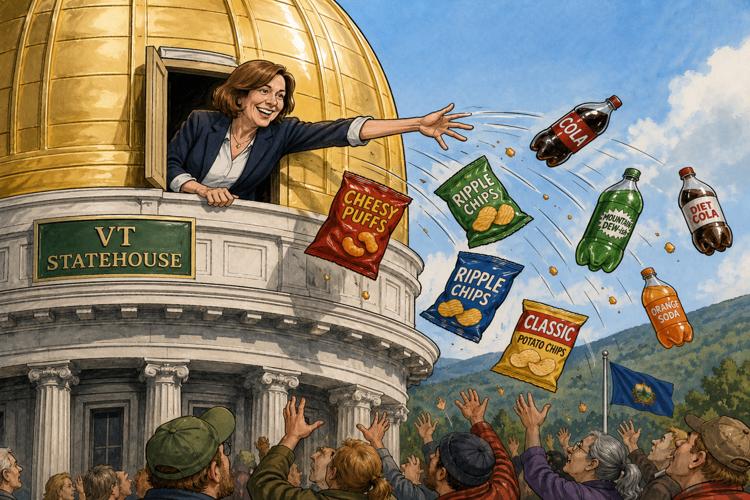
VT Farmers Push Back on Livestock Rule Proposal

VT Farmers Push Back on Livestock Rule Proposal

A proposal discussed this week in the House Environment Committee could change how Vermont regulates small livestock operations, raising questions among farm groups about enforcement authority, water quality oversight, and the role of municipal zoning.

During testimony Tuesday, Caroline Sherman-Gordon, legislative director for Rural Vermont, outlined concerns from a coalition of agricultural organizations about language being considered in connection with S.323 and related House proposals addressing agricultural regulation and municipal authority.

The discussion comes as lawmakers continue working through the implications of last year’s Taft Corners court decision and broader land-use reforms tied to Act 181.

Gordon said the coalition — which includes the Vermont Farm Bureau, Northeast Organic Farming Association of Vermont (NOFA-VT), the Vermont Dairy Producers Alliance, the Vermont Sustainable Jobs Fund, the Vermont Association of Conservation Districts, and the American Farmland Trust — has been working for months on possible language aimed at addressing “bad actor” situations while avoiding what farmers describe as an expanding patchwork of local rules.

“We think the heart of the problem is the bad-actor issue,” Gordon told the committee. “People want to make sure that there’s an accountable way to handle those things.”

🍁 Make a One-Time Contribution — Stand Up for Accountability in Vermont 🍁

Proposed Language Targets Livestock Density and Land Base

One concept discussed during the hearing would allow the Agency of Agriculture to determine whether a parcel has a “sufficient land base” to properly manage the number and type of livestock kept there.

Under the concept, the Secretary of Agriculture could evaluate whether livestock density and manure management on a property are adequate to prevent water-quality impacts.

The language being discussed would apply particularly to livestock operations on small parcels, including farms with less than four acres devoted to animal management.

Gordon said the proposal could give state regulators clearer authority to address situations where livestock density may be too high for the available land, potentially causing nutrient runoff or waste-management problems.

Currently, Vermont’s Required Agricultural Practices (RAP) rules govern water-quality protections and manure management for farms that meet certain thresholds. Smaller or non-commercial livestock operations may fall outside those thresholds unless specific problems arise.

Supporters of the proposal say giving the Agency of Agriculture explicit authority to evaluate whether a parcel has adequate land for livestock could help regulators intervene earlier in situations that might otherwise escalate into water-quality violations or animal welfare concerns.

Debate Over State Oversight vs. Municipal Regulation

Committee members also questioned whether such an approach could reduce the need for municipalities to regulate farming through zoning.

Representative Amy Sheldon, D-Middlebury, asked whether state-level livestock density rules might address some of the conflicts that have driven calls for local zoning authority over agricultural activity.

“Do you feel like if we enacted this … we would still need the language around zoning bylaws to deal with the kinds of conflicts that we’ve heard about?” Sheldon asked during the hearing.

Gordon said the coalition believes stronger state-level rules could address many of those situations without expanding municipal control over farming.

So far, Gordon said, the coalition has not heard a clear explanation from municipal advocates about why towns need additional zoning authority over agricultural activity.

The Vermont League of Cities and Towns has argued that municipalities need limited authority in certain situations — particularly in developed areas — to address conflicts between farming activities and nearby residential uses.

Act 181 and Tiered Development Add Another Layer

Those issues have been discussed in the context of Act 181, a major land-use reform law passed last year that introduced a tiered development framework intended to guide where housing and development should occur.

Under that system, “Tier 1A” and “Tier 1B” areas are expected to see more concentrated development around village centers and downtowns.

Farm groups have expressed concern that allowing municipalities greater regulatory authority in those areas could create new complications for agricultural operations that span multiple towns.

Gordon warned that including Tier 1B areas in expanded municipal authority could lead to inconsistent rules across the state.

“Many farms operate across several municipalities,” she said. “The more complexity added to the business of farming, the more difficult it becomes.”

Some larger farms, she noted, operate across a dozen or more towns.

Questions Remain About Water Quality Enforcement

Committee members also raised questions about how the proposed language would interact with existing water-quality enforcement.

Representative Terry Austin, R-Colchester, pointed to phosphorus runoff concerns around Lake Champlain and asked whether small livestock operations located near waterways could create additional pollution risks.

Gordon responded that water-quality protections are already addressed through the state’s RAP rules, which are administered by the Agency of Agriculture.

Others on the committee said they would need more time to review the proposed language before determining how it might affect the broader legislation.

Legislative Next Steps

Ellen Czajkowski of the Office of Legislative Counsel told lawmakers the proposal would likely need revisions to fit properly within Vermont’s statutory framework.

The language discussed during the hearing was partly based on rule language that appears in the Senate version of the bill.

Czajkowski noted that while the legislature can amend agency rules directly through statute, doing so is relatively uncommon and would require careful drafting.

Lawmakers indicated that the Agriculture Committee is expected to advance legislation this week, while the Environment Committee may consider amendments at a later stage.

For farm advocates, Gordon said the immediate goal is ensuring that lawmakers continue working on the issue during the second half of the legislative session.

“The current legal situation is already our worst scenario,” she told the committee. “We want to keep moving forward.”

If you found this information valuable and want to support independent journalism in Vermont, become a supporter for just $5/month today!

Dave Soulia | FYIVT

You can find FYIVT on YouTube | X(Twitter) | Facebook | Instagram

#fyivt #vtpoli #vermontagriculture #vtleg

Support Us for as Little as $5 – Get In The Fight!!

Make a Big Impact with $25/month—Become a Premium Supporter!

Join the Top Tier of Supporters with $50/month—Become a SUPER Supporter!

admin Avatar

4 responses to “VT Farmers Push Back on Livestock Rule Proposal”

  1. H. Jay Eshelman Avatar
    H. Jay Eshelman

    Re: “We think the heart of the problem is the bad-actor issue,” Gordon told the committee. “People want to make sure that there’s an accountable way to handle those things.”

    You can bet your bottom dollar that the “language aimed at addressing the ‘bad actor’ issue” won’t include the harm done by our legislators, Municipal, County, or State.

    Why, specifically, aren’t existing Required Agricultural Practices (RAP) rules sufficient to hold private ‘bad actors’ accountable? The paradox here is that while our elected and appointed officials (i.e., public ‘bad actors’) are deliberating this so-called issue, they are simultaneously legislating their own personal immunity from legal scrutiny.

    This is kinda’ like the Covid vaccine scam, when Emergency Use Authorization legislation protected the pharmaceutical and healthcare industries from liability for charging exorbitant prices for their products, not to mention liability protection from lawsuits resulting from the ineffectiveness of the vaccines and side-effects they caused to the public at large.

    “Half the harm that is done in this world is due to people who want to feel important. They don’t mean to do harm; but the harm does not interest them. Or they do not see it, or they justify it because they are absorbed in the endless struggle to think well of themselves.” ― T.S. Eliot

    “Of all tyrannies, a tyranny sincerely exercised for the good of its victims may be the most oppressive…. This very kindness stings with intolerable insult. To be ‘cured’ against one’s will and cured of states which we may not regard as disease is to be put on a level of those who have not yet reached the age of reason or those who never will; to be classed with infants, imbeciles, and domestic animals.” ― C.S. Lewis

    1. H. Jay Eshelman Avatar
      H. Jay Eshelman

      The Regulatory Exclusion of Vermont’s Rural Working Class
      How Vermont’s Act 181 and the Tier 2 / Tier 3 Expansion of Act 250 Constitute a System of Regulatory Displacement Targeting Vulnerable Vermonters
      MacIsaac Highland Cattle
      Feb 24, 2026

      The Short Version
      This investigation presents a human rights analysis of Vermont’s Act 181 (2024) and its implementation through ongoing administrative rulemaking, with particular focus on the expansion of Act 250’s jurisdictional reach through the creation of Tier 2 and Tier 3 review categories. The central thesis is straightforward: these regulatory instruments, promoted by their architects as environmental protection and housing equity measures, function in practical operation as a system of wealth-stratified exclusion that strips Vermont’s rural poor and multi-generational working-class landowners of the economic value and the intergenerational transmissibility of their most critical and often only asset: their land.1

      The mechanism of harm is the imposition of procedural and financial costs so staggering relative to the means of working-class landowners that the legal exercise of ordinary property rights like subdividing a family parcel to allow a son or daughter to build a modest home on ancestral land becomes effectively impossible.

      The statute treats everyone equally on paper. In practice, only the wealthy can survive the process intact.

      The parallels to historically recognized forms of forced displacement such as the forced removal of Native Americans from optimal lands to marginal reservation lands, Vermont’s own eugenics-era policies targeting rural poor families for forced sterilization and social control are not rhetorical flourishes. They identify a recurring pattern: the use of nominally neutral regulatory authority to produce class-stratified outcomes that dispossess communities of intergenerational land wealth.2

      1. Act 181 of 2024, H.687, enacted June 17, 2024 over gubernatorial veto.

      2. University of Vermont, EUGENICS: A VERMONT HISTORY PROJECT, https://www.uvm.edu/~lkaelber/eugenics/; Nancy Gallagher, Vermont’s Eugenics Project: Breeding Better Vermonters, 52 VT. HIST. 121 (1984).

      https://substack.com/home/post/p-189031980

  2. Fred Avatar

    The only problems with farming big or small in Vermont are all the “bad actors” under the des,,, er ,, domes in Montpelier and DC

  3. H. Jay Eshelman Avatar
    H. Jay Eshelman

    Substack:
    The Regulatory Exclusion of Vermont’s Rural Working Class
    How Vermont’s Act 181 and the Tier 2 / Tier 3 Expansion of Act 250 Constitute a System of Regulatory Displacement Targeting Vulnerable Vermonters
    MacIsaac Highland Cattle
    Feb 24, 2026

    The Short Version
    This investigation presents a human rights analysis of Vermont’s Act 181 (2024) and its implementation through ongoing administrative rulemaking, with particular focus on the expansion of Act 250’s jurisdictional reach through the creation of Tier 2 and Tier 3 review categories. The central thesis is straightforward: these regulatory instruments, promoted by their architects as environmental protection and housing equity measures, function in practical operation as a system of wealth-stratified exclusion that strips Vermont’s rural poor and multi-generational working-class landowners of the economic value and the intergenerational transmissibility of their most critical and often only asset: their land.1

    The mechanism of harm is the imposition of procedural and financial costs so staggering relative to the means of working-class landowners that the legal exercise of ordinary property rights like subdividing a family parcel to allow a son or daughter to build a modest home on ancestral land becomes effectively impossible.

    The statute treats everyone equally on paper. In practice, only the wealthy can survive the process intact.

    The parallels to historically recognized forms of forced displacement such as the forced removal of Native Americans from optimal lands to marginal reservation lands, Vermont’s own eugenics-era policies targeting rural poor families for forced sterilization and social control are not rhetorical flourishes. They identify a recurring pattern: the use of nominally neutral regulatory authority to produce class-stratified outcomes that dispossess communities of intergenerational land wealth.2

    1. Act 181 of 2024, H.687, enacted June 17, 2024 over gubernatorial veto.

    2. University of Vermont, EUGENICS: A VERMONT HISTORY PROJECT, https://www.uvm.edu/~lkaelber/eugenics/; Nancy Gallagher, Vermont’s Eugenics Project: Breeding Better Vermonters, 52 VT. HIST. 121 (1984).

Leave a Reply to FredCancel reply

By signing up, you agree to the our terms and our Privacy Policy agreement.

RSS icon Subscribe to RSS