

While Vermont’s congressional delegation was busy condemning ICE raids in South Burlington last month, calling the agency “Trump’s domestic army” in a joint statement issued March 12, a separate federal enforcement problem was generating far less outrage — one with consequences that make immigration politics look like a parking dispute.
The question nobody in Washington asked during four years of record border crossings is a simple one: what came with them?
Nearly Two Million Unknowns
The numbers are not projections or estimates. They come from the House Homeland Security Committee, sourced directly to CBP data. Under the Biden administration, nearly 2 million known gotaways evaded U.S. Border Patrol — people who crossed between ports of entry with no screening, no biometrics, no intelligence assessment, and no radiation detection. The then-chief of U.S. Border Patrol, Raul Ortiz, testified that the actual number could be undercounted by as much as 20%.
At the northern border — Vermont’s border — the Swanton Sector hit its highest monthly total on CBP record in April 2024, up 7,250% compared to April 2021. That’s not the Rio Grande. That’s Derby Line. Newport. The Northeast Kingdom.
In that same period, 362 individuals whose names appeared on the terrorist watchlist were caught attempting to cross the Southwest border illegally. Those are the ones they caught. Federal officials estimate they intercept somewhere between 5 and 10 percent of fentanyl crossing the border. The same physics that hides a kilo of fentanyl in a car door panel hides a shielded radiological source in a backpack.
🍁 Make a One-Time Contribution — Stand Up for Accountability in Vermont 🍁
What the GAO Already Proved
In 2006, investigators from the Government Accountability Office conducted an undercover operation with a straightforward premise: could radioactive material be smuggled across U.S. borders? They wanted to find out before a terrorist did.
The answer was yes. GAO investigators successfully transported radioactive sources across U.S. borders at two locations — not through unmanned stretches of desert, but at official ports of entry equipped with radiation detection equipment and trained CBP personnel. The material crossed. The alarms didn’t stop it.
That was at monitored crossings. The gotaways didn’t go through monitored crossings.
The GAO further documented that detection capability gaps remained for railcars entering from Canada and Mexico, international air cargo, and international commercial aviation. The portal monitors at official crossings — the ones that failed the 2006 test — don’t cover any of those pathways. And they certainly don’t cover someone who walked around them through the woods north of Richford.
Three Ounces
To understand what the detection failure actually means in human terms, consider what happened in Goiânia, Brazil in 1987 — not from a weapon, not from a state actor, not from any malicious intent at all. Just an abandoned cancer treatment machine left behind when a hospital relocated.
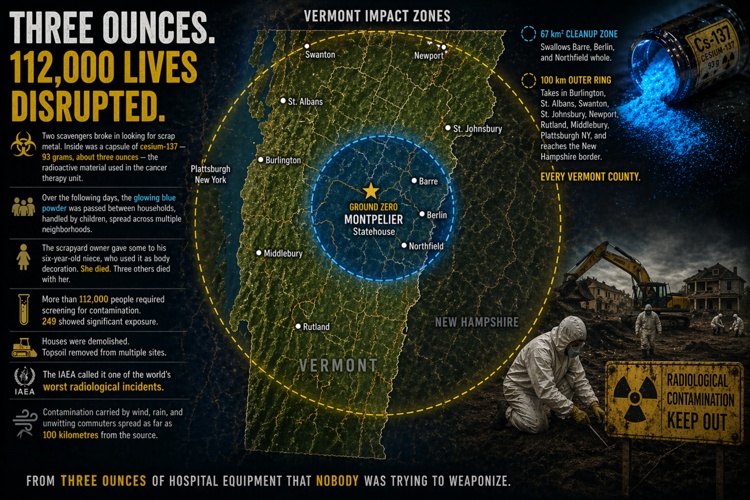
Two scavengers broke in looking for scrap metal. Inside was a capsule of cesium-137 — 93 grams, about three ounces — the radioactive material used in the cancer therapy unit. Over the following days, the glowing blue powder was passed between households, handled by children, spread across multiple neighborhoods. The scrapyard owner gave some to his six-year-old niece, who used it as body decoration. She died. Three others died with her. More than 112,000 people required screening for contamination. 249 showed significant exposure. Houses were demolished. Topsoil removed from multiple sites. The IAEA called it one of the world’s worst radiological incidents.
The IAEA documented active cleanup operations covering more than 67 square kilometres of urban area around ground zero. Contamination carried by wind, rain, and unwitting commuters spread as far as 100 kilometres from the source. Place that on a Vermont map with Montpelier’s Statehouse as ground zero: the 67 square kilometre cleanup zone swallows Barre, Berlin, and Northfield whole. The 100 kilometre outer ring takes in Burlington, St. Albans, Swanton, St. Johnsbury, Newport, Rutland, Middlebury, Plattsburgh New York, and reaches the New Hampshire border. Every Vermont county. From three ounces of hospital equipment that nobody was trying to weaponize.
The 2004 BBC/HBO film Dirty War — still streaming on Max — modeled what happens when someone actually tries, set in London, with meticulous technical research. It won a BAFTA for accuracy. Its conclusion: parts of central London closed for up to thirty years, thousands of projected long-term cancer deaths, a city’s financial core rendered uninhabitable — not by a nuclear weapon, but by dispersed radioactive material and the panic that followed. It aired in September 2004. The 7/7 bombings happened nine months later.
The Threat No One Is Discussing
The IAEA has documented hundreds of incidents worldwide involving lost or stolen radiological sources — medical equipment, industrial radiography tools, abandoned Soviet-era devices. The material suitable for a radiological attack is not exotic. It exists in hospitals, in pipeline inspection equipment, in food irradiation facilities on every continent. It does not need to originate in Iran. It does not need a ballistic missile. It needs to get here.
The political debate in Washington — and in Vermont — has focused on the human face of immigration enforcement. Those are legitimate conversations. The dairy worker. The pastor. The asylum seeker. Vermont’s delegation has been vocal, consistent, and on the record about where they stand on ICE and border enforcement.
What they haven’t addressed — what almost nobody has addressed — is the threat model that doesn’t have a sympathetic face. The 2 million gotaways don’t include a breakdown of who they were, where they came from, or what they carried. The Swanton Sector doesn’t have a radiation portal monitor on every trail through the woods. The GAO already proved that the ones with portal monitors aren’t a reliable barrier either.
Three ounces destroyed a Brazilian neighborhood. The people who study this threat for a living don’t lose sleep over a missile from Tehran. They lose sleep over a shielded canister the size of a thermos that nobody screened.
Dave Soulia | FYIVT
You can find FYIVT on YouTube | X(Twitter) | Facebook | Instagram
#fyivt #BorderSecurity #RadiologicalThreat #VermontPolitics
Support Us for as Little as $5 – Get In The Fight!!
Make a Big Impact with $25/month—Become a Premium Supporter!
Join the Top Tier of Supporters with $50/month—Become a SUPER Supporter!


 Subscribe to RSS





Leave a Reply