

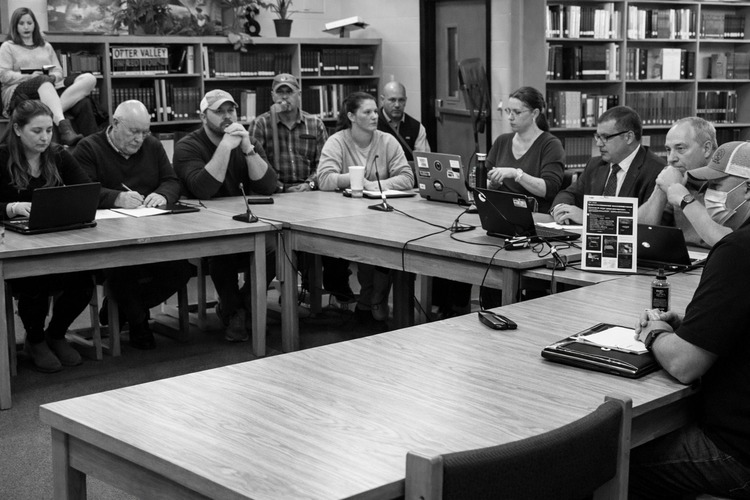
At its Jan. 6 meeting, the Otter Valley Unified Union (OVUU) school board voted to move educational programs out of Whiting and Caverly schools, actions that would end the schools’ operation in their current form. The votes passed with seven affirmative votes and a mix of abstentions and dissenting votes, according to attendees.
The votes came despite the fact that neither Whiting nor Caverly — nor any program relocation affecting those schools — appeared on the publicly posted agenda for the meeting.
What the agenda showed — and didn’t
The posted Jan. 6 agenda listed several substantive items, including review of the FY27 proposed budget and consideration of annual district warning articles. It did not include any item referencing Whiting, Caverly, school reconfiguration, program relocation, facility changes, or school closures.
The agenda also contained an explicit limitation on board action, stating that the board would not discuss topics other than those listed on the published agenda and that issues not on the agenda should be routed into future agenda planning.
Other publicly posted materials for the meeting — including the consent agenda, supplemental documents, and the superintendent’s January announcements — likewise contained no reference to proposed votes to move programs from Whiting or Caverly.
Objections raised during the meeting
According to multiple attendees, one or more board members raised concerns during the Jan. 6 meeting that the proposed votes were not properly warned because they were not listed on the agenda. Despite those objections, the board proceeded with the votes, which passed.
No motion to amend the agenda to add the program moves was reported by attendees, and none appears in the materials posted prior to the meeting.
A long-running discussion — but not a warned vote
The possibility of reconfiguring pre-kindergarten and elementary programs within the district has been discussed publicly for months in the context of declining enrollment, budget pressures, and the uncertainty surrounding Act 73 and Act 46 governance changes.
In October, the board was presented with multiple reconfiguration options, including relocating programs and potentially closing or returning school buildings to towns. Reporting at the time described the proposals as options under consideration and noted significant public opposition, with many community members calling the discussions premature.
Throughout November and December (11/4, 11/18, 12/16), the board continued to discuss Whiting and Caverly in meetings framed as exploratory and analytical. Transcripts and minutes from those meetings show board members and administrators discussing possible configurations, cost implications, licensing requirements, and unanswered logistical questions.
In those meetings, the discussion was consistently characterized as ongoing. Board members acknowledged that additional numbers were still being developed, that key details remained unresolved, and that revised recommendations would need to be brought back for further consideration. Nowhere in the November or December minutes is there a statement that the board had reached a final conclusion or that a vote would be taken at the next meeting.
The December budget presentation explicitly listed Whiting and Caverly program location decisions as “open items,” with scenarios labeled “to move or not to move.” The presentation also showed that the draft FY27 budget at that point exceeded the board’s 3 percent target and included placeholders for unresolved costs.
Budget context adds to the surprise
At the Jan. 6 meeting, the board reviewed an updated budget that attendees said was relatively tight and close to a 3 percent increase goal. That budget context added to the surprise among those present when the board moved forward with program relocations.
Publicly posted budget materials prior to the meeting did not indicate that moving programs from Whiting and Caverly was necessary to meet a specific fiscal target, nor did they identify an emergency requiring immediate action.
🍁 Make a One-Time Contribution — Stand Up for Accountability in Vermont 🍁
De facto closures without the word “closure”
While the motions approved by the board reportedly avoided the term “school closure,” moving the programs out of Whiting and Caverly would, as a practical matter, end the schools’ operation as schools. Without students or programs housed in the buildings, the effect mirrors a closure even if the language does not.
That practical impact is significant in evaluating what the public could reasonably expect to see disclosed on a meeting agenda. Votes that effectively shut down a school’s educational function are materially different from routine budget adjustments or policy approvals.
The core issue: notice and public participation
The Jan. 6 votes raise a straightforward process question: whether the board can take final action on decisions that effectively shut down schools when those actions were not disclosed on the meeting agenda provided to the public in advance.
Agendas exist so that members of the public and press can decide whether to attend a meeting and participate before decisions are made. In this case, none of the publicly posted materials warned that the board would vote on relocating programs from Whiting and Caverly.
As one local observer put it, had the votes been clearly listed on the agenda, the public would have had the opportunity to show up in force, as it did during earlier meetings when similar ideas were presented as options.
What options remain
Under Vermont’s Open Meeting Law, the board retains several procedural options if it chooses to address the issue further. In addition to the already scheduled Jan. 13 special meeting for budget adoption, the board could warn a separate regular or special meeting to hear public comment or revisit the program relocation decisions. Public bodies are permitted to hold multiple meetings on the same day, provided each meeting is separately warned, opened, and closed. Any such meeting would require advance public notice and an agenda clearly identifying the matters to be discussed or acted upon.
The district provides a “Reach Out!” form for submitting messages to the school board.
What happens next
The official video recording and minutes from the Jan. 6 meeting have not yet been released. Those records will provide definitive documentation of the motions, any objections raised, and how the chair, Laurie Bertrand, addressed concerns about agenda notice.
For now, based on the agendas, minutes, transcripts, and budget documents available to the public before the meeting, the votes represent a significant action taken without clear advance warning — a departure from how the issue had been presented and discussed in prior months.
Dave Soulia | FYIVT
You can find FYIVT on YouTube | X(Twitter) | Facebook | Instagram
#fyivt #ovuu #schoolgovernance #openmeetinglaw
Support Us for as Little as $5 – Get In The Fight!!
Make a Big Impact with $25/month—Become a Premium Supporter!
Join the Top Tier of Supporters with $50/month—Become a SUPER Supporter!


 Subscribe to RSS




Leave a Reply to H. Jay EshelmanCancel reply