

Data centers do two things. They use electricity and they produce heat. Everything controversial about them — noise, water use, grid strain, neighbor complaints — comes back to how a facility handles those two things. Those choices are made when the building is designed, and Vermont’s climate makes the clean choices the economically rational ones.
What the bill’s sponsor said
S.205’s lead sponsor, Sen. Becca White (D-Windsor), is not a tech skeptic. She built her career in Vermont’s clean energy sector — she began as an organizer for a local solar company, moved to Efficiency Vermont as a community engagement manager, and now co-chairs the Senate’s Climate Solutions Caucus. Her concerns about AI data centers come from inside the green policy framework, not against it.
Testifying before the Senate Committee on Finance on Jan. 15, White told lawmakers AI data centers are more dangerous to the environment than traditional data centers because of their demands on resources. She said a facility could use up to 5 million gallons of fresh water per day, “roughly the same amount used per day in a town of 10,000 to 50,000 people.” She specified what that would mean in Vermont terms: “That’s Burlington, South Burlington and Colchester.” She framed the bill as “a common sense pause on development when we are experiencing an exponential growth in an unregulated market.“
The 5 million gallon figure traces to analyses by the Environmental and Energy Study Institute and the Brookings Institution. It is accurate — for a specific class of facility. It describes hyperscale AI data centers using evaporative cooling, the dominant design in Arizona, Texas, Virginia, and other hot-climate states. It does not describe closed-loop or immersion-cooled facilities, which use negligible water. And it does not describe any facility that would be built in Vermont, because Vermont’s climate makes the high-water design choice economically irrational. The rest of this piece walks through why.
🍁 Make a One-Time Contribution — Stand Up for Accountability in Vermont 🍁
The heat problem
A 30-megawatt data center turns almost all of its electricity into heat. That heat has to go somewhere. In hot climates, getting rid of it means either spraying water into hot air — the evaporative cooling that drives the 5 million gallon figure — or running big air conditioners that burn more electricity. Vermont’s climate offers a different path.
Vermont’s ground is cold. Dig down eight to ten feet and the soil temperature sits in the mid-40s year-round. For about six months of the year, the air outside is already cold enough to cool servers directly. For about half the year, the job is essentially free.
A closed-loop cooling system uses sealed pipes full of glycol, like the antifreeze in a car. The pipes run underground and pass heat into the soil. No water gets used up. It’s the same system used in geothermal home heating, scaled up.
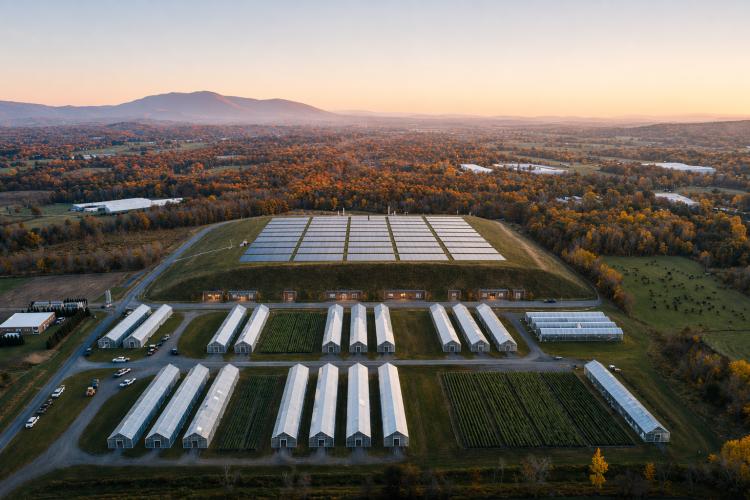
Liquid-cooled facilities also produce a continuous stream of warm water — typically 100 to 140 degrees Fahrenheit — that doesn’t have to be rejected as waste. Stockholm and Helsinki already pipe data center heat into district heating systems that warm homes and businesses. For Vermont, the more obvious application is agriculture. Heating greenhouses through winter is one of the largest ongoing energy costs in year-round Vermont produce operations, and demand peaks during exactly the months a data center’s heat output would be most abundant. Aquaculture, food dehydration, dairy processing, and maple evaporator preheat fall in the same low-grade-heat band. A 30-megawatt facility produces enough waste heat to run a commercial greenhouse complex year-round, displacing propane and fuel oil.
The noise problem
Regular data centers are loud because of fans — server fans, big air handlers, rooftop coolers, all running constantly. That hum is what has driven neighbors in Loudoun County, Virginia to file lawsuits.
Liquid cooling gets rid of most of the fans. Immersion cooling, where servers are submerged in a non-conductive liquid, gets rid of them entirely. What’s left is pump noise, which is low-frequency and easier to muffle. Bury the building and it gets quieter still. At 1,000 feet from a buried, liquid-cooled facility, the only noise sources left are backup generators during testing and the transformers — both of which can be enclosed or shielded.
The water problem
Closed-loop cooling systems don’t use meaningful amounts of water. A coolant is circulated through sealed piping to absorb server heat, then passed through dry coolers that blow air over the pipes to release it. The loop gets filled once and topped off occasionally. Meta’s December 2025 water stewardship report describes this as its current standard design for new data centers and states the company’s Beaver Dam, Wisconsin facility will use less water per year than two full-service restaurants. That’s the cooling approach Vermont’s climate makes economically obvious. A Vermont facility wouldn’t consume “Burlington, South Burlington and Colchester” worth of water because it wouldn’t be built that way.
The power problem
This one doesn’t go away with clever engineering. A 30-megawatt facility uses 30 megawatts no matter how efficient the cooling is. Vermont’s peak electricity demand runs around 1,000 megawatts, so one 30-megawatt facility would be about 3 percent of that.
Building one requires approval from both ISO-New England, the regional grid operator, and the Vermont Public Utility Commission under Act 248. That process weighs jobs, tax revenue, and grid reliability against environmental and community impacts.
Vermont’s energy policy is built around reducing total electricity use, so a new 30-megawatt customer runs against that goal even if the facility itself is efficient. Dedicated solar with battery storage or small modular nuclear could address it, but each would need its own approvals.
What the money looks like
This is the part that matters most to towns that would actually host one.
Vermont’s statewide commercial education property tax rate for FY2026 is $1.703 per $100 of assessed value, per the Vermont Department of Taxes. Municipal taxes get added on top, typically bringing the combined effective rate to 2.0 to 2.5 percent for most towns.
Vermont also taxes business personal property separately. Under 32 VSA § 3618, towns assess “tangible personal property of a depreciable nature” used in a business, including property used for “the production, transmission, control or disposition of power, energy, heat, light, water or waste.” That covers data center equipment directly — servers, cooling, switchgear, transformers, backup generators. Assessment uses net book value from the federal tax return, with a floor: fully depreciated equipment still gets listed at 10 percent of original cost. The equipment never stops generating tax revenue.
A 30-megawatt facility involves roughly $50 million in building and site work, $80 million in electrical infrastructure, $40 million in cooling, and $200 to $300 million in IT equipment — total initial assessed value of $370 to $470 million. At a 2 percent combined effective rate, that generates roughly $7 to $9 million a year early on. As IT equipment depreciates toward the 10 percent floor, annual tax drops but never falls below roughly $4 to $5 million — a sustained revenue stream for decades.
A typical small rural Vermont town’s entire municipal budget runs $3 to $5 million. One facility could fund the whole operation with enough left over to reduce what homeowners pay in residential property taxes. Data centers aren’t big employers, and that’s worth flagging. But as pure fiscal infrastructure, few land uses generate revenue per acre at this scale.
What S.205 covers and what it doesn’t
The moratorium proposed in S.205 only applies to facilities over 100 megawatts. The class of project where Vermont’s climate advantages matter most — 20 to 50 megawatts — isn’t covered by the bill at all. Whatever rules come out of the Public Utility Commission’s January 2027 report will shape how smaller facilities get reviewed under existing Act 248 authority.
The engineering problems are solved problems. Cold climates cool servers. Closed loops don’t use water. Buried buildings are quiet. These aren’t breakthroughs; they’re standard practice in countries that have been building this way for years.
Real candidate sites already exist in Vermont. Pittsford’s industrial zone, adjacent to OMYA’s existing operation off of Route 7, has the heavy grid infrastructure, the zoning, the acreage, and the geographic buffering the engineering requires. Similar industrial zones in towns across Rutland County, the Northeast Kingdom, and the Connecticut River Valley meet the same criteria. Zoning is not the obstacle.
The questions that remain are ones Vermont gets to decide: who pays for grid upgrades, where facilities get sited, how power contracts are structured, and whether the state wants the tax revenue enough to say yes.
Dave Soulia | FYIVT
You can find FYIVT on YouTube | X(Twitter) | Facebook | Instagram
#fyivt #VTpoli #GreenEngineering #S205
Support Us for as Little as $5 – Get In The Fight!!
Make a Big Impact with $25/month—Become a Premium Supporter!
Join the Top Tier of Supporters with $50/month—Become a SUPER Supporter!


 Subscribe to RSS






Leave a Reply