

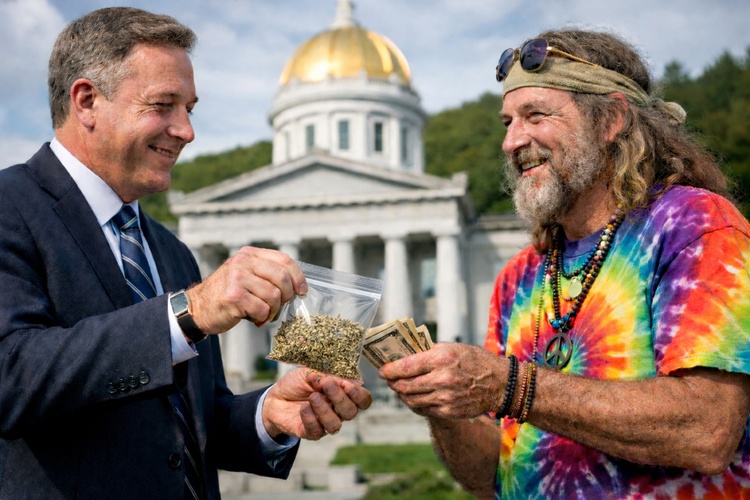
Five years after Vermont legalized and regulated adult-use cannabis, the state’s Cannabis Control Board is requesting $7.141 million in FY2027 funding to maintain 28 positions, according to testimony and budget materials presented to the House Committee on Appropriations. The request is split between roughly $4.6 million from the General Fund and about $2.6 million from the Cannabis Regulation Fund, a dedicated account supported by cannabis licensing fees, product registration fees, and administrative penalties.
During committee discussion, lawmakers acknowledged that cannabis licensing fees alone were not expected to cover the full cost of regulation. Rep. Robin Scheu (D – Addison-1) told the committee, “we always thought [fees] weren’t going to cover it,” and Cannabis Control Board director James Pepper noted that prior Joint Fiscal Office review suggested full cost recovery through fees “might not be possible”. In other words, the program was designed to rely not only on fees and penalties, but also on broader state revenue.
That structure matters because Vermont’s broader state budget carries long-term benefit obligations — particularly retiree health — and lawmakers have never adopted a statutory rule that cannabis regulation must remain permanently self-funded.
🍁 Make a One-Time Contribution — Stand Up for Accountability in Vermont 🍁
The FY2025 revenue picture
In FY2025, Vermont collected approximately $28.6 million in cannabis-related taxes, including roughly $20.2 million in cannabis excise tax and about $8.38 million in sales tax, according to Joint Fiscal Office tracking.
State law directs those revenues to multiple purposes. Under Act 164 of 2020, 30% of cannabis excise tax revenue (capped at $10 million annually) is allocated to substance misuse prevention programming. Based on FY2025 collections, that allocation would represent about $6.07 million.
The same act directs sales tax revenue from cannabis sales to support afterschool and summer learning grants administered through the Agency of Education. In FY2025, that amounted to approximately $8.38 million.
After accounting for the prevention allocation and the Cannabis Control Board’s $7.141 million operating request, excise revenue alone would still leave roughly $7 million remaining from FY2025 collections. At current revenue levels, cannabis taxes appear sufficient to cover regulatory operations, prevention programming, and afterschool grants while still leaving additional cannabis-origin dollars flowing into state accounts.
This is why Vermont’s cannabis program does not currently look like an immediate fiscal drag. The money is there.
Why the General Fund is still involved
If cannabis revenue is sufficient, why fund most of the regulator through the General Fund?
Part of the answer is simply how the Legislature structured it. Act 164 established the Cannabis Regulation Fund and restricted it to cannabis implementation, administration, and enforcement purposes, but it did not require the Cannabis Control Board to be funded solely from that account. Instead, lawmakers appropriate the board’s budget through the same annual process used for other agencies, and General Fund dollars are part of that mix.
Another part of the answer, raised directly in committee, is policy choice. Lawmakers and staff have treated fee levels as a lever that can affect the legal market. If Vermont pushed fees high enough to cover every dollar of regulatory cost, it could raise barriers to entry, increase costs for licensees, and potentially strengthen the illegal market by making legal participation less attractive. That is why the committee record includes explicit acknowledgement that fees alone were not expected to cover the program.
The result is a regulator that can be “paid for” in an economic sense — because cannabis taxes exceed operating costs — while still being funded through a General Fund appropriation as a matter of budgeting.
The long-term benefit question
The Cannabis Control Board’s request includes standard personnel costs and benefits. Budget rollups list roughly $4.7 million in Personal Services and about $1.69 million in Fringe Benefits, which is where the state accounts for employer contributions tied to payroll, including retirement and retiree-health obligations.
That matters because Vermont’s retiree health system remains significantly underfunded statewide. The Vermont State Employees’ Retirement System’s other post-employment benefits plan has been reported with a funded ratio in the mid-teens as of mid-2025. That underfunding is not unique to cannabis; it is a statewide issue that applies across state government.
However, the structural question for cannabis is different from the short-term cash question. The short-term question — whether cannabis revenue is large enough to cover regulatory costs — currently appears to be yes. The long-term question is whether Vermont intends cannabis regulation to be permanently self-sustaining, including over decades of benefit obligations, or whether the program may eventually lean on broader state finances if revenue falls, costs rise, or benefit pressures increase.
With 28 positions, the Cannabis Control Board is small relative to Vermont’s full workforce. But the policy debate is not about the size of the board in isolation. It is about whether the Legislature wants cannabis regulation to stand entirely on cannabis-derived revenue, or to function like other permanent state agencies funded through the General Fund and the broader payroll-benefit framework.
A choice lawmakers have not made explicit
At present revenue levels, the program’s math is favorable. But Vermont has not enacted a statutory “no-subsidy” firewall guaranteeing that the General Fund (and taxpayer dollars) will never support cannabis regulation — now or in the future — if conditions change.
As the FY2027 budget process advances, lawmakers face a clear choice: keep cannabis regulation inside the standard budgeting model, accepting that it could at some point require broader taxpayer support, or adopt a policy requiring cannabis revenue to cover the full lifecycle costs of the program, with automatic adjustments if revenue declines.
Either way, the question is not whether cannabis revenue exists. It is whether Vermont intends to lock in a permanent rule for who pays if the numbers change.
Dave Soulia | FYIVT
You can find FYIVT on YouTube | X(Twitter) | Facebook | Instagram
#fyivt #Vermont #CannabisPolicy #VTbudget
Support Us for as Little as $5 – Get In The Fight!!
Make a Big Impact with $25/month—Become a Premium Supporter!
Join the Top Tier of Supporters with $50/month—Become a SUPER Supporter!


 Subscribe to RSS



Leave a Reply