

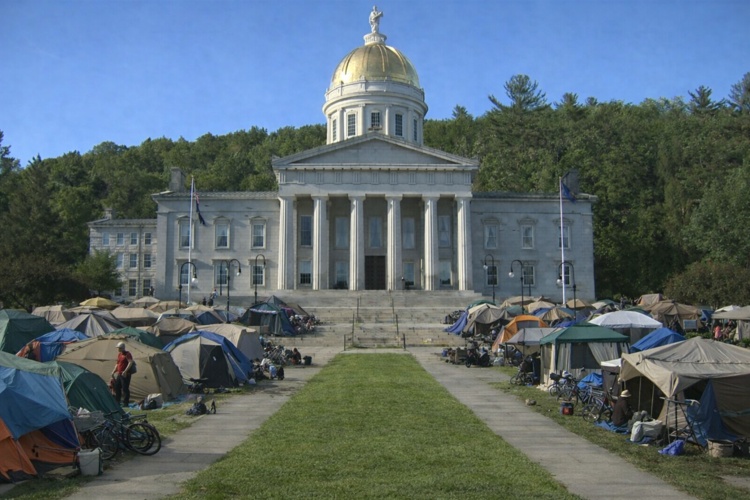
A newly introduced bill in the Vermont House would significantly limit when municipalities can restrict unsheltered people from sleeping or sheltering on public land, while also adding “housing status” as a protected category under multiple state anti-discrimination laws.
H.885, introduced by Rep. Jubilee McGill (D – Addison-5), Rep. Conor Casey (D – Washington-4), Rep. Brian Cina (D – Chittenden-15), and Rep. Troy Headrick (I – Chittenden-15), proposes a statewide standard governing how towns and counties regulate public property when it comes to homelessness. If enacted, it would mark one of the most sweeping state-level preemptions of municipal authority over public space in recent years.
Core Provision: Limits on Regulating Public Land
At the heart of the bill is a new section of law barring municipalities and counties from regulating or prohibiting the use of municipal property for what the bill defines as “life-sustaining activities.”
The definition is broad. It includes moving, resting, sitting, standing, lying down, sleeping, protecting oneself from the elements, eating, drinking, engaging in adaptive behaviors, and storing personal property needed to shelter safely.
In practical terms, the bill would prevent towns from enforcing local ordinances that effectively prohibit sleeping outdoors or maintaining temporary shelter on municipal land, unless specific conditions are met.
🍁 Make a One-Time Contribution — Stand Up for Accountability in Vermont 🍁
The legislation contains two primary exceptions. The prohibition on local regulation would not apply if a municipality:
- Has sufficient “adequate alternative indoor space” available to individuals experiencing homelessness within the municipality, or
- Has designated certain municipal growth centers, downtowns, or village centers as available for life-sustaining activities.
“Adequate alternative indoor space” is defined as housing or shelter that is legally and physically accessible, located within the individual’s community of choice, allows households to remain intact, and does not require a person to sacrifice other legal rights. The bill specifies that space in a neighboring jurisdiction does not count unless the individual requests placement there.
The measure also states that its provisions would supersede any conflicting municipal charter, ordinance, bylaw, or rule. That language signals clear legislative intent to override local control where it conflicts with the state standard.
Expanded Anti-Discrimination Protections
Beyond public land regulation, H.885 would amend multiple sections of Vermont law to add “housing status” as a protected class.
The bill defines housing status as the actual or perceived status of being homeless, consistent with federal definitions.
If passed, discrimination based on housing status would be prohibited in:
- Public accommodations
- Housing sales and rentals
- Employment practices
- Certain state human services policies
This would place homelessness alongside categories such as race, sex, religion, disability, and sexual orientation in several civil rights statutes.
Enforcement and Litigation Risk
The bill includes robust enforcement mechanisms.
The Vermont Attorney General would be authorized to sue municipalities or municipal officials that violate the law, seeking declaratory and injunctive relief. The bill also creates a new private right of action, allowing individuals adversely affected by violations to file civil lawsuits directly against the state, its political subdivisions, or individual officials. Similar enforcement structures have appeared in several recent Vermont laws, expanding opportunities for litigation against state and local government.
Courts would be required to award litigation costs and reasonable attorney’s fees to prevailing plaintiffs. Plaintiffs would not be liable for a defendant’s attorney’s fees in nonfrivolous cases.
That fee-shifting provision is significant. It lowers the financial barrier to litigation and increases potential exposure for municipalities. Even isolated enforcement actions that are later deemed inconsistent with the statute could trigger costly legal challenges.
The bill also attempts to preclude certain immunity defenses, stating that municipalities or officials enforcing unlawful limitations shall not be immune under the 10th Amendment, 11th Amendment, or other sources of law. Whether that language would withstand constitutional scrutiny if challenged is uncertain, as immunity doctrines are ultimately defined by courts.
Legal Context: After the Supreme Court’s Grants Pass Decision
The proposal arrives in the wake of the U.S. Supreme Court’s 2024 decision in City of Grants Pass v. Johnson. In that case, the Court held that enforcing generally applicable anti-camping ordinances does not violate the Eighth Amendment’s prohibition on cruel and unusual punishment.
That ruling reversed earlier federal appellate precedent that had limited local enforcement when shelter beds were unavailable. Since the decision, many cities across the country have adopted or strengthened camping bans and public space enforcement policies.
H.885 would move Vermont in the opposite direction by creating a state statutory constraint on local enforcement, regardless of the narrower federal constitutional standard now in place.
Comparison With Other States
Vermont would not be the first state to legislate around homelessness and access to public space.
Rhode Island enacted the nation’s first “Homeless Bill of Rights” in 2012, affirming that individuals experiencing homelessness have the right to use and move freely in public spaces and not be denied rights solely because of their status. Illinois later adopted a similar statute prohibiting discrimination based on homelessness.
Other states have considered or advanced legislation closer in structure to H.885, tying local enforcement limits to shelter availability and defining protected “life-sustaining” conduct. Washington state lawmakers are currently considering a proposal that would restrict local enforcement of encampment bans unless adequate shelter is available. Connecticut legislators have advanced bills addressing penalties for activities of daily living on public land and discrimination based on housing status.
California has repeatedly debated “Right to Rest” proposals over the past decade, though none have been enacted statewide in their most expansive form.
What stands out about H.885 is the combination of broad state override of local rules, the shelter-availability gating standard, expanded protected-class coverage, and an enforcement scheme that makes successful plaintiffs’ legal fees recoverable as a matter of right.
Potential Impacts in Vermont
If enacted, municipalities would likely need to review and revise park regulations, trespass policies, and enforcement practices. Key legal questions would center on how courts interpret “adequate alternative indoor space,” whether shelters meet accessibility standards, and how much regulatory authority towns retain over time, place, and manner restrictions.
Supporters argue the bill would prevent the criminalization of homelessness when sufficient housing options do not exist. Critics are likely to raise concerns about municipal autonomy, public safety, and the management of shared spaces.
The bill is at an early stage in the legislative process. Its ultimate shape and scope may evolve through committee review and amendment. But as introduced, H.885 represents a significant potential shift in the balance between state authority, local control, and the legal treatment of unsheltered homelessness in Vermont.
Dave Soulia | FYIVT
You can find FYIVT on YouTube | X(Twitter) | Facebook | Instagram
#fyivt #Vermont #VTpolitics #Homelessness
Support Us for as Little as $5 – Get In The Fight!!
Make a Big Impact with $25/month—Become a Premium Supporter!
Join the Top Tier of Supporters with $50/month—Become a SUPER Supporter!


 Subscribe to RSS




Leave a Reply to Joseph VociCancel reply