

A Year of Strange Spending Priorities
In a year when the federal debt blew past $38 trillion and interest costs alone topped $1.22 trillion, Senator Rand Paul’s latest “Festivus Report” reads like a tour of Washington’s strangest spending priorities. The 2025 edition tallies roughly $1.64 trillion in what the Kentucky Republican brands as waste, from animal experiments and pop-culture outreach campaigns to pandemic programs and foreign aid.
Interest on the Debt: The Biggest “Program” of All
The headline figure is not a quirky grant but compound interest. According to Treasury data highlighted in the report, the federal government paid $1.22 trillion this year just to service existing debt, making interest the third-largest line item in the budget after Social Security and Medicare. Paul again promotes his “Six Penny Plan” to balance the budget by trimming six cents from every projected federal dollar over five years.
Messaging, Influencers and COVID-Era Campaigns
Below that towering number, the report lines up what Paul considers emblematic cases of misaligned priorities. One cluster involves public-health messaging. HHS spent more than $1.5 million on an initiative in South Florida that recruits 30 celebrity “Latinx” influencers to push anti-drug content, and $1.9 million on a “hybrid mobile phone family intervention” in Los Angeles that tries to curb childhood obesity among Latino families with push notifications and brief counseling visits.
The biggest communication effort cited is a pair of COVID-era vaccination campaigns totaling about $41.8 million. One, run through the National Urban League, built coalitions and pop-up clinics in 20 cities; a companion grant to UnidosUS financed the “Esperanza Hope for All” media blitz aimed at Latino communities. Paul argues that the grants show how federal health agencies leaned on “culturally resonant influencers” even as public trust in official COVID guidance eroded.
Beagles, Ferrets and “Plinko” Monkeys
Some of the most vivid entries involve animals. The report highlights $13.8 million in beagle experiments that expose young dogs to disease-carrying ticks and more than $5.2 million for earlier National Institute on Drug Abuse studies in which beagle puppies wore jackets delivering doses of cocaine. A Department of Veterans Affairs project worth about $1.08 million studies alcoholism using ferrets that endure repeated “forced binge” days with alcohol but no water.
Non-canine species feature prominently as well. Federal grants totaling roughly $14.6 million, shared among the National Science Foundation, Defense Department and National Institutes of Health, funded “Plinko”-style video-game experiments on monkeys with headposts fixed to their skulls so researchers could track brain activity. Another $77 million a year supports a Navy marine-mammal program that trains dolphins and sea lions for mine-detection and other missions despite the availability of unmanned undersea drones.
🍁 Make a One-Time Contribution — Stand Up for Accountability in Vermont 🍁
High-Risk Research Abroad
The Festivus rundown also revisits the debate over high-risk research tied to China. One $1 million U.S. Department of Agriculture grant supported a collaboration between the Wuhan Institute of Virology’s parent organization and an affiliated researcher to alter bird-flu viruses in ways that could make them more transmissible to mammals. A separate $54 million in U.S. Agency for International Development funding went to EcoHealth Alliance to collect bat coronaviruses and conduct gain-of-function work in foreign labs, including Wuhan.
Culture, Climate and Food Experiments
Culture-and-climate spending adds to the list. The State Department sent $244,252 to a Pakistani nonprofit to create a climate-change cartoon series for children and another $1.5 million to the American Film Showcase, which ships U.S. films and filmmakers overseas for screenings and workshops. At home, a $3.3 million NIH grant to Northwestern University finances “scientific neighborhoods,” “safe space ambassadors” and related programming under a project called NURTURE, described as an effort to “dismantle systemic racism” on campus.
Food policy gets unconventional treatment as well. The National Science Foundation’s push for “insect farming” and “insect biomanufacturing” receives about $2.5 million, promoting bugs as a sustainable protein source for both humans and animals, while a $141,517 Agriculture Department grant backs a New York City project centered on “QT BIPOC” farmers and “culturally relevant” vegetables for queer and transgender residents in the Bronx and Brooklyn.
Pandemic Money, Green Projects and the Big Picture
The report closes by zooming back out to big-ticket items. Nearly $200 billion in federal COVID-relief money for schools, it notes, has financed everything from hotel rooms at Caesars Palace to ice-cream trucks and synthetic-turf fields, according to government audits. The Biden administration’s $7.5 billion electric-vehicle charging initiative, launched in 2021, had produced only 68 charging stations with 384 public ports by April of this year. And a separate investigation by Paul’s committee finds that the Federal Reserve’s interest-on-reserve-balances program paid out $187 billion last year to U.S. and foreign banks.
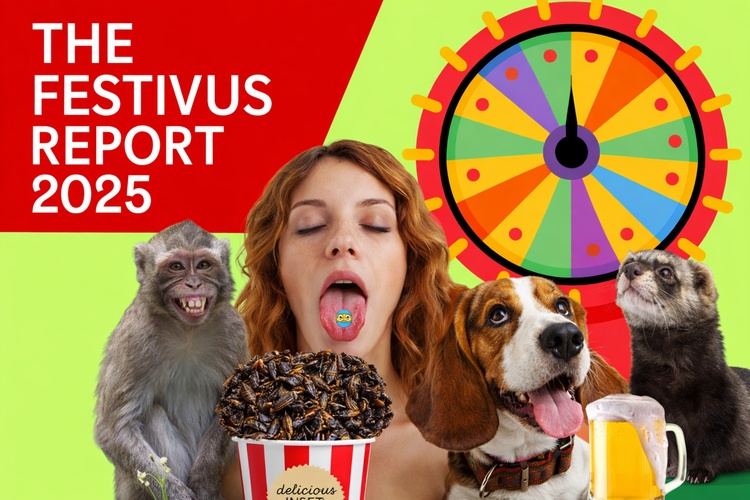
Taken together, the Festivus Report’s parade of ferrets, influencers, cartoons, chargers and balance-sheet line items is meant to channel public irritation at how Washington allocates scarce dollars. Whether readers share Paul’s policy prescriptions or not, the document offers a pointed reminder, reinforced by its collage-style cover of beer-drinking ferrets, spinning wheels and a tub of “delicious insects,” that debates over federal spending are increasingly fought not just over what government should do — but over what, in a year of trillion-dollar interest bills, it can still afford.
Dave Soulia | FYIVT
You can find FYIVT on YouTube | X(Twitter) | Facebook | Instagram
#fyivt #FestivusReport #GovernmentWaste #RandPaul
Support Us for as Little as $5 – Get In The Fight!!
Make a Big Impact with $25/month—Become a Premium Supporter!
Join the Top Tier of Supporters with $50/month—Become a SUPER Supporter!


 Subscribe to RSS



Leave a Reply to H. Jay EshelmanCancel reply