

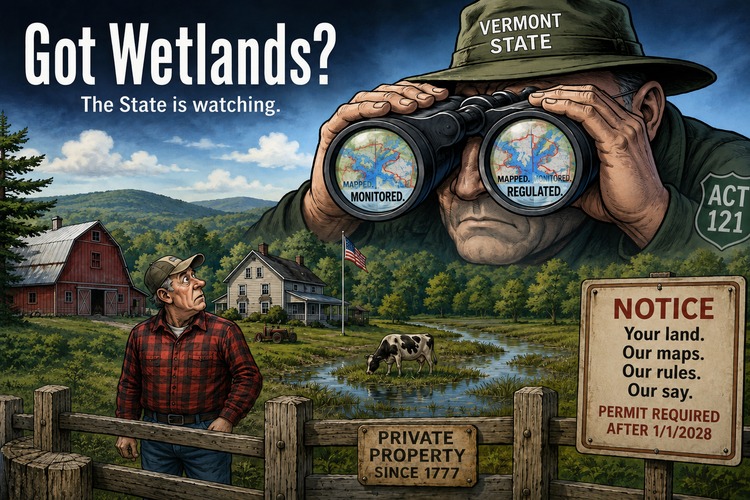
The Vermont Department of Environmental Conservation is inviting the public to review the latest round of updates to the state’s wetland maps, a process that could carry real consequences for property owners whose land is newly mapped, remapped, or placed closer to regulated wetland areas.
The Department announced June 9 that draft updates are available for more than 100 towns in Addison, Bennington, Orleans, Essex, Caledonia, Rutland, Chittenden, Lamoille, and Franklin counties. The maps show the approximate location and shape of existing wetlands where prior mapping was absent or inaccurate, according to the Department.
The update is part of a statewide effort required under Act 121, the 2024 Flood Safety Act. The law requires the Agency of Natural Resources to update the Vermont Significant Wetlands Inventory maps by January 1, 2026, and at least annually after that. The annual updates must include verified wetland delineations submitted as part of permit applications, wetlands determinations, rulemaking changes, and certain town-specific inventories of previously unmapped wetlands.
For landowners, the issue is not simply whether the state has produced a better map. It is whether a draft map could become the state’s working assumption for future permits, land sales, subdivisions, driveways, utility work, farm improvements, financing, or development plans.
Why The Maps Matter
Wetland maps are not parcel surveys, and they do not by themselves establish every exact boundary on a property. But they matter because they can become the first place state officials, town officials, engineers, buyers, lenders, attorneys, and abutters look when deciding whether land is likely to be regulated.
A property that previously appeared clear of mapped wetlands may now show wetland areas or nearby wetland boundaries. That can affect whether a landowner needs a wetland delineation, state review, or a permit before doing work.
The practical impact can include delay, additional consulting costs, loss of buildable area, new project conditions, or questions during a sale or financing process. A landowner who believes the draft map is wrong may have a much cheaper fight during the public review period than after the map becomes the state’s default reference.
🍁 Make a One-Time Contribution — Stand Up for Accountability in Vermont 🍁
Act 121 Goes Beyond Mapping
The wetland map update is one piece of a larger law. Act 121 also directs the state toward broader regulation of river corridors, flood hazard areas, wetlands, and dams.
One of the major provisions requires the Secretary of Natural Resources to adopt rules by July 1, 2027 for permits covering development within mapped river corridors. Beginning January 1, 2028, a person may not commence or conduct development in a mapped river corridor without a permit issued under those rules.
That is a major change for property owners near rivers and streams. The law uses a broad definition of development tied to federal flood hazard rules, which can include more than construction of buildings. Depending on final rulemaking, work such as grading, filling, paving, excavation, storage of materials, or other land changes may be affected.
The law does call for exemptions for certain minor development activities that have no adverse environmental effects. But the scope of those exemptions will depend on the rules adopted by the state.
Wetland Policy Now Aims For “Net Gain”
Act 121 also changes state water resources policy to say Vermont’s wetlands shall be protected, regulated, and restored so the state achieves a net gain of wetland acreage.
The law requires changes to the Vermont Wetlands Rules to clarify that wetlands regulation and management are aimed at protecting existing wetlands and restoring wetlands that were previously adversely affected.
For permit applicants, that policy shift matters. If a permitted activity will cause more than 5,000 square feet of wetland impacts that cannot be avoided, the Secretary must require the applicant to restore, enhance, or create wetlands or buffers to compensate.
For wetlands permanently drained or filled, the law sets a minimum 2-to-1 restoration ratio. In other words, the amount of wetland restored, enhanced, or created must be at least twice the acreage or square footage permanently lost. The law also says creating a buffer next to a wetland cannot substitute for actual wetland restoration, enhancement, or creation.
Permittee-designed restoration projects must also include five years of post-restoration monitoring, after which the Agency may decide if further action is needed.
Enforcement Authority Expanded
The law strengthens enforcement language as well. If a person damages the ecological functions of wetlands or fails to comply with wetland-related permits or orders, the Secretary may bring suit in Superior Court. Courts may order restoration of damaged wetlands, and wetlands damaged in violation of state law may be ordered restored, enhanced, or created.
Civil penalties can reach up to $10,000 per day for each day of violation.
Dam Owners Also Affected
Act 121 also revises Vermont’s dam safety laws. DEC can investigate the safety of a nonfederal dam of any size on petition from at least 10 interested persons, by request of a municipality, or on its own motion. If the Department finds a dam unsafe or a menace to people or property, it may order reconstruction, repair, removal, breaching, draining, or other action.
That provision may matter for rural landowners with old pond dams, partially breached structures, or legacy impoundments.
Some Existing Projects May Be Protected
Act 121 includes a transition provision for projects already underway before the new river-corridor permitting requirements take effect.
The Secretary may not require the new permit for development in a flood hazard area or mapped river corridor if all necessary local, state, or federal permits were obtained before January 1, 2028 and the permit holder does not later take an action requiring a new permit or registration under the relevant chapter.
The law also protects some projects with complete permit applications submitted by January 1, 2028, but only if the applicant does not later file certain permit amendments and substantial construction begins within two years after all applicable permits become final.
For landowners with pending plans, that creates a timing issue. Delay, incomplete applications, or later project changes could determine whether a project remains outside the new permit system or falls into it.
Public Meetings Scheduled This Month
DEC is directing the public to review and compare the changes through the Vermont Significant Wetlands Inventory online interactive map and related Environmental Notice Bulletin materials.
The Department scheduled two public meetings for the current round of updates.
The first meeting is scheduled for June 16 at 6:30 p.m. at The Arlington Common, 3938 VT-7A in Arlington, with virtual access available by advance registration.
The second meeting is scheduled for June 17 at 3 p.m. at the Morristown Town Office Building, 43 Portland Street in Morrisville, in the Community Meeting Room, with virtual access also available by advance registration.
The Department said the latest map updates cover watersheds that include major portions of Bennington, Lamoille, and Orleans counties. The mapping was created mostly by GeoSpatial Services at Saint Mary’s University and spot-checked in the field, according to DEC.
Landowners Should Check Now
The immediate public-interest issue is the current wetland map update. Landowners in affected towns should review the draft maps, compare them with their property boundaries, and determine whether newly mapped or revised wetlands affect land they own, use, plan to sell, subdivide, farm, build on, or improve.
The state’s public meetings and Environmental Notice Bulletin materials provide the formal opportunity to learn more and raise questions before the map updates are finalized.
Dave Soulia | FYIVT
You can find FYIVT on YouTube | X(Twitter) | Facebook | Instagram
#fyivt #Vermont #PropertyRights #Wetlands
Support Us for as Little as $5 – Get In The Fight!!
Make a Big Impact with $25/month—Become a Premium Supporter!
Join the Top Tier of Supporters with $50/month—Become a SUPER Supporter!


 Subscribe to RSS



Leave a Reply