

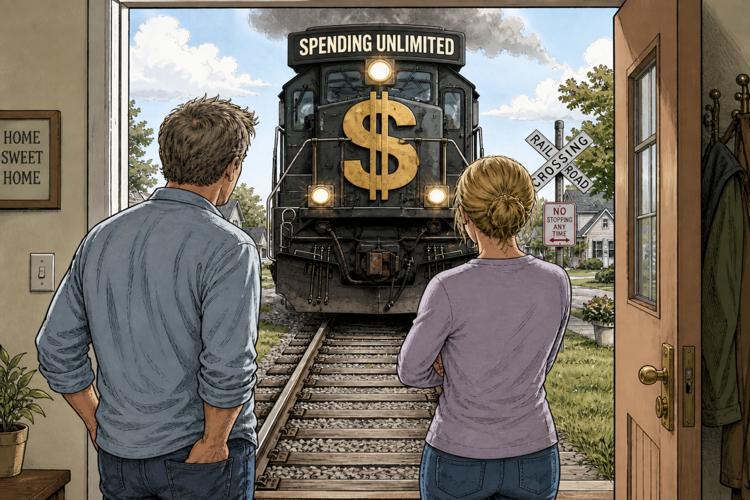
The numbers have been clear for years. Now the Legislature is offering a voluntary fix for a mandatory problem.
Vermont’s K-12 enrollment has shed roughly 25,000 students since fiscal year 2005 — dropping from 98,000 to 73,000 — while total education spending climbed from an estimated $1.1 billion to $2.22 billion by FY2023, according to state and federal education finance data. The math is simple and brutal: the cost of running a school system doesn’t shrink just because fewer kids show up.
That divergence has become a tax crisis. In FY2025, Vermont property tax bills for education jumped an average of 18.5% in a single year — the worst single-year spike in decades — driven by a 12% surge in school spending, the expiration of federal pandemic relief funds, and rising healthcare and mental health service costs. FY2026 looks calmer on paper, with average bills rising just over 1%, but only because the Legislature injected $118 million in one-time funds to buy the rate down. The underlying spending grew 5.5%.
Those one-time funds won’t be there in FY2027.
🍁 Make a One-Time Contribution — Stand Up for Accountability in Vermont 🍁
What the Projections Show
Three fiscal trajectories emerge when current data is projected forward to 2045, each hinging on whether Vermont achieves meaningful structural reform.
Under a base-case scenario — 3.5% annual spending growth with modest consolidation savings — total education spending reaches roughly $5.2 billion by 2045 while enrollment stabilizes near 55,000 students. The average homestead education tax rate, currently around $1.70 per $100 of assessed value, climbs past $2.00 before 2032 and approaches $2.90 by mid-century. On a $350,000 home, that’s an education-only property tax bill of more than $10,000 annually.
A genuine reform scenario — one where consolidation delivers real administrative savings and spending growth is held to around 2.5% per year — slows the climb but doesn’t reverse it. The tax rate reaches approximately $2.27 by 2045 rather than $2.90. The gap compounds to roughly $220 million per year in avoided cost by the end of the projection period.
The fiscal crisis scenario, with 5% annual spending growth and no structural reform, is the one that keeps state budget analysts up at night. The tax rate crosses $3.00 before 2040 and reaches $4.18 by 2045. On a $350,000 home, the annual education tax bill approaches $14,600 — consuming close to 20% of median Vermont household gross income. That’s not a tax burden. That’s a structural barrier to living here.
The underlying enrollment math doesn’t help any of the scenarios. Vermont’s birth rate is among the nation’s lowest, and the state was one of only five to lose population between 2024 and 2025, at a steeper rate than any other. Analysts project K-12 enrollment continuing to decline roughly 1,000 students per year through the mid-2030s before leveling off near 55,000. Fewer students means higher per-pupil costs even if total spending holds flat — which it historically has not.
Act 73 Is the Law. H.955 Is the Detour.
Last session’s Act 73 was supposed to be the fix. It mandated consolidation of Vermont’s 119 school districts into roughly a dozen regional units by 2028 and laid groundwork for a foundation formula that would restructure how education dollars flow statewide. It was ambitious, prescriptive, and politically expensive.
This session, the House Education Committee spent weeks trying to implement it — and couldn’t. After repeated deadlocks, the committee pivoted to H.955, which passed committee on a 7-4 party-line vote and cleared the full House 79-62 in April, again with only Democratic support. Ten Democrats joined all Republicans in voting no.
H.955 does not mandate consolidation. It creates seven Cooperative Educational Service Areas — CESAs — that would facilitate shared services like special education, transportation, and human resources across districts. Study committees would examine voluntary mergers within each CESA. Local voters retain final say. The bill also quietly pushes the foundation formula’s effective date from 2028 to 2030.
That delay is the tell. The foundation formula — the mechanism designed to change the financial incentives that drive spending upward — is now two full fiscal cycles further away from taking effect. The Joint Fiscal Office has offered no estimate of what that delay costs taxpayers.
Rep. Peter Conlon, D-Cornwall, the House Education Committee chair, framed the bill as respecting local voice. Gov. Phil Scott called it insufficient and has threatened to veto the state budget without more prescriptive reform. Education Secretary Zoie Saunders told the committee the House and Senate directions were “concerning.” The Senate’s path remains unclear.
Vermont has been here before. Act 46, passed in 2015, reduced the state’s school districts from roughly 270 to the current 119. H.955, if it becomes law and study committees recommend mergers that local voters approve, would reduce that 119 further — on a timeline extending past 2028, with outcomes uncertain. Two independent analyses, including work by Vermont’s own Joint Fiscal Office, found that administrative consolidation “does not necessarily directly impact teachers, students, or education outcomes.” Savings, the JFO noted, “could” be realized.
Could. Not will.
Spending more than twice the national average per pupil while producing assessment scores rated only “Approaching” target levels — the finding from Vermont’s own 2024-25 Annual Snapshot — is a data point that has not shifted the Legislature’s structural assumptions. The question facing Vermont taxpayers isn’t whether the state wants to control education costs. It’s whether voluntary study committees, on a multi-year timeline, with local voter veto power at every step, can move fast enough to bend a cost curve already in motion.
The projections suggest the answer matters.
Data sources: Vermont Joint Fiscal Office; UVM Vermont Legislative Research Service (November 2024); Vermont Agency of Education financial reports; Campaign for Vermont legislative analyses; VTDigger; Seven Days.
Dave Soulia | FYIVT
You can find FYIVT on YouTube | X(Twitter) | Facebook | Instagram
#fyivt #VermontPolitics #EducationReform #PropertyTaxes
Support Us for as Little as $5 – Get In The Fight!!
Make a Big Impact with $25/month—Become a Premium Supporter!
Join the Top Tier of Supporters with $50/month—Become a SUPER Supporter!


 Subscribe to RSS





Leave a Reply