

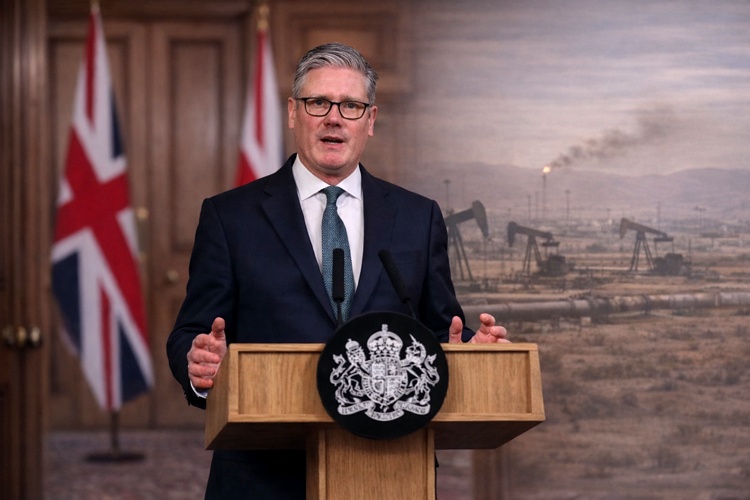
British Prime Minister Keir Starmer has insisted that the escalating confrontation with Iran is “not Britain’s war,” drawing a line between U.K. policy and ongoing U.S. military action in the region. As tensions rise, the British government has emphasized restraint—focusing on diplomacy, maritime security, and avoiding direct involvement in strikes.
But that claim sits uneasily against the historical record.
The modern conflict between the United States and Iran did not begin in Washington. It began with British control of Iranian oil—and a decision, more than seventy years ago, to bring the United States into a crisis that London could no longer manage on its own.
Britain’s Oil Grip on Iran
At the center of that story was the Anglo-Iranian Oil Company, the British-controlled firm that would later become BP. By the mid-20th century, Britain effectively dominated Iran’s oil industry, extracting enormous value while returning only a limited share of profits to the Iranian state. Oil from Iran was not just a commercial asset; it was a strategic pillar of British power.
That arrangement came under direct challenge in 1951, when Iran’s parliament, under Prime Minister Mohammad Mossadegh, voted to nationalize the oil industry. The move was widely supported inside Iran as an assertion of sovereignty. For Britain, it represented a direct threat to both economic interests and geopolitical influence.
🍁 Make a One-Time Contribution — Stand Up for Accountability in Vermont 🍁
From Economic Pressure to Regime Change
London responded with economic pressure, organizing a global boycott of Iranian oil that severely damaged Iran’s economy. But sanctions alone did not resolve the standoff. As the crisis deepened, British officials began looking for ways to remove Mossadegh from power.
By that point, however, Britain’s ability to act independently had diminished. The empire was no longer what it had been, and direct intervention was no longer politically or militarily viable. So London turned to Washington.
Early U.S. responses were cautious. The Truman administration initially resisted calls for direct involvement, viewing the dispute primarily as a conflict over oil. But British officials reframed the situation in Cold War terms, warning that instability in Iran could open the door to Soviet influence.
That argument gained traction.
Operation Ajax and the Shift to U.S. Leadership
In 1953, the United States and the United Kingdom carried out a joint covert operation—known as Operation Ajax—to overthrow Mossadegh. The effort relied on a combination of propaganda, political pressure, and orchestrated unrest. By August of that year, Mossadegh had been removed, and Shah Mohammad Reza Pahlavi was restored to power with Western backing.
The outcome secured Western access to Iranian oil, but under a new structure. Rather than restoring a purely British monopoly, the post-coup arrangement created an international consortium that included American companies alongside British interests. The profits—and the political ownership of the outcome—were now shared.
What followed was a shift in visibility as much as power.
Britain Fades, the U.S. Becomes the Target
In the years after the coup, the United States became the Shah’s primary external backer, providing military aid, economic support, and political cover. Britain remained involved, but increasingly in the background. For many Iranians, the face of foreign influence was no longer London—it was Washington.
That distinction proved decisive.
As dissatisfaction with the Shah’s rule grew—fueled by repression, inequality, and the perception of foreign control—the United States became the central target of public anger. When the Iranian Revolution erupted in 1979, it was the U.S. embassy in Tehran that became the focal point of the crisis, culminating in the hostage standoff that cemented decades of hostility.
Britain’s earlier role did not disappear. But it receded.
The Long Shadow of 1953
Over time, the narrative of U.S.–Iran tensions came to be understood primarily as an American story: U.S. intervention, U.S. backing of the Shah, U.S. confrontation with the Islamic Republic. Britain’s role—though foundational—became less visible, embedded in the earlier chapters of the conflict.
Yet those earlier chapters remain central to understanding how the situation developed.
The nationalization crisis, the economic pressure campaign, and the joint coup of 1953 were not peripheral events. They were the turning point that transformed Iran’s political trajectory and reshaped its relationship with the West. Without them, the alignment that later defined U.S.–Iran hostility may never have taken the same form.
A War That Didn’t Start in Washington
Today, as the United States and Iran again move closer to direct confrontation, Britain has positioned itself at a measured distance—supporting de-escalation while avoiding direct military involvement.
That may reflect current policy.
But it does not erase history.
The conflict now described as “not Britain’s war” traces back, in significant part, to decisions made in London—decisions that drew the United States into Iran’s internal crisis, secured Western control over oil, and helped set in motion decades of mistrust and confrontation.
Britain may no longer be at the center of the conflict.
But it was there at the beginning.
Dave Soulia | FYIVT
You can find FYIVT on YouTube | X(Twitter) | Facebook | Instagram
#fyivt #Iran #UKPolitics #MiddleEast
Support Us for as Little as $5 – Get In The Fight!!
Make a Big Impact with $25/month—Become a Premium Supporter!
Join the Top Tier of Supporters with $50/month—Become a SUPER Supporter!


 Subscribe to RSS


Leave a Reply