

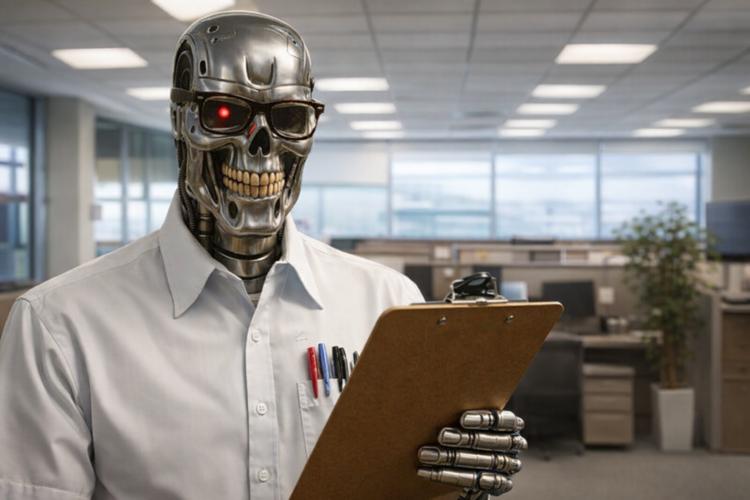
What AI Actually Is (And Why Business Leaders Should Pay Attention)
A few days ago I asked an artificial intelligence system a simple question.
“If I ask you what 2 + 2 is, can you guarantee the answer will always be 4?”
The response was blunt.
“No.”
Not “probably.” Not “almost always.”
No guarantee.
That one answer tells you almost everything you need to understand about modern artificial intelligence.
🍁 Make a One-Time Contribution — Stand Up for Accountability in Vermont 🍁
What’s In The Box?
Despite the hype, despite the headlines, despite Silicon Valley’s breathless predictions, systems like ChatGPT are not digital brains. They do not “know” things. They do not understand what you’re saying. They don’t even understand what they themselves are saying.
At their core, they are something much simpler.
They are extremely sophisticated wild-ass guessometers.
That phrase may sound like something out of a military briefing room, but technically it’s pretty accurate. Modern AI systems are massive probability engines trained on enormous amounts of text. When you ask a question, the system calculates which words are most likely to come next based on patterns it learned during training. Then it predicts the next word. Then the next. Then the next.
Thousands of times per second.
The result can look uncannily intelligent. Essays appear. Code appears. Explanations appear.
But under the hood it’s still prediction.
Or, to borrow another analogy that came up during that conversation: it’s like rolling dragon dice in Dungeons & Dragons.
You roll a die, add modifiers based on experience and knowledge, and hope the result lands close to the truth.
AI does something similar—except the die has billions of sides and the weighting comes from patterns learned across huge datasets.
Most of the time, the roll lands pretty well.
But it’s still a roll.
The Machine That Doesn’t Understand
One of the hardest things for people to grasp about AI is that there is no mind inside the machine.
When a human reads a sentence, the brain connects it to experiences, memories, and the physical world. If someone says “the stove is hot,” you remember heat, pain, kitchens, maybe even the smell of something burning.
The machine has none of that.
It has statistical relationships between symbols.
That’s it.
The system doesn’t feel confusion when a question is complicated. It doesn’t feel satisfaction when it produces a correct answer. And if it generates something completely wrong, it doesn’t experience embarrassment, consequences, or regret.
In fact, when I asked the AI directly whether it suffers any consequences if it’s wrong, the answer was simple:
“No.”
And that distinction matters more than most people realize.
Because humans pay the price for mistakes.
If a business decision based on AI analysis goes wrong, the CEO answers for it. If an AI-generated report contains false information, the company’s reputation suffers. If an AI-generated system introduces a hidden error, someone eventually has to clean up the mess.
The machine itself doesn’t care.
Why This Still Matters for Business
Despite those limitations, artificial intelligence is already changing how work gets done.
One argument circulating widely in the technology world is that AI capability is accelerating faster than the public realizes. Improvements in recent models have allowed them to write working code, analyze documents, and automate parts of knowledge work that previously required teams of people.
That has executives asking a predictable question:
“If AI can do this, why am I paying eight employees to do it?”
And in some cases, the math will look compelling.
One person using AI tools may be able to produce the output of several employees. Draft reports appear instantly. Documents can be summarized in seconds. Data can be processed quickly.
For a while, the spreadsheets will look fantastic.
But there’s a trap hiding inside that productivity boost.
When Companies Get Overconfident
AI systems are extremely good at producing work that looks correct.
They are much less reliable at guaranteeing that the work actually is correct.
Because the system is predicting language patterns rather than verifying facts, it can generate convincing answers that contain subtle errors, missing context, or outright fabricated details.
Researchers call these “hallucinations.”
A more practical description might simply be: bad guesses.
This is where companies may learn some expensive lessons.
History shows a familiar pattern whenever a new technology appears. Executives see early success and assume the technology can replace more human expertise than it really can.
Then reality intervenes.
Output that seemed impressive at first starts producing problems. Hidden errors accumulate. Nuance disappears. Edge cases break systems. Eventually companies discover that the human judgment they thought they replaced was actually doing most of the invisible work.
The result is usually the same cycle:
First, companies cut too deeply.
Then they quietly hire people back.
The Real Opportunity
None of this means AI is useless. Quite the opposite.
Used properly, these systems can dramatically increase the productivity of people who know what they’re doing. A skilled professional paired with AI tools can analyze documents faster, explore ideas more broadly, and eliminate enormous amounts of routine work.
That’s where the real advantage lies.
Human judgment plus machine horsepower.
Think of AI as a powerful horse. It can move quickly and carry a lot of weight.
But someone still has to hold the reins.
The Bottom Line
Artificial intelligence is not magic. It is not a digital brain. And it is not a replacement for human responsibility.
It is a very large probability machine trained on patterns.
A very fast one.
A very useful one.
But still, at heart, a wild-ass guessometer.
Treat it like a tool and it can help people do remarkable things.
Treat it like an oracle—and sooner or later, the dice roll the wrong way.
Dave Soulia | FYIVT
You can find FYIVT on YouTube | X(Twitter) | Facebook | Instagram
#fyivt #ArtificialIntelligence #AIExplained #TechnologyAndBusiness
Support Us for as Little as $5 – Get In The Fight!!
Make a Big Impact with $25/month—Become a Premium Supporter!
Join the Top Tier of Supporters with $50/month—Become a SUPER Supporter!


 Subscribe to RSS



Leave a Reply