

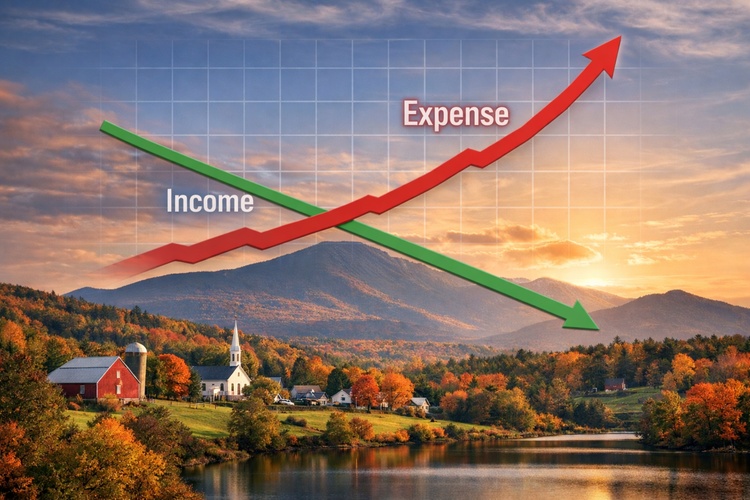
A Slow, Relentless Rise in State Spending
Vermont’s fiscal picture has evolved gradually over the past two decades, but the long-term trend is unmistakable: total state spending has risen at a rate consistently faster than the growth of the underlying tax base. While individual budget cycles may not appear dramatic, the cumulative effect of 3% to 5% annual spending increases is substantial. These increases are driven by structural factors rather than short-term choices. Human services costs rise faster than inflation, education spending grows even in the face of declining enrollment, and labor-related expenses continue to climb steadily.
State employee contracts include “step increases“—automatic annual raises of 3-4% built into compensation schedules regardless of budget capacity or economic conditions. Combined with health insurance cost growth, these contractual obligations function as a structural ratchet: spending can only move in one direction.
When combined, these forces create a functional reality: the state requires approximately a 5% annual increase in revenues simply to maintain current services. This pressure is not likely to diminish soon, as the categories that grow fastest are the ones most resistant to cuts or restructuring.
A Tax Base That Can’t Keep Pace
From 2003 to 2023, Vermont’s state budget grew at an annual rate of 3-5%, more than doubling in size over two decades. During the same period, Vermont’s economy grew at just 1.2% annually. This structural imbalance—government spending consistently outpacing economic growth by a factor of three or more—creates fiscal pressure that compounds year after year.
Property taxes, now Vermont’s single largest source of state-generated revenue, have more than tripled since 2000. The median Vermont household now pays approximately $6,200 annually in property taxes compared to roughly $2,000 in 2000—a 210% increase during a period when median household income grew only 65%. Income and sales tax collections have grown as well, but not fast enough to match long-run spending commitments.
Because taxpayers do not experience equivalent income growth, each additional percentage point of tax increase represents a larger share of household resources. This creates a form of structural tension: as long as spending growth outpaces the growth of incomes, affordability concerns intensify. Vermont’s tax burden is already among the highest per capita in the country, and indications suggest these upward trends will continue unless underlying cost drivers change.
The Demographic Cliff
Vermont’s demographic trajectory compounds these fiscal pressures. The state’s worker-to-retiree ratio continues to deteriorate as younger working-age residents leave while the population over 65 expands. Fewer workers generate less tax revenue while simultaneously requiring more expensive services for an aging population. Healthcare costs, prescription drug programs, and senior services all grow faster than general inflation, creating a feedback loop where the tax base shrinks precisely as demand for costly services increases.
Pension Reform and Its Narrow Margins
In 2022, lawmakers implemented Act 114, a reform intended to stabilize the state employee and teacher pension systems. The act raised employee contributions for some workers, adjusted retirement timelines, and—most importantly—committed Vermont to making additional supplemental payments beyond actuarially required levels. If everything functions as projected, the plan would fully fund pensions by around 2038 and bring retiree healthcare obligations to roughly 90% funding by 2048.
However, the plan rests on several assumptions that introduce uncertainty. The most critical is the assumed rate of return on pension investments, currently in the 6.5% to 7% range. If long-term market returns fall short, unfunded liabilities could increase instead of shrinking. In such a scenario, the required contributions from the state would rise accordingly, placing additional strain on future budgets.
🍁 Make a One-Time Contribution — Stand Up for Accountability in Vermont 🍁
Even a prolonged period of 5% returns instead of 7% would widen the funding gap substantially. A significant market downturn early in the funding horizon would be especially damaging, as pension mathematics make early losses disproportionately difficult to recover from.
Furthermore, the success of the funding schedule depends on the legislature consistently making supplemental payments each year. Economic downturns, competing budget priorities, or unexpected shortfalls could lead to skipped contributions. Historically, Vermont has adjusted pension funding schedules during difficult fiscal periods, and doing so again would push the stabilization timeline further into the future, potentially by decades.
Indicators to Watch Over the Next 10–15 Years
Vermont is not facing immediate fiscal crisis, but the combination of steady cost increases, constrained revenue growth, and significant long-term obligations creates a narrow path forward. Several indicators will help determine whether the state’s current trajectory remains viable:
Out-migration among working-age residents, reducing the tax base while leaving fixed obligations unchanged.
Rising property tax delinquencies, indicating that household capacity to absorb costs has reached limits.
Continued rejection of school budgets, signaling diminished tolerance for rising costs.
Credit rating shifts, which reflect external assessments of long-term fiscal sustainability.
General Fund crowd-out, where pension payments consume increasing shares of the budget, forcing cuts to current services.
If these trends intensify, they signal that Vermont’s current fiscal model is becoming unsustainable.
The Choice Vermont Faces
Vermont’s fiscal trajectory does not lead to immediate collapse, but the mathematics are unforgiving. A system where spending grows at 5% while revenues grow at 2-3% cannot continue indefinitely. The gap compounds annually, and each year of continuation makes eventual reconciliation more difficult and more painful.
Other states have already traveled this path. Connecticut faced a similar mismatch between obligations and capacity and responded with massive tax increases that accelerated out-migration of high earners. Illinois delayed pension reforms for decades and now confronts unfunded liabilities so large that full funding appears mathematically impossible without either default or confiscatory taxation.
Vermont has not yet reached that point, but the current trajectory leads there. The state can choose structural reforms now—genuine pension restructuring, spending controls tied to revenue growth, or elimination of automatic cost escalators—or it can continue the present course until external forces impose harsher solutions. What it cannot do is maintain current promises at current tax rates. The arithmetic simply doesn’t allow it.
Dave Soulia | FYIVT
You can find FYIVT on YouTube | X(Twitter) | Facebook | Instagram
#fyivt #VermontBudget #FiscalReality #PropertyTaxes
Support Us for as Little as $5 – Get In The Fight!!
Make a Big Impact with $25/month—Become a Premium Supporter!
Join the Top Tier of Supporters with $50/month—Become a SUPER Supporter!


 Subscribe to RSS





Leave a Reply