

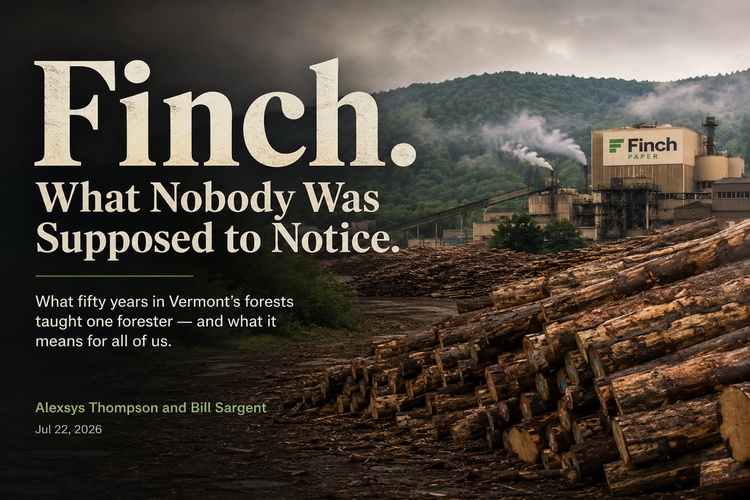
What fifty years in Vermont's forests taught one forester — and what it means for all of us.
On July 17, 2026, Finch Paper announced that its roundwood yards in Glens Falls, New York — yards that came to symbolize the company and the city itself — will cease to exist.
"When Finch transitions to purchased pulp," the company said, "it will no longer be necessary for the company to purchase large quantities of roundwood from wood suppliers in the Northeast and New England."
For William Sargent, a Vermont forester with more than fifty years of watching the Northeast's working landscape change, the announcement landed with the weight of something long predicted.
A 50-Year Arc
Finch Paper's announcement did not arrive in a vacuum. It is the latest entry in a long list.
Sargent has spent decades documenting the disappearance of the mills that once formed the economic backbone of Vermont's working forest. In Bennington County alone — Eagle Lumber in Stamford, Caruso in Readsboro, NorthEast Wood Products in Pownal, Wilcox in Arlington, Kelly Hardwood with its portable sawmill operations in Glastonbury and Somerset, Lewis in West Rupert, BearPaw in Dorset — mill after mill, decade after decade.
Across the broader region the picture is the same. Vermont has lost approximately 150 sawmills since 2000. Six mills in the Northeast and Quebec had already paused or decreased wood deliveries before Finch's announcement, according to reporting by the Maine Monitor in November 2025.
The industry's own data confirmed what foresters like Sargent had long been watching on the ground. The Professional Logging Contractors of the Northeast published their most recent Logging and Trucking Economic Impact Study in February 2026, documenting a 40 percent reduction in wood markets for members over the past five years. Many are experiencing severe revenue losses, layoffs, loss of clients, reduced productivity, and an inability to plan for the future.
"We are deeply concerned for those, including many of our own members in New York, New Hampshire and Vermont, whose livelihoods will be affected by this announcement," said Dana Doran, PLC Executive Director, in a statement published July 20 in Vermont Business Magazine.
"The Glen Falls mill is one of two pulp markets in Eastern New York that purchases wood from logging contractors from multiple states in the Northeast region, and that market is critical both to the financial survival of logging and trucking firms and to their ability to properly manage forest health. Both will suffer from its loss."
The Northeast logging industry contributed an estimated $1.3 billion to the regional economy in 2024, supported approximately 10,500 jobs directly or indirectly, and generated an estimated $61 million in state and local tax revenue, according to the PLC's own economic impact data. In Vermont alone, logging and trucking supports 1,300 jobs and $140 million in economic output. In New York, the sector generates 2,400 jobs and $280 million in economic output.
A July 2026 survey by Timber Processing found that not one logger out of more than 190 surveyed expected pulpwood demand to improve significantly in their area.
This is not a sudden event. It is a structural collapse that has been building for fifty years and is now, with the Finch closure, reaching a new threshold.
Who Owns Finch Paper
What the trade coverage of this announcement has largely not addressed is who made this decision and from what position.
Finch Paper is not an independent company. It is owned by Atlas Holdings LLC, a private equity firm headquartered in Greenwich, Connecticut, that manages more than $16 billion in assets across approximately 30 portfolio companies globally.
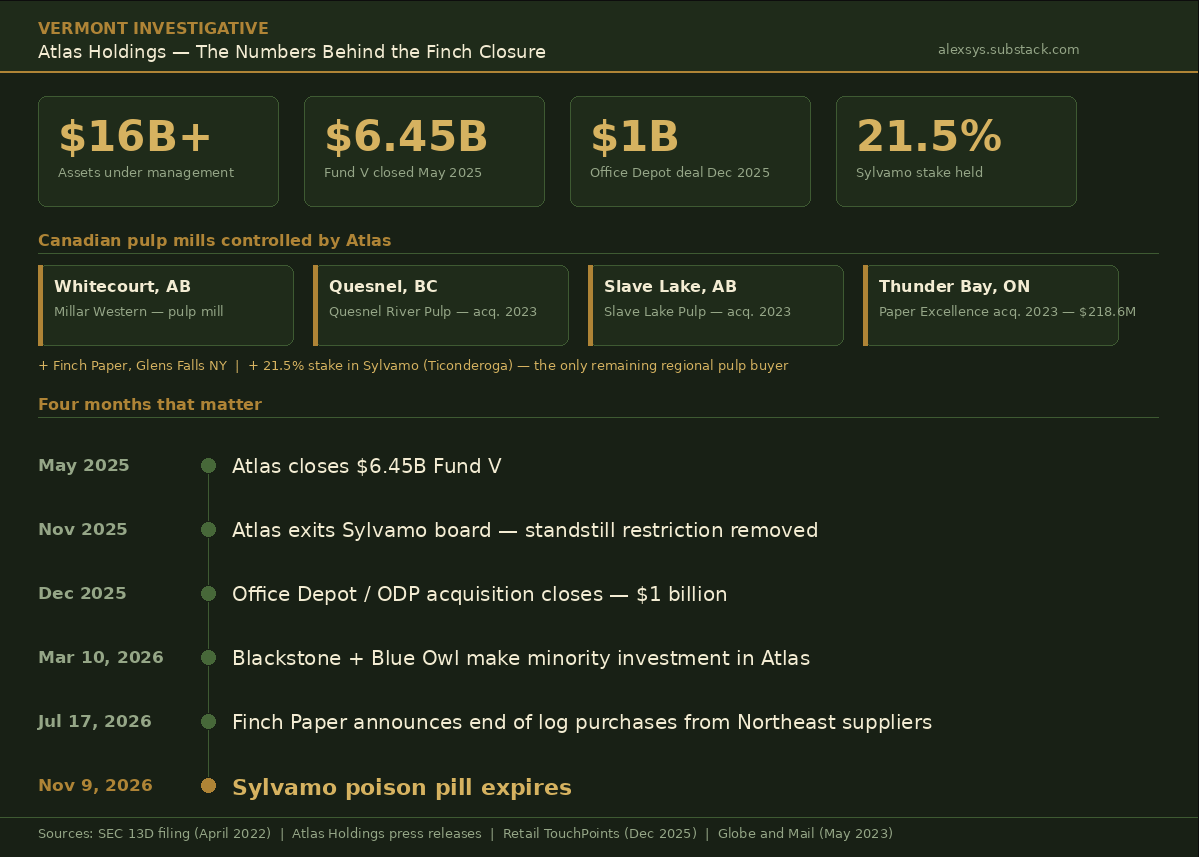
Atlas Holdings by the numbers. Graphic: Vermont Investigative.
Atlas Holdings was founded in 2002 by Andrew Bursky and Timothy Fazio, two veteran industrial investors. The firm describes itself as specializing in "transforming businesses into performance organizations" — acquiring companies in sectors like paper, packaging, and industrial manufacturing. Most recently Atlas took the parent company of Office Depot and Office Max private in an all-cash transaction valued at approximately $1 billion, completed December 2025. In March 2026 — four months before the Finch announcement — Atlas closed a $6.45 billion fund and announced a minority investment from Blackstone, one of the world's largest private equity firms. Private equity ownership of paper and pulp mills is not new — six of Maine's major mills are private equity owned, and firms including Apollo Global Management, Brookfield Asset Management, Blue Wolf Capital, and American Industrial Partners are all active in the sector. What distinguishes Atlas is the scope of its position across both ends of the Northeast fiber market simultaneously — owning the mills that make the paper and holding a significant stake in the only remaining regional pulp buyer.
Atlas acquired Finch Paper in 2007. That same year, it acquired a controlling stake in Millar Western Forest Products, a more than 100-year-old Canadian forest products company headquartered in Edmonton, Alberta, with pulp mill operations in Whitecourt, Alberta. In September 2023, Atlas — operating through Millar Western — acquired two additional pulp mills from West Fraser Timber for $120 million: the Quesnel River Pulp mill in Quesnel, British Columbia, and the Slave Lake Pulp mill in Slave Lake, Alberta.
Atlas now controls at least four Canadian pulp and paper mills — three through Millar Western in Alberta and British Columbia, and a Thunder Bay, Ontario mill acquired in 2023 from Paper Excellence Group for $218.6 million — in addition to Finch Paper in Glens Falls.
Finch Paper's own website, as of the date of this publication, continues to state: "We have a stringent chain-of-custody program in place to track the sources of our fiber and ensure that it comes from legal, responsibly managed forests." It describes a "feet-in-the-forest philosophy" and states that at least 90 percent of its fiber comes from Sustainable Forestry Initiative or Forest Stewardship Council certified sources.
When Finch Paper announced it will stop making its own pulp and begin purchasing it from outside suppliers, Atlas did not name those suppliers. The New York Almanack reported on July 18 that "Finch is likely to source all its pulp from Canada," and noted directly that Atlas's sister company Millar Western "makes the kind of pre-processed pulp sheets Finch said it would be buying in the future."
The PLC's Doran made the Canadian sourcing concern explicit: "We are hopeful that Finch will revisit this decision once the global pulp situation stabilizes and determines that it is more economical to produce its own pulp rather than purchasing kraft pulp from other countries such as Canada."
Vermont Investigative has submitted a right-of-reply inquiry to Atlas Holdings asking directly whether Millar Western has been designated as Finch's replacement pulp source. Atlas Holdings had not responded as of publication.
The Sylvamo Question
Atlas's position in the Northeast fiber market extends further still.
Sylvamo Corporation — spun off from International Paper in 2021, and still known colloquially in the logging community as "International Paper" or "IP" — owns the Ticonderoga, New York mill. As of this writing, Ticonderoga is the only remaining large-scale regional pulp buyer in the Northeast after Finch's exit. That mill processes approximately 100 truckloads of wood daily, roughly 75 percent harvested in New York, with the remainder coming from Vermont and New Hampshire, according to the New York Almanack.
Atlas holds an approximately 21.5 percent economic interest in Sylvamo through stock purchases and derivatives. Andrew Bursky and Timothy Fazio — Atlas's co-founders and co-managing partners — personally signed the SEC Schedule 13D filing documenting that stake in April 2022. That filing stated, on the record with the Securities and Exchange Commission, that an "extraordinary corporate transaction including but not limited to a merger, reorganization or liquidation" of Sylvamo was among the possible outcomes Atlas was considering.
Atlas obtained two seats on Sylvamo's board in 2023 through a cooperation agreement. In November 2025, Atlas resigned both seats — removing the standstill restriction that had prevented a hostile acquisition move. Sylvamo responded by adopting a shareholder rights plan — commonly called a poison pill — designed to prevent an unwanted acquisition. That rights plan expires November 9, 2026.
Four months after Atlas resigned its Sylvamo board seats and freed itself from the standstill, Finch Paper announced it will stop buying logs from Northeast suppliers — leaving Sylvamo's Ticonderoga mill as the sole remaining large-scale regional buyer.
Vermont Investigative has submitted right-of-reply inquiries to both Atlas Holdings and Sylvamo Corporation. Neither had responded as of publication.
What This Means for Vermont's Working Forest
The concern extends beyond the immediate economic impact on loggers and truckers, significant as that is.
Vermont's working forest model — the idea that sustainable logging and conservation can coexist, enshrined in programs like the state's Current Use program and increasingly supported by forest carbon offset investments — depends on there being a viable market for the fiber those forests produce. When the buyers disappear, the economic rationale for the working forest disappears with them.
The pulp market has also allowed loggers to better manage forest health by making it financially possible to selectively thin forest stands rather than targeting only the largest and straightest trees for saw logs, the PLC noted in its statement. Without a pulp buyer, that selective management becomes economically impossible for many operations.
Sam Lincoln, owner of Lincoln Farm Timber Harvesting in Randolph Center and a former Vermont Department of Forests, Parks and Recreation deputy commissioner, told VTDigger that the Finch closure is deeply concerning for the region's loggers, with Ticonderoga now the only comparable remaining option.
Sargent testified before the Vermont House Environment Committee in May 2026 — a warning, he says, about exactly the kind of regional market collapse the Finch closure now represents. The logging community has been sounding the alarm for years. The Finch closure is not a surprise. It is a confirmation and a warning.
What Comes Next
Atlas Holdings' Canadian pulp operations — three mills through its subsidiary Millar Western — are among the largest in the country. That context is the subject of Part 2.
Vermont Investigative is continuing to report on the ownership structure behind the Finch closure, including Atlas Holdings' position in the broader Northeast paper and pulp market, the carbon credit commitments on the former Finch Pruyn Adirondack lands now held by institutional investors, and the implications for Vermont's working landscape policy.
FOILs have been submitted to the New York State Department of Environmental Conservation. Right-of-reply inquiries are outstanding to Atlas Holdings, Sylvamo Corporation, Finite Carbon (a BP subsidiary), and Vermont's Department of Forests, Parks and Recreation.
Part 2 is coming.
Sources
- Glens Falls Chronicle, July 17, 2026: glensfallschronicle.com/finch-paper-will-stop-making-its-own-pulp
- New York Almanack, July 18, 2026: newyorkalmanack.com/2026/07/finch-paper-glens-falls-pulp-mill
- VTDigger, July 20, 2026 (Charlotte Oliver): a-new-york-paper-mill-is-closing-part-of-its-operation
- Vermont Business Magazine, July 20, 2026 (PLC statement): plc-deeply-concerned-announcement-finch-paper-llc
- PLC 2024 Logging and Trucking Economic Impact Study: 2024 Economic Impact Report (PDF)
- Maine Monitor, November 2025 (Dana Doran on six mills pausing)
- VTDigger, April 8, 2026 (Jonathan Wood, Vermont logging sector economic data)
- Seven Days (150 Vermont sawmills closed since 2000)
- Timber Processing, July 2026 (logger survey)
- Atlas Holdings / West Fraser press release, September 22, 2023: Millar Western pulp mill acquisitions
- SEC Schedule 13D, Atlas Holdings / Sylvamo Corporation, April 2022
- Finch Paper environmental stewardship page: finchpaper.com/environmental-stewardship
This report is by Alexsys Thompson with William Sargent for Vermont Investigative, an independent investigative journalism project published within Follow the Yellow Brick Road on Substack. Right-of-reply is standard practice on all subjects; Atlas Holdings and Sylvamo Corporation were contacted for comment and had not responded as of publication. Republished on FYIVT with the author's permission.
If you value this work, support it directly: subscribe on Substack, tip via Ko-fi, or read the original here.
Comments