

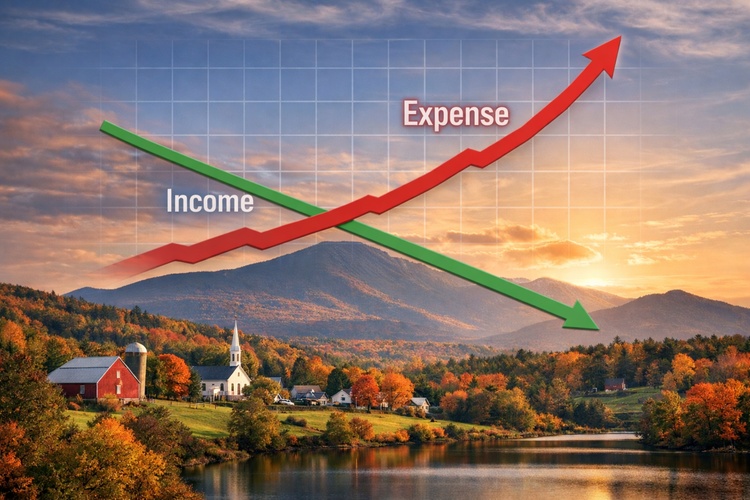
Property Tax Rates Climb Sharply
Vermont property taxpayers are facing another significant increase in education-related tax rates heading into fiscal year 2026, according to the Joint Fiscal Office’s Fiscal Facts 2026 report.
The average homestead property tax rate is projected to rise from $1.303 in FY2025 to $1.593 in FY2026. The uniform nonhomestead rate is also set to increase, from $1.391 to $1.703.
These increases continue a multi-year trend of rising tax burdens tied directly to the state’s education funding system, which relies heavily on the statewide property tax as its primary revenue source.
While annual bill changes can vary depending on local factors, the underlying statewide rate increases reflect systemic cost pressures rather than isolated district-level decisions.
🍁 Make a One-Time Contribution — Stand Up for Accountability in Vermont 🍁
Spending Continues to Grow
At the same time, overall education spending continues to increase, even as tax rates climb.
Statewide education spending grew:
- 8.0% in FY2024
- 10.7% in FY2025
- 5.5% projected in FY2026
Total Education Fund appropriations are projected to reach approximately $2.43 billion in FY2026, up from about $2.15 billion in FY2024. The largest component—direct education payments—is expected to total roughly $1.99 billion.
Although the growth rate is moderating compared to the previous year, total spending continues to rise in absolute terms. That sustained increase drives the need for higher revenue, primarily through property taxes.
Yield Per Pupil Declines
While both taxes and spending are rising, the system’s efficiency—measured by yield per pupil—has declined sharply.
Property yield per pupil fell from:
- $15,443 in FY2024
- to $9,893 in FY2025
- to a projected $8,596 in FY2026
Income yield per pupil also dropped significantly, falling from $17,537 in FY2024 to $10,110 in FY2025, before partially rebounding to $12,172 in FY2026.
This metric reflects how much funding is generated per student relative to tax effort. A declining yield indicates that higher tax rates are producing less funding per pupil, meaning the system requires more tax effort to sustain the same level of spending.
Enrollment Pressures Persist
Student enrollment trends are another key factor shaping the system.
The state’s long-term weighted average daily membership (LTWADM)—a measure of student enrollment—is projected at 142,564 students in FY2026, essentially flat compared to the prior year.
Longer-term demographic data shows a decline in school-age populations, with fewer children entering the system over time.
When enrollment stagnates or declines while spending increases, per-pupil costs rise automatically. This dynamic amplifies funding pressures, as the system must spread fixed and growing costs across a stable or shrinking student base.
Revenue Still Falls Short
Despite higher tax rates and increasing revenue, the Education Fund continues to run deficits.
The report projects a $32.5 million deficit in FY2026, following a $20.2 million deficit in FY2025 and a $94.8 million deficit in FY2024.
These recurring shortfalls indicate a structural imbalance between revenues and expenditures. The system is not fully supported by ongoing revenue streams and instead relies on adjustments such as prior-year balances, transfers, and reserve funds to close gaps.
This pattern suggests that current funding mechanisms are not keeping pace with underlying cost growth.
Property Tax Dominates Funding
Vermont’s education system remains heavily dependent on the statewide property tax.
The tax is projected to generate approximately $1.69 billion in FY2026, making it the largest single source of state revenue.
Additional funding sources—including sales and use tax, meals and rooms tax, lottery transfers, and Medicaid-related transfers—contribute to the Education Fund but remain smaller in comparison.
Vermont is unusual among states in the degree to which education funding is centralized and tied to a statewide property tax rather than primarily local property taxes.
A System Under Strain
Taken together, the data points to a system experiencing multiple, reinforcing pressures:
- Rising property tax rates
- Continued growth in education spending
- Declining yield per pupil
- Flat or declining student enrollment
- Recurring structural deficits
Each of these factors compounds the others. Rising costs drive higher tax rates. Stable or declining enrollment increases per-pupil costs. Declining yield reduces efficiency, requiring even more revenue to maintain spending levels.
The result is a feedback loop where taxpayers face higher rates while the system delivers diminishing financial efficiency.
Looking Ahead
The Fiscal Facts 2026 report does not propose policy changes, but it outlines a clear trajectory.
Vermont’s education funding model is producing higher tax burdens alongside declining efficiency metrics, while demographic trends continue to put upward pressure on per-pupil costs.
Without structural changes—whether in spending growth, enrollment alignment, or funding design—the current dynamics suggest continued strain on both taxpayers and the Education Fund in the years ahead.
Dave Soulia | FYIVT
You can find FYIVT on YouTube | X(Twitter) | Facebook | Instagram
#fyivt #Vermont #PropertyTaxes #EducationFunding
Support Us for as Little as $5 – Get In The Fight!!
Make a Big Impact with $25/month—Become a Premium Supporter!
Join the Top Tier of Supporters with $50/month—Become a SUPER Supporter!


 Subscribe to RSS


Leave a Reply