

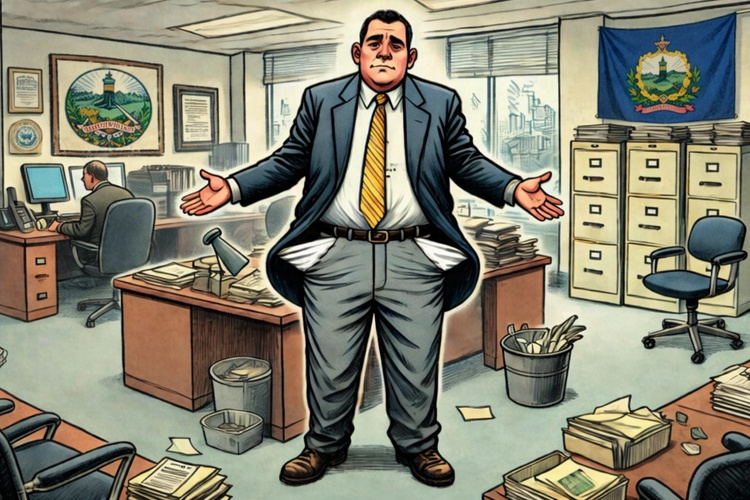
A new briefing from the Legislature’s nonpartisan Joint Fiscal Office (JFO) offers a sober look at Vermont’s finances heading into 2026 — and several pressure points that could hit Vermonters’ wallets in the next year or two.
Revenues Are Missing the Mark
Through November, Vermont’s three major funds — General, Education, and Transportation — are collectively running $8.9 million below forecast, about 0.7% under target. For November alone, they missed the monthly target by $17.2 million, or 7.4%.
The General Fund was the main culprit in November, coming in $15.3 million (10.6%) below target and now $4.2 million (0.5%) short for the year. That shortfall was driven largely by corporate income tax refunds: some large companies chose to take cash back rather than leave overpayments as credits toward future liabilities. JFO notes this doesn’t yet look like a trend, but it’s still money out the door this year.
The Education Fund, which helps pay for Vermont’s schools, was $2.1 million (3.4%) below target in November and $2.3 million (0.7%) below forecast year-to-date. JFO suggests some of this may simply be timing — tax remittances delayed by the Thanksgiving holiday — with those dollars likely to show up in December.
The Transportation Fund slightly overperformed in November but is still $2.3 million (1.8%) under forecast for the year. That matters because this fund is already under stress and heavily reliant on federal dollars to keep roads, bridges, and other projects moving.
On their own, these shortfalls are not yet a crisis. But they narrow the margin for lawmakers trying to hold down taxes while maintaining services — especially when other pressures are rising.
SNAP Shutdown Costs Likely on the State
The Joint Fiscal Committee also got a detailed review of how Vermont navigated the recent federal government shutdown and the temporary freeze in full SNAP (3SquaresVT) benefits. More than 38,000 households — over 63,000 individuals — rely on 3SquaresVT. During the shutdown, federal guidance would have left many of them with sharply reduced or no benefits for a period of time.
To avoid that outcome, the Emergency Board approved a one-time emergency SNAP benefit of about $6.3 million, covering roughly 15 days of normal benefits, plus $250,000 for the Vermont Foodbank to keep food shelves stocked. The money came from a $50 million Emergency Board appropriation in the FY26 budget, created to respond to federal funding reductions when the Legislature is out of session.
Although the shutdown ended and full federal benefits resumed (late, but intact), JFO notes it is “unlikely” that the state funds used to provide that emergency benefit will be reimbursed, even though the federal government has promised to reimburse other state costs associated with carrying out federal programs.
Bottom line: Vermonters on SNAP avoided a serious short-term hit, but the state likely absorbed more than $6 million in additional costs to do it. That is one more draw on finite state dollars that could otherwise be used for tax relief or other priorities.
Federal Cuts and a Transportation Match Cliff
The JFO briefing flags two more cost centers that, while less visible day to day, have major implications for what Vermonters pay and what services they receive.
First, the state has already seen over $12 million in federal funding cuts this fiscal year (through October 2025). A process created in Act 27 now requires the Administration to notify the Joint Fiscal Committee and propose a response when federal cuts hit certain thresholds. Those thresholds haven’t been met yet, but the trend line is clear: less federal money means either reduced services or more state revenue to backfill — often through taxes, fees, or local budget pressures.
🍁 Make a One-Time Contribution — Stand Up for Accountability in Vermont 🍁
Second, the Transportation Fund is facing a looming structural problem. Federal money currently covers 51% of Vermont’s transportation costs, but to draw those funds down the state must provide a match — on average, 17% state/nonfederal to 83% federal. For fiscal year 2027, JFO projects a $33.4 million gap in that state match. If Vermont can’t come up with that money, it would forgo about $163 million in federal transportation funds. That deficit is expected to grow in later years.
Practically speaking, lawmakers will face a choice: find new or higher state-level revenues for transportation (for example, taxes, fees, or reallocations from other areas), or accept fewer road, bridge, and infrastructure projects. Either way, Vermonters pay — through their tax bills, their vehicle costs, or the condition of the infrastructure they rely on.
A 12% Property Tax Warning Shot
Perhaps the most direct price signal in the JFO update is on property taxes. House Appropriations has begun work on the mid-year budget adjustment, and Governor Scott has urged lawmakers to keep changes limited and preserve as much money as possible for property tax relief in the fiscal year 2027 budget.
That plea comes against the backdrop of the Department of Taxes’ annual December 1 Letter, which forecasts an average 12% increase in property taxes in the coming year. JFO stresses that this letter is a starting point, not an automatic outcome: lawmakers will spend the session setting yields and rates to fully fund the school budgets voters approve in the spring. However, a 12% starting point is a clear sign of pressure in the education finance system, and property owners — as well as renters who feel property tax increases through higher rents — will be watching closely.
What to Watch Next Session
The JFO update also highlights broader cost drivers: rising health care expenses, slower real wage growth, and a job market that isn’t keeping pace with AI-driven gains in stock-market wealth. Transportation costs are outpacing revenues, health care stakeholders are warning of system stress, and major education reforms under Act 73 — including early care and learning and a new foundation formula — are still being analyzed.
Individually, any one of these issues might be manageable. Taken together — revenue shortfalls, unreimbursed emergency spending, federal funding cuts, a transportation match cliff, and double-digit projected property tax increases — they outline a session where the central question will be how much more Vermonters are asked to pay, and where, to keep the state’s promises.
Dave Soulia | FYIVT
You can find FYIVT on YouTube | X(Twitter) | Facebook | Instagram
#fyivt #vtpoli #vtbudget #vermont
Support Us for Just $5/month—Become a Committed Supporter!
Make a Big Impact with $25/month—Become a Premium Supporter!
Join the Top Tier of Supporters with $50/month—Become a SUPER Supporter!


 Subscribe to RSS


Leave a Reply