

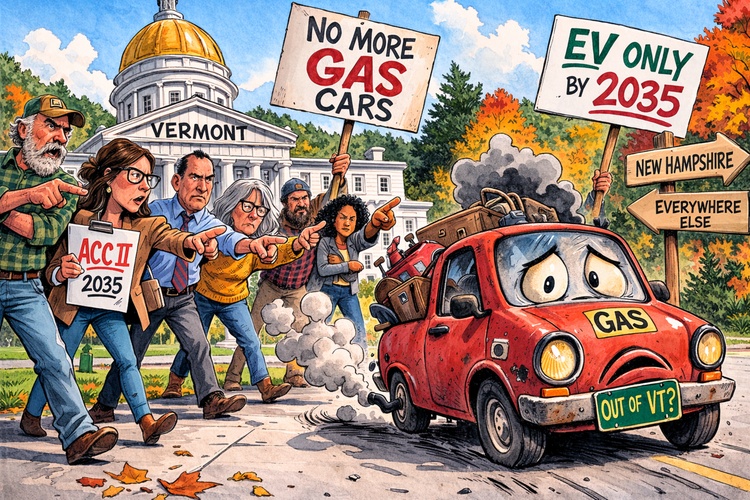
In case it was forgotten, Vermont’s electric-vehicle sales mandate has not gone away. For now, it is simply paused.
The state adopted California’s Advanced Clean Cars II (ACC II) rule in 2022, placing Vermont on a regulatory path that would require manufacturers to deliver increasing numbers of zero-emission vehicles to Vermont dealerships beginning with model year 2026 and reaching 100 percent of new light-duty vehicle deliveries by 2035.
In May 2025, Gov. Phil Scott issued Executive Order 04-25, temporarily suspending enforcement of the rule after concerns emerged about vehicle availability and the effect on local dealers. The order does not repeal the regulation itself. Unless it is extended or replaced, the suspension expires December 31, 2026.
If nothing changes before then, enforcement of the ACC II rule would resume.
🍁 Make a One-Time Contribution — Stand Up for Accountability in Vermont 🍁
How the rule affects vehicle sales
ACC II does not ban Vermonters from owning or driving gasoline vehicles. Existing vehicles can remain on the road, and used gasoline vehicles can still be bought and sold.
The rule instead regulates what manufacturers deliver to Vermont dealerships. Automakers must ensure that a growing share of the vehicles shipped for sale in Vermont qualify as zero-emission vehicles, including battery-electric vehicles, hydrogen fuel-cell vehicles, and certain plug-in hybrids.
By model year 2035, the rule requires manufacturers to meet a 100-percent zero-emission standard for new vehicles delivered for sale in the state.
For Vermont consumers, the practical effect would likely be felt in dealership inventories. Over time, traditional gasoline-only vehicles would become increasingly scarce on Vermont dealer lots, while electric and plug-in vehicles would dominate the new-car market.
Buying a gasoline vehicle elsewhere
ACC II is structured as a manufacturer compliance program, not a consumer prohibition. The rule governs automakers’ delivery obligations to dealers; it does not directly regulate individual buyers.
That means Vermonters could still purchase a gasoline vehicle through the used market or buy a new vehicle outside the state and register it in Vermont under existing registration rules.
However, the broader regional picture may make that option less straightforward than it appears.
Several states in the Northeast have adopted the same California ACC II framework, including New York and Massachusetts, which share borders with Vermont. Those states are implementing similar requirements for manufacturers delivering vehicles to their dealerships.
As a result, large portions of the regional new-vehicle market could be moving toward the same ZEV requirements.
For many Vermonters, the nearest state without California-style vehicle rules is New Hampshire, which follows federal emissions standards instead. If neighboring ACC II states proceed with the policy, New Hampshire dealerships could become the closest market where gasoline-only models remain widely available.
Where the policy came from
Vermont adopted ACC II through its authority under Section 177 of the federal Clean Air Act, which allows states to follow either federal vehicle emissions standards or California’s stricter program.
The rule was also adopted against the backdrop of the Global Warming Solutions Act (Act 153 of 2020), which established legally binding greenhouse-gas reduction requirements for the state.
Transportation accounts for roughly 40 percent of Vermont’s greenhouse-gas emissions, making vehicle policy a central part of the state’s climate strategy.
Legislative effort to repeal the rule
In January 2025, lawmakers introduced H.65, a bill designed to withdraw Vermont from California’s vehicle-emissions program and repeal the state’s low-emission and zero-emission vehicle rules.
The proposal drew more than two dozen sponsors in the House and was referred to the House Energy and Digital Infrastructure Committee.
Since then, the bill has seen little movement. After an introductory hearing early in the session, it has remained in committee without advancing.
With legislative crossover deadlines approaching, the window for the bill to move forward this year is narrowing quickly.
If the Legislature does not act, the underlying regulatory framework will remain in place.
A decision point ahead
Vermont now faces a decision before the end of 2026.
Lawmakers could still pass legislation revisiting the state’s adoption of California vehicle rules. Regulators could modify aspects of the program through rulemaking. The governor could also extend or revise the current enforcement suspension.
Absent any of those steps, the executive order will expire at the end of the year and the ACC II rule will still be part of Vermont regulations.
At that point, the state would return to enforcing the policy adopted in 2022 — one designed to reshape the new-vehicle market in Vermont over the next decade.
Dave Soulia | FYIVT
You can find FYIVT on YouTube | X(Twitter) | Facebook | Instagram
#fyivt #Vermont #ElectricVehicles #ClimatePolicy
Support Us for as Little as $5 – Get In The Fight!!
Make a Big Impact with $25/month—Become a Premium Supporter!
Join the Top Tier of Supporters with $50/month—Become a SUPER Supporter!


 Subscribe to RSS


Leave a Reply