

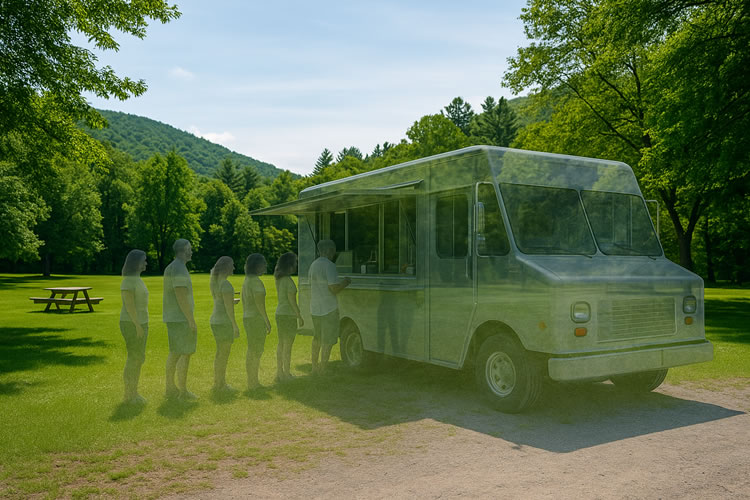
Texas will launch a statewide food truck permitting system on July 1, 2026, allowing mobile food vendors to operate across multiple jurisdictions under a single regulatory framework.
The change is intended to reduce duplication in the permitting process. Instead of requiring vendors to obtain separate approvals in each city or town, the state will centralize key aspects of licensing, particularly those tied to health and safety inspections. Local governments will retain authority over issues such as zoning, traffic, and site-specific concerns, but the core approval process will no longer restart at every municipal boundary.
The approach reflects a broader policy shift: treating food trucks as inherently mobile businesses rather than as stationary operations subject to repeated local licensing.
🍁 Make a One-Time Contribution — Stand Up for Accountability in Vermont 🍁
Vermont’s two-layer system
Vermont operates under a different model.
At the state level, food trucks and similar mobile food units must be licensed through the Department of Health. That process includes inspection and oversight tied to food safety, and it applies regardless of where the vendor operates within the state.
Beyond that, however, municipalities can impose their own permitting requirements.
Cities and towns typically regulate food trucks under peddler or itinerant vendor ordinances. These often require proof of state licensing, insurance documentation, and local applications. Fees vary widely. In Burlington, for example, vendors must submit multiple forms and pay licensing fees that depend on where they operate within the city. Winooski’s fee structure includes annual charges that can reach into the hundreds or more, depending on location. Other municipalities, including South Burlington and Essex Junction, maintain their own permitting systems with separate requirements.
The result is a decentralized system in which a vendor operating in multiple communities may need to navigate multiple sets of rules.
Costs that can stack
Because food trucks are designed to move between locations, the structure of local permitting has a direct effect on operating costs.
Each municipality may require its own application, fee, and approval process. Even when requirements overlap — such as proof of state health licensing or insurance — vendors may still need to resubmit documentation and pay additional fees.
In some cases, fees are tied to specific districts or locations within a municipality, creating additional layers of cost depending on where a vendor operates.
For small businesses, those costs can accumulate quickly. A vendor operating across several towns may face multiple annual or recurring fees, in addition to the initial state license.
How fees are supposed to work
Under Vermont law, municipalities have the authority to regulate businesses and issue permits, including for mobile vendors. They may also charge fees associated with those permits.
At the state level, fee policy requires that charges be “reasonably and directly related” to the cost of providing a service. While municipalities set their own fee structures, that same general principle is often used as a benchmark for evaluating whether a fee reflects administrative costs or extends beyond them.
In practice, that distinction matters because regulatory fees are generally understood to cover the cost of administering a program — including application review, processing, and enforcement — rather than serving as broad revenue tools.
This principle is not limited to food trucks. It applies across a wide range of local permits and licenses.
Courts typically give municipalities some flexibility, and fees do not need to match costs exactly. But the closer a fee tracks the actual work required, the easier it is to justify.
A look at the numbers
One way to evaluate that relationship is to compare typical municipal labor costs with the work involved in issuing a permit.
In Vermont, a zoning administrator or similar official — often the staff responsible for reviewing vendor permits — typically costs a municipality on the order of $40 to $50 per hour when salary, benefits, and overhead are included.
Even assuming a relatively thorough review process, a single permit might involve a few hours of staff time. That could include application intake, coordination with other departments, and recordkeeping.
Using those assumptions, the administrative cost of issuing a permit could reasonably fall in the range of $150 to $300.
Fees within that range align closely with the expected cost of providing the service. Higher fees may still be justified, particularly if they reflect additional enforcement, inspections, or ongoing administrative work. But as fees increase, the connection between cost and price becomes a more central question.
The issue can become more pronounced when fees are applied repeatedly. If a vendor pays separate fees across multiple jurisdictions — or for multiple locations within the same municipality — the total cost may exceed what would be expected based on administrative time alone.
Policy questions going forward
The contrast between Texas and Vermont highlights two different approaches to regulating mobile vendors.
Texas is moving toward a model that reduces duplication by centralizing key approvals at the state level. Vermont, by contrast, maintains a system in which local governments play a larger role in permitting, resulting in variation from one community to another.
That variation allows municipalities to address local conditions, but it can also create inconsistencies and additional costs for businesses that operate across town lines.
For lawmakers, the question is not simply whether food trucks should be regulated. It is how that regulation should be structured — and whether the current balance between state oversight and local control is producing predictable and proportional outcomes.
As other states experiment with statewide permitting systems, Vermont may face increasing pressure to examine whether its existing framework remains the most effective approach.
For now, food truck operators in Vermont continue to navigate a system where approval does not end at the state level, and where the cost of doing business can depend as much on municipal boundaries as on the business itself.
Dave Soulia | FYIVT
You can find FYIVT on YouTube | X(Twitter) | Facebook | Instagram
#fyivt #Vermont #FoodTrucks #LocalGovernment
Support Us for as Little as $5 – Get In The Fight!!
Make a Big Impact with $25/month—Become a Premium Supporter!
Join the Top Tier of Supporters with $50/month—Become a SUPER Supporter!


 Subscribe to RSS





Leave a Reply