

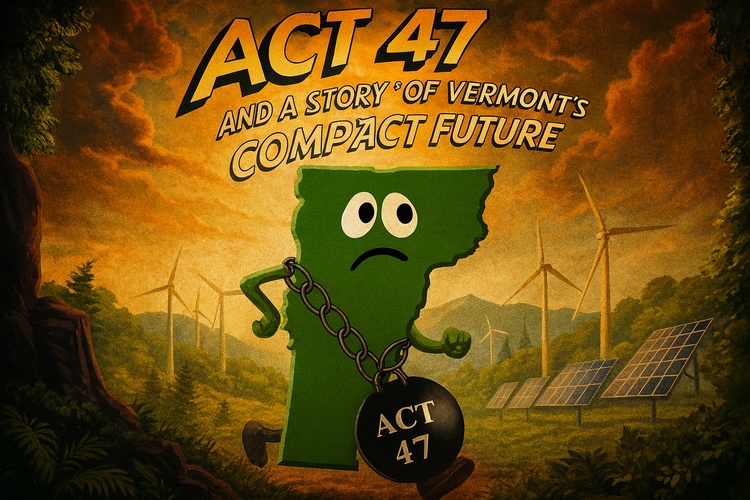
In the Vermont of 2042, Saturdays begin the same way they have since Act 47’s implementation era: with the chirp of the municipal transit app reminding residents that the Weekend Rural Reconnection Shuttle leaves promptly at 9:15 a.m.
Stepping out of your Burlington Micro-Dwelling Cluster™ — a tasteful 380-square-foot unit stacked among dozens in what was once a quiet single-family neighborhood — you make your way down the solar-shaded pedestrian path. The EV charging canopy hums overhead. Parking, of course, does not exist anymore; such “legacy land uses” were deprecated years earlier. You join the line of fellow residents, reusable mugs and state-issued hiking permits in hand, waiting for eBus 14B to whisk everyone to their allotted slice of countryside.
The irony is familiar by now: Vermont’s countryside, once defined by dispersed farms, private woodlots, and homes on winding back roads, now functions more like a curated natural exhibition. Conservation, electrification, and statewide zoning alignment have turned vast areas into a network of “Protected Natural Immersion Zones,” where visitors are encouraged to walk mindfully, stay on the interpretive paths, and avoid disturbing the rewilding marmot colonies.
You disembark at Scenic Access Point A-17 — what locals used to call “the Johnson place.” A QR code sign welcomes you to Rural Vermont: A Natural Heritage Experience™. Your group ambles along the designated half-mile loop. At the turnaround, a staff interpreter reminds you not to wander; housing here has been off-limits since the buildable-land realignment of the 2030s.
After your prescribed three-hour sojourn in what Vermonters once simply called “being outside,” the e-bus returns you to your compact dwelling zone. You return to your living pod, comforted by the knowledge that although you no longer live anywhere near Vermont’s fabled open spaces, you may continue to visit them — on weekends, and only by bus.
It’s a charming future, in its way. Or perhaps it’s a preview of what can emerge when tightening land limits and state-driven zoning mandates converge.
And that brings us back to the present.
ACT 47: What’s Actually Being Mandated?
Vermont today is not 2042, but the structural forces shaping land use are already at play. As FYIVT reported this week, Vermont’s buildable land base is dramatically smaller than most residents realize. Between conservation lands, Current Use enrollment, federal holdings, steep slopes, wetlands, and other physical constraints, only a small fraction of the state remains realistically suitable for development.
That narrowing land base forms the backdrop for Act 47, a sweeping 2023 housing law that represents one of the most significant shifts of zoning authority from municipalities to the state in Vermont’s modern history.
Here’s what Act 47 actually does — in plain terms.
1. Forces Higher Density in Serviced Areas
In any district with municipal water and sewer, towns must now allow:
- At least five dwelling units per acre, and
- Fourplexes as a permitted use, not subject to discretionary review.
This effectively eliminates the ability of towns to preserve lower-density patterns in their serviced neighborhoods.
(Act 47, Sec. 2)
2. Makes Duplexes Universal in Residential Zones
Every zoning district that allows year-round residential development must now treat duplexes the same as single-family homes — by right.
This means municipalities can no longer limit entire neighborhoods to single-family dwellings.
(Act 47, Sec. 2)
3. Restricts Local Ability to Require Parking
Municipalities are now prohibited from requiring more than:
- One parking space per dwelling unit in serviced districts
- 1.5 spaces in unserved rural districts
This dramatically alters development patterns and effectively pushes towns toward walkability-focused urban forms, regardless of local preferences.
(Act 47, Sec. 1)
🍁 Make a One-Time Contribution — Stand Up for Accountability in Vermont 🍁
4. Reduces Local Discretion in Development Review
Municipal panels may no longer:
- Require larger lot sizes than the zoning minimum
- Reduce building footprints or heights below what zoning already allows
- Limit density or impose additional parking beyond state caps
Unless a development violates a nondiscretionary environmental standard, towns must allow it to proceed as-of-right.
(Act 47, Sec. 10)
5. Mandates ADU Accommodation and Restricts Private Covenants
Accessory dwelling units (ADUs) must be permitted under far more flexible standards, and private deed restrictions may no longer:
- Require minimum house sizes
- Restrict ADUs
- Mandate parking beyond state allowances
This is an unprecedented preemption of private land-use controls.
(Act 47, Sec. 20)
6. Loosens Act 250 for Certain Dense Housing Projects
Projects of up to 25 units in designated areas can bypass Act 250 review until 2026, accelerating infill and urban densification.
(Act 47, Sec. 16)
THE COMMON THREAD
When you pair Vermont’s shrinking pool of developable land with Act 47’s aggressive push toward compact, high-density, walkable development, you get a clear directional trend:
Growth must happen in tight, vertical, centrally planned ways — because the land base no longer supports dispersed settlement, and state law now prohibits towns from steering otherwise.
The dystopian satire at the top of this article may be fiction.
But the pressures shaping Vermont’s future are very real.
Dave Soulia | FYIVT
You can find FYIVT on YouTube | X(Twitter) | Facebook | Instagram
#fyivt #vermont #housingpolicy #act47
Support Us for as Little as $5 – Get In The Fight!!
Make a Big Impact with $25/month—Become a Premium Supporter!
Join the Top Tier of Supporters with $50/month—Become a SUPER Supporter!


 Subscribe to RSS




Leave a Reply