

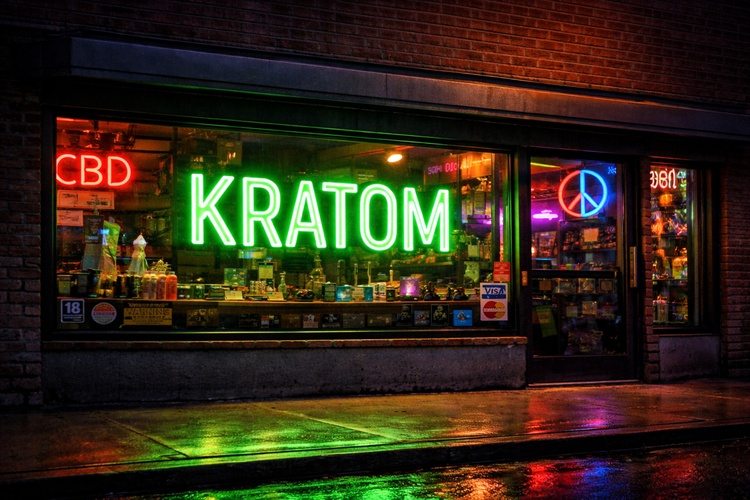
A bill introduced by Rep. Troy Headrick ( I – Chittenden-15 ) and Rep. James Gregoire ( R – Franklin-6 ) would establish a comprehensive regulatory framework for kratom products sold in the state, including mandatory product registration, laboratory testing standards, labeling requirements, and criminal penalties for violations.
H.416, titled the “Kratom Consumer Protection Act,” would add a new subchapter to Vermont law governing products derived from Mitragyna speciosa, commonly known as kratom. The measure has been referred to committee for further review.
Scope and Definitions
The bill defines kratom as the plant Mitragyna speciosa or any part of the plant. A “kratom product” would include any finished article containing fresh, dehydrated, or dried leaf material, as well as kratom extracts.
The legislation applies to processors, distributors, and retailers operating in Vermont. It also covers “kratom food service establishments,” defined as licensed food service businesses that sell kratom beverages prepared on-site or offer prepackaged kratom drinks.
Independent laboratory testing under the bill must be conducted by a laboratory accredited under ISO/IEC 17025 standards.
🍁 Make a One-Time Contribution — Stand Up for Accountability in Vermont 🍁
Mandatory Product Registration
Under the proposal, processors or distributors would be required to register annually with the Vermont Department of Health any kratom product intended for sale or distribution to consumers in the state.
Registrants would pay a fee, subject to annual adjustment, designed to cover administrative costs associated with processing registrations and maintaining a publicly accessible kratom product registry on the Department’s website. The registry would allow retailers to verify whether a product is authorized for sale in Vermont.
Registration applications would need to include:
- Sworn assurances that any facility where the product was prepared, manufactured, or maintained holds a valid FDA food facility registration
- Evidence demonstrating a reasonable basis to believe the product is safe for consumption under the conditions of use stated on its label
- A certificate of analysis from an independent laboratory showing compliance with statutory requirements
- Sworn assurances that the product complies with the bill’s prohibitions
Products containing the same kratom ingredients in the same approved delivery form could be grouped under a single registration, even if sold in different container sizes.
Product Prohibitions
The bill prohibits the preparation, sale, or distribution of kratom products that contain dangerous non-kratom substances, including controlled substances under state or federal law.
Products may not be mixed with compounds known to inhibit certain liver enzymes, unless specifically permitted by Department rule. Kratom extract products must comply with residual solvent limits established by the U.S. Pharmacopeia.
The legislation also bars products that contain synthesized material, defined as chemically or biosynthetically created alkaloids or derivatives rather than those produced through traditional preparation methods such as heating or extraction.
In addition, kratom products may not be sold if they are combustible, intended for vaporization, injectable, packaged in a manner considered attractive to children, or not registered with the Department.
Labeling Requirements
The bill establishes detailed labeling standards for kratom products sold in Vermont, unless preempted by federal law.
Required label elements would include:
- A recommendation against use by individuals under 21 years of age or who are pregnant or breastfeeding
- A recommendation to consult a healthcare professional prior to use
- A statement that kratom may be habit forming
- The federal dietary supplement disclaimer stating the product has not been evaluated by the Food and Drug Administration
- The name and place of business of the registering processor or distributor
- Instructions for use, including serving size, maximum recommended servings within a 24-hour period, and number of servings per container
- Disclosure of kratom alkaloid content, including Mitragynine and 7-hydroxymitragynine levels
A kratom food service establishment serving beverages prepared on-site would be required to provide this information directly to customers or prominently display it near the point of sale.
The bill also restricts marketing for products containing more than two percent 7-hydroxymitragynine, prohibiting them from being labeled or marketed as kratom products or as derivatives of mitragynine.
Enforcement and Penalties
H.416 establishes both civil and criminal penalties for violations.
Knowingly selling an unregistered kratom product could result in fines of up to $5,000 per product for a first violation and up to $10,000 for subsequent violations involving the same product. A third or subsequent violation could result in a two-year prohibition on selling that product.
Knowingly selling kratom intended for human ingestion to an individual age 21 or younger would carry criminal penalties of up to one year of imprisonment, a fine of up to $1,000, or both for a first offense. Penalties increase for subsequent offenses.
Additional criminal penalties apply to preparing or selling kratom products that contain controlled substances or synthetic mitragynine, synthetic 7-hydroxymitragynine, or other synthetically derived compounds of the plant.
The Department of Health would have authority to require updated certificates of analysis upon receiving reports of alleged violations. If a registrant fails to provide required documentation within a specified time frame, the Department could revoke the product’s registration and issue a stop-sale order. The Department may also require independent third-party testing at the registrant’s expense.
Retailers who relied in good faith on representations from a processor or distributor would not be considered in violation.
Regulatory Framework Rather Than Ban
Kratom is not classified as a controlled substance under federal law. H.416 does not propose prohibiting kratom in Vermont. Instead, it establishes a regulatory structure centered on product registration, laboratory verification, labeling transparency, and enforceable compliance mechanisms.
The measure now awaits committee consideration.
Dave Soulia | FYIVT
You can find FYIVT on YouTube | X(Twitter) | Facebook | Instagram
#fyivt #Vermont #Kratom #VTleg
Support Us for as Little as $5 – Get In The Fight!!
Make a Big Impact with $25/month—Become a Premium Supporter!
Join the Top Tier of Supporters with $50/month—Become a SUPER Supporter!


 Subscribe to RSS



Leave a Reply