

When NewsNation host Chris Cuomo squared off with Bill O’Reilly on April 8 over Iran’s nuclear program, the argument centered on whether 60% enriched uranium represents a real threat. Cuomo’s position — that enriched uranium and a deployable weapon are two different things — is defensible as policy debate. But the science underneath it is being presented incorrectly, and what the international nuclear watchdog community has actually documented on the subject deserves a closer look.
The Sedan and the Race Car
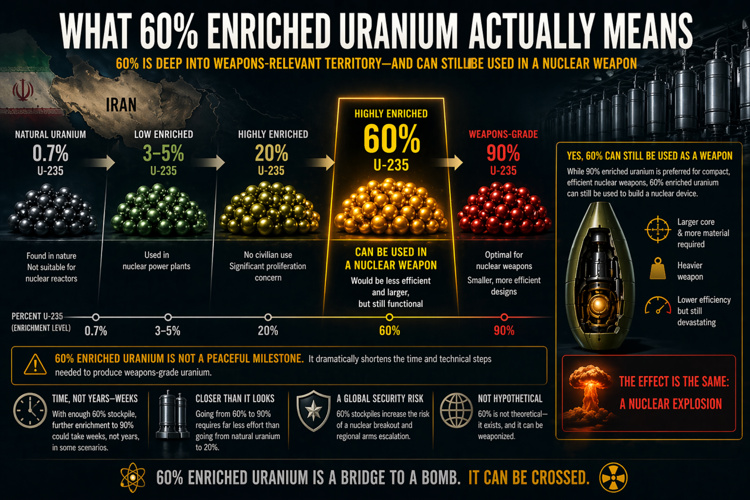
Here is the part that almost never gets explained clearly: “weapons grade” uranium — typically defined as 90% enriched U-235 — is a performance threshold, not an on/off switch. Think of 60% enriched uranium as a sedan and 90% as a race car. They are both cars. They both go. The race car is faster and more efficient, but the sedan will still get you where you’re going — you just need more of it and a slightly different route.
The Bulletin of the Atomic Scientists — the publication that sets the Doomsday Clock and is nobody’s idea of a right-wing outlet — stated this plainly in July 2025, nine months before the Cuomo-O’Reilly exchange: the assertion that Iran needs weapons-grade uranium to build a nuclear explosive device is simply wrong. The IAEA itself classifies any uranium enriched above 20% as a “direct use” material — meaning it can be used to manufacture a nuclear explosive device without further enrichment. Iran is at 60%. That is three times the IAEA’s own weapons-usable threshold.
The math on Iran’s stockpile is not ambiguous. At 60% enrichment, Iran’s 408 kilograms of highly enriched uranium could be used to make roughly 6 to 7 nuclear weapons of an implosion type — without enriching a single additional gram. If further enriched to 90%, that stockpile could allow Iran to build as many as 10 nuclear bombs, according to IAEA Director General Rafael Grossi. And the remaining enrichment work? Getting uranium from its natural state to 60% enriched represents 99% of the total enrichment effort. The final climb to weapons-grade 90% is the last 1%. The hard part, in other words, is done.
🍁 Make a One-Time Contribution — Stand Up for Accountability in Vermont 🍁
The Part Nobody Mentions: The Trigger
Fissile material is only half the equation. A nuclear weapon also requires a neutron initiator — the trigger that starts the chain reaction at precisely the right nanosecond. This is where the conversation almost always stops, and where the documented record is most alarming.
This is not speculation. The IAEA’s own May 2025 comprehensive safeguards report — filed weeks before the June strikes — concluded that Iran used undeclared uranium metal at the Lavisan-Shian facility in Tehran in 2003 to produce explosively-driven neutron sources — the initiator component at the core of an implosion-type nuclear weapon. That same year, neutron detector housings built at Lavisan-Shian were deployed at a separate military test site called Marivan, where the IAEA confirmed Iran conducted four full-scale hemispherical implosion tests. The agency assessed that the neutron detectors were intended to measure output from the initiator during those tests.
The IAEA further documented that Iran’s weapons-related activities included computer modeling of implosion and nuclear yield, high explosive tests simulating a nuclear explosion, and construction of containment vessels at military sites for that testing. Neutron initiator development has no civilian application.
Following IAEA inquiries, all four sites connected to that program — Lavisan-Shian, Varamin, Marivan, and Turquzabad — underwent what the agency formally documented as sanitization: buildings demolished, ground scraped, containers removed. The report notes the cleanup at each location began after the IAEA signaled interest in that site.
The agency’s formal conclusion, in paragraph 77 of the report, is that those locations were part of an undeclared structured nuclear programme carried out by Iran until the early 2000s involving undeclared nuclear material. Paragraph 83 states that the agency cannot determine whether the nuclear material at those sites has been consumed, mixed with declared material, or remains outside of safeguards. The current location of that material remains unknown.
The Incomplete Conversation
Chris Cuomo’s argument, stripped to its core, is that 60% enriched uranium isn’t weapons-grade, that Iran still has a long way to go, and that the threat is being overstated. That’s a position worth examining — but only if the science supports it. It doesn’t.
The IAEA’s own classification system defines weapons-usable material as anything enriched above 20%. The Bulletin of the Atomic Scientists stated plainly in July 2025 that Iran’s 60% stockpile can be used to build nuclear explosive devices without further enrichment — fewer devices, less efficient ones, but functional ones. The sedan gets you there. The remaining 1% of enrichment work gets you the race car. Iran has already done the other 99%.
The trigger mechanism work documented in the IAEA’s May 2025 report — implosion tests, neutron initiators, high-explosive containment chambers — has no civilian explanation. The threat picture isn’t what Cuomo described. The science isn’t what Cuomo described. Reasonable people can disagree about what to do about Iran. They shouldn’t have to disagree about what Iran has.
Dave Soulia | FYIVT
You can find FYIVT on YouTube | X(Twitter) | Facebook | Instagram
#fyivt #IranNuclear #KnowTheFacts #NuclearThreat
Support Us for as Little as $5 – Get In The Fight!!
Make a Big Impact with $25/month—Become a Premium Supporter!
Join the Top Tier of Supporters with $50/month—Become a SUPER Supporter!


 Subscribe to RSS





Leave a Reply