

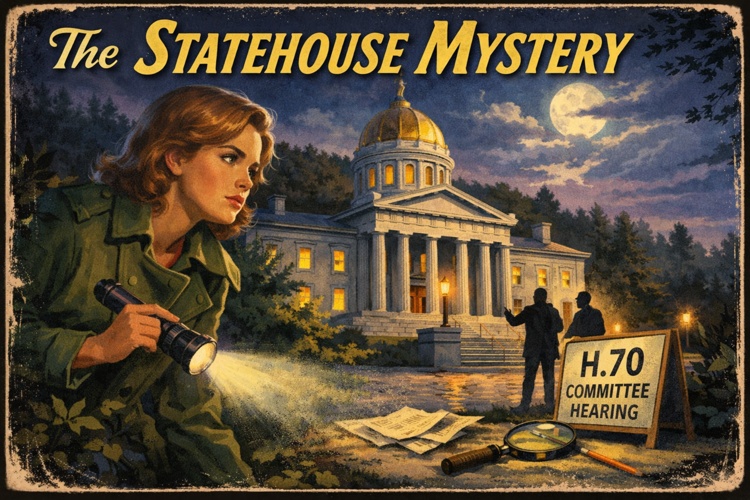
A motion to vote on H.70 briefly disrupted a Feb. 27 hearing of the Vermont House Committee on Environment and Energy, highlighting both a procedural dispute among lawmakers and a broader debate over how the state defines conserved land.
Near the end of the hearing, Rep. Rob North ( R – Addison-3 ) moved that the committee vote immediately on H.70. Another member seconded the motion.
The committee did not proceed to debate or vote on the motion. Instead, the chair moved the committee into a break and the meeting concluded without action on the bill.
The moment came after an earlier exchange in which committee members raised concerns about limits on public testimony and the timeline for further discussion of the bill.
At the start of the hearing, Committee Chair Rep. Amy Sheldon ( D – Addison-1 ) indicated that witnesses would be limited to roughly ten minutes so the committee could hear from everyone scheduled to testify.
Later in the meeting, Rep. Mike Tagliavia ( R – Orange-1 ) objected to the limit, saying that restricting testimony in what he described as the “people’s house” prevented members of the public from fully presenting their views.
Sheldon responded that the hearing represented “the beginning of a conversation” about the bill. Near the end of the meeting, however, she also said there was “no guarantee” the committee would be able to continue the discussion after the upcoming Town Meeting Day legislative break.
The exchange was followed by North’s motion to vote.
🍁 Make a One-Time Contribution — Stand Up for Accountability in Vermont 🍁

What Would H.70 Do?
H.70 would amend Vermont’s Act 59 conservation planning framework by requiring that land enrolled in the Use Value Appraisal (UVA) program, commonly known as Current Use, be included in the state’s conserved lands inventory.
Under current planning definitions used in Act 59, conserved land generally refers to land permanently protected through mechanisms such as conservation easements. The bill would direct planners to also account for land enrolled in Current Use when compiling statewide conservation inventories.
Current Use is Vermont’s largest land stewardship program, covering more than 2.5 million acres of forest and agricultural land. The program allows qualifying land to be taxed based on its agricultural or forestry value rather than potential development value, provided the land remains in active production and follows approved management plans.
Supporters of H.70 argue that, while Current Use is not permanent conservation, the scale and stability of the program make it functionally similar to long-term land protection. According to the Vermont Department of Taxes, roughly 2.5 million acres are enrolled in Current Use across nearly 20,000 parcels. Annual withdrawals from the program typically represent well under one percent of enrolled acreage in a given year.
Even when land is withdrawn from Current Use, a contingent lien tied to Vermont’s Land Use Change Tax remains attached to the property until development occurs or the tax is paid. That mechanism discourages rapid conversion to development and means land leaving the program does not necessarily return immediately to the development market.
Supporters of H.70 argue that these structural features make Current Use a major component of Vermont’s working landscape and that excluding it entirely from conservation inventories may understate how much land is already being managed for long-term forest and agricultural use.
Debate Over the Definition of “Conserved”
During the hearing, witnesses offered differing views on whether land enrolled in Vermont’s Current Use program should be included in the state’s conservation inventory.
Peter Tucker of the Vermont Association of Realtors said H.70 reflects the practical role Current Use already plays in maintaining Vermont’s landscape and working lands.
Other witnesses emphasized that the program differs from permanent conservation protections because land enrolled in Current Use can eventually be withdrawn from the program.
Lauren Oates of The Nature Conservancy said Current Use is widely supported and plays an important role in land stewardship, but she noted that it serves a different purpose than permanent conservation easements. Many permanently conserved properties are also enrolled in Current Use, she said, describing the relationship between the two programs as overlapping but not interchangeable.
Jamie Fidel of the National Audubon Society of Vermont acknowledged that Current Use represents a major share of Vermont’s conserved landscape, describing it as “probably the most important conservation program” in the state by acreage. His concern, Fidel said, is that formally counting Current Use toward the state’s conservation targets could weaken the intent of the Act 59 planning process. If Current Use acreage were included in the state’s “50 by 50” goal, he said, Vermont could appear to have already met the target, potentially “deflating” the broader conservation planning effort.
The discussion also touched on the difference between permanent conservation protections and land managed under a tax program. Fidel said conservation groups often focus on the long-term durability of protections because landowners can withdraw from Current Use.
Rep. Mike Tagliavia pushed back on that point during the hearing, noting that wildlife habitat exists regardless of a program designation. “None of those birds know that I have a contract,” he said.
Working Lands and Economic Concerns
Testimony also addressed the role of Vermont’s working landscape and the forest economy.
Bill Sargent of the Vermont Forest Products Association warned that policies affecting working lands should consider long-term economic impacts on the forest products industry. He pointed to the closure of a lumber mill in Bennington County and said pressures on the working landscape can accumulate gradually over time.
Supporters of H.70 have argued that recognizing Current Use land within conservation inventories would better reflect the role working lands already play in maintaining Vermont’s rural landscape.
H.70 remains in the House Committee on Environment and Energy for further consideration. It remains to be seen whether the motion to vote made and seconded during the Feb. 27 hearing will be taken up when the committee returns to the bill.
Dave Soulia | FYIVT
You can find FYIVT on YouTube | X(Twitter) | Facebook | Instagram
#fyivt #Vermont #VTPolitics #LandUse
Support Us for as Little as $5 – Get In The Fight!!
Make a Big Impact with $25/month—Become a Premium Supporter!
Join the Top Tier of Supporters with $50/month—Become a SUPER Supporter!


 Subscribe to RSS






Leave a Reply