

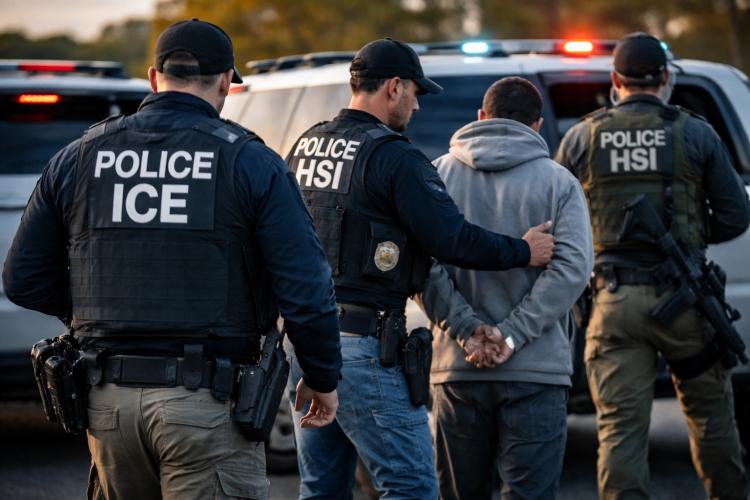
Public debate over Immigration and Customs Enforcement (ICE) often rests on a simple but incorrect assumption: that ICE agents have no authority to stop, detain, or interfere with U.S. citizens. Federal law tells a more complicated story. While ICE has no power to subject citizens to civil immigration enforcement, its agents do possess limited—but real—law-enforcement authority that can apply to anyone, including citizens, depending on the circumstances.
Understanding the legal boundaries requires separating immigration law from criminal law, and rhetoric from statute.
The Two ICEs: ERO and HSI
ICE is not a single monolithic police force. It contains two operational arms with different missions and legal authorities.
Enforcement and Removal Operations (ERO) is responsible for civil immigration enforcement: locating, arresting, detaining, and removing noncitizens who are unlawfully present or otherwise removable under federal law.
Homeland Security Investigations (HSI) conducts criminal investigations involving federal offenses such as drug trafficking, human trafficking, financial fraud, child exploitation, and weapons violations. HSI agents routinely operate like other federal criminal investigators and often work on joint task forces.
This distinction matters because HSI agents generally exercise broader criminal arrest authority than ERO officers, even though both are commonly referred to as “ICE agents.”
ICE’s Core Immigration Authority
ICE’s basic immigration powers are set out in the Immigration and Nationality Act (INA), primarily 8 U.S.C. § 1357 (INA §287).
Under this statute, immigration officers may:
- Question individuals believed to be noncitizens about their right to be in the United States.
- Arrest noncitizens without a warrant if there is reason to believe they are unlawfully present and likely to escape before a warrant can be obtained.
- Conduct certain searches and vehicle boardings within 100 air miles of the U.S. border, as defined by federal regulation.
Critically, these powers apply to noncitizens. U.S. citizens cannot be arrested, detained, or removed on a civil immigration basis because they are not subject to immigration law.
That is where many public explanations stop—and where confusion begins.
ICE and Criminal Law Enforcement
Although ICE’s primary mission is immigration enforcement, federal law does grant ICE agents limited authority to enforce criminal law.
Under 8 U.S.C. § 1357(a)(5), immigration officers may make warrantless arrests for federal offenses committed in their presence, but only under narrow conditions and typically when acting in connection with immigration duties.
More significantly, many HSI agents operate under 19 U.S.C. § 1589a, a statute originally tied to customs enforcement. This law authorizes designated federal officers to:
- Carry firearms
- Execute warrants
- Make warrantless arrests for any federal offense committed in their presence
- Arrest for federal felonies based on probable cause, even if not committed in their presence
When operating under this authority, HSI agents have arrest powers comparable to other federal law-enforcement officers. Those powers apply regardless of a person’s citizenship.
Brief Detentions and the Fourth Amendment
Even when no arrest occurs, ICE agents—like all law-enforcement officers—are governed by the Fourth Amendment’s rules on stops and seizures.
ICE’s own regulations, 8 C.F.R. § 287.8(b), permit officers to briefly detain any person for questioning if they have reasonable suspicion, based on specific and articulable facts, that the person is engaged in a federal offense or is unlawfully present in the United States.
For citizens, the “unlawfully present” justification should disappear once citizenship is established. But the regulation still allows brief detention when reasonable suspicion of a federal crime exists. This is not unique to ICE; it reflects general constitutional law.
What Is a Terry Stop?
The concept underlying these brief detentions comes from the Supreme Court’s 1968 decision in Terry v. Ohio.
A Terry stop allows police to temporarily detain a person for investigative purposes when the officer has reasonable suspicion that criminal activity is afoot. This standard is lower than probable cause and must be based on specific facts—not hunches or generalizations.
Key features of a Terry stop:
- It is temporary and limited in scope.
- The person is not under arrest.
- The officer may ask questions and, in some cases, conduct a limited pat-down for weapons if there is reason to believe the person is armed and dangerous.
ICE agents, like all federal officers, may conduct Terry stops when the legal standard is met. Citizenship does not exempt a person from such a stop.
🍁 Make a One-Time Contribution — Stand Up for Accountability in Vermont 🍁
Protests, Interference, and Federal Crimes
Peaceful protest is protected by the First Amendment. Physical interference with law-enforcement operations is not.
If conduct crosses into assaulting, resisting, or impeding federal officers, ICE agents may rely on federal criminal statutes such as 18 U.S.C. § 111, which criminalizes forcibly interfering with federal officials performing their duties. In such cases, agents may detain or arrest individuals, including citizens, based on ordinary criminal law standards.
The History
Much of the authority exercised by ICE agents today predates the agency itself and did not originate from recent legislation. The statutes and doctrines summarized below span congressional action, executive regulation, and Supreme Court case law developed over several decades. While policies and enforcement priorities change between administrations, the underlying legal framework governing stops, arrests, and investigations has remained largely stable, with no major recent statutory expansion of ICE’s core authority.
Timeline Snapshot: Key Authorities Governing ICE Enforcement
| Statute / Doctrine | Origin | Major Recent Revision? |
|---|---|---|
| 8 U.S.C. § 1357 (Immigration Stops & Arrests) | Immigration and Nationality Act of 1952; codified and refined through the 1960s | No major statutory rewrite in recent decades |
| 8 C.F.R. Part 287 (DHS / ICE Regulations) | Implemented following the creation of the Department of Homeland Security (mid-2000s) | Periodic regulatory updates; no fundamental expansion of authority |
| 19 U.S.C. § 1589a (Customs / Federal Arrest Authority) | Customs enforcement authority predating DHS; applied to ICE/HSI following the 2002 Homeland Security reorganization | No major recent change |
| Terry Stop Doctrine (Case Law) | Established by Terry v. Ohio (1968) | Continues to evolve through court decisions, not statute |
What ICE Cannot Do
ICE agents cannot:
- Detain U.S. citizens on civil immigration grounds.
- Issue immigration detainers against citizens.
- Remove citizens from the United States.
- Ignore constitutional limits on searches, seizures, or use of force.
Administrative immigration warrants do not authorize forced entry into homes without consent or exigent circumstances, and ICE operations remain subject to Fourth Amendment constraints.
The Bottom Line
The claim that ICE has “no authority over citizens” is false. The equally simplistic claim that ICE can do whatever it wants is also false.
In reality:
- ICE has no civil immigration authority over citizens.
- ICE agents may stop, detain, or arrest citizens under limited circumstances tied to federal criminal law and constitutional standards.
- All ICE enforcement actions—immigration or criminal—are constrained by the Fourth Amendment and use-of-force jurisprudence.
Understanding these distinctions is essential to evaluating real-world encounters without collapsing legal analysis into slogans.
Dave Soulia | FYIVT
You can find FYIVT on YouTube | X(Twitter) | Facebook | Instagram
#fyivt #immigrationlaw #civilrights #federalauthority
Support Us for as Little as $5 – Get In The Fight!!
Make a Big Impact with $25/month—Become a Premium Supporter!
Join the Top Tier of Supporters with $50/month—Become a SUPER Supporter!


 Subscribe to RSS





Leave a Reply