

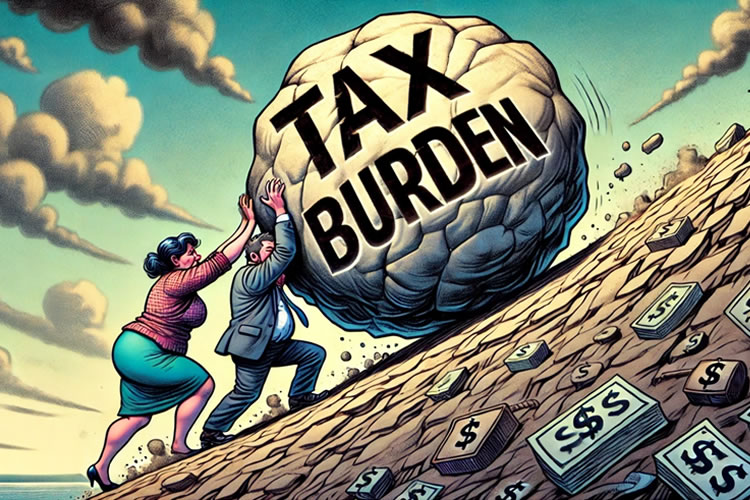
On paper, Vermont’s tax burden appears moderate: according to the Institute on Taxation and Economic Policy (ITEP), the combined state and local tax burden ranges from 6.3% for the wealthiest households to 10.6% for the lowest-income earners. But when actual Vermonters break down their paychecks and monthly bills, the numbers often feel much higher—sometimes pushing into the 30–40% range before factoring in basic living costs like housing, fuel, and food.
A closer look at the real-world costs reveals why.
Start with Income Taxes—But Don’t Stop There
For a household earning Vermont’s median income of $81,200, federal income taxes alone take a 12%–22% bite depending on deductions. Payroll taxes (Social Security and Medicare) strip away another 7.65%. State income taxes, based on Vermont’s progressive brackets, typically remove 6–8% more. When combined, a typical middle-class earner might see 24% or more of gross income gone before ever touching their paycheck.
But that’s only the beginning.
Property Taxes: The Silent Pillar
Homeowners in Vermont pay some of the highest property taxes in the nation. According to the state’s Fiscal Facts 2025 report, the Education Fund—funded largely by property tax—makes up more than 26% of total state revenue, with nearly $2 billion raised through property taxes annually. For a modest $250,000 home, it’s common to see $5,000 to $7,000 in annual property tax bills, or another 6–8% of income.
For renters, property taxes are baked into rent—landlords pass those costs along, often silently.
Fees, Licenses, Surcharges, and the Cost of Existing
Vermont’s budget isn’t built solely on traditional taxes. The “other revenues” section of the Joint Fiscal Office (JFO) reports adds up quickly: vehicle registrations, hunting and fishing licenses, septic permits, dog licenses, emissions inspections, snowmobile tags, and more. Utilities tack on surcharges for energy efficiency and telecom services. Fuel oil is taxed. Even broadband service includes layered fees and state universal service charges.
It’s easy to underestimate the burden here—but when combined, these often mandatory outlays can add another $1,000–$3,000 annually per household. Add in Vermont’s 6% sales tax on most goods (plus local option taxes in some cities), and the total government take creeps ever higher.
So How Much Do Vermonters Really Pay?
The Economic Review and Revenue Forecast Update estimates total state spending in Vermont at $8.7 billion in FY2024. Divide that by Vermont’s ~645,000 residents, and the cost per capita is about $13,500. But that includes children and others who pay little or nothing in direct taxes.
Based on the ITEP and Census data, roughly 400,000 Vermonters are taxpaying adults. When that denominator is applied instead, the per-adult cost of Vermont government climbs to about $21,750 per person.
Not every Vermonter pays that much—some contribute little, others bear far more. But across income brackets, the message is clear: the real feel of Vermont’s tax burden is significantly higher than the state’s official rate sheets suggest.
🍁 Make a One-Time Contribution — Stand Up for Accountability in Vermont 🍁
How Vermont Compares
Compared to large, urbanized states like California, New York, or Texas, Vermont lacks a deep corporate tax base. It doesn’t have Fortune 500 headquarters or sprawling oil fields. As a result, the tax load falls more heavily on individuals, especially the middle class.
Per Urban Institute data, Vermont ranks among the top 5 states in per-capita state and local spending, rivaling places with far greater economies of scale. In raw terms, Vermont spends more per person than dozens of metro areas with populations above 650,000, despite being a rural state with relatively limited industry.
When Do Taxes Break Households?
A 2022 Harvard Joint Center for Housing Studies report reaffirmed the federal government’s “30% housing burden” rule, meaning no more than 30% of income should go to housing. But that 30% is typically calculated off gross income, not post-tax income. In a place like Vermont—where taxes and fees may consume 30–40% of household income—hitting both the tax burden and the housing affordability threshold is rare.
“People are tapped out before they’ve paid their rent or bought groceries,” one Barre resident told FYIVT. “The paycheck disappears before it even hits the account.”
Conclusion: A Disconnect Between Paper and Pocketbook
While Vermont officials cite tax fairness and progressive rates, the lived experience of many Vermonters tells a more complicated story. After subtracting income, payroll, and property taxes, then layering in vehicle, energy, and communications fees, the effective take-home income may be less than 60% of gross pay. And that’s before housing, healthcare, childcare, or savings.
Whether one views that as a moral commitment to public goods—or an unsustainable burden—depends on politics and priorities. But by any honest arithmetic, the real-feel tax burden in Vermont is not 7–11%. It’s more like 30–40%, and climbing.
Dave Soulia | FYIVT
You can find FYIVT on YouTube | X(Twitter) | Facebook | Parler (@fyivt) | Gab | Instagram
#fyivt #vermonttaxes #costofliving #fiscaltruth
Support Us for as Little as $5 – Get In The Fight!!
Make a Big Impact with $25/month—Become a Premium Supporter!
Join the Top Tier of Supporters with $50/month—Become a SUPER Supporter!


 Subscribe to RSS





Leave a Reply