

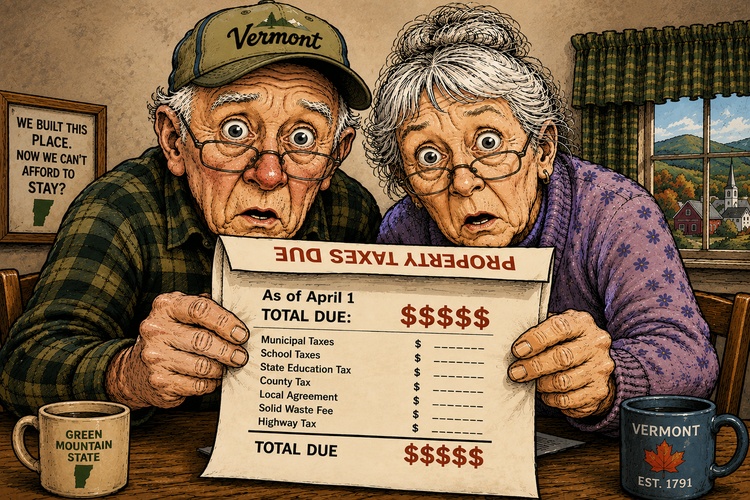
Here's Why Vermont Homeowners Should Pay Attention
Most Vermonters know property values have climbed dramatically over the past several years. What many may not realize is that the State of Vermont believes those values still haven't caught up.
According to the 2026 Property Valuation and Review Report, Vermont estimates that taxable property statewide is currently assessed at only about 70% of its fair market value. That doesn't mean your tax bill is about to jump overnight, but it does mean the state is preparing for more frequent reappraisals designed to close that gap.
For homeowners—particularly those living on fixed incomes—it's worth understanding how the system works before the next assessment notice arrives.
Vermont says there's a $45 billion valuation gap
Every year, the Department of Taxes estimates both the assessed value of Vermont property and what it believes that property would sell for in today's market.
This year's report is eye-opening. The state's education grand list totals approximately $107.9 billion, while the Department estimates the same property has a fair market value of roughly $153.3 billion. That leaves a difference of more than $45 billion statewide.
Residential property makes up much of that gap. Homes on parcels under six acres account for about $47.4 billion in assessed value but are estimated to be worth nearly $68.6 billion. Larger residential properties add another $24.6 billion in assessed value compared with an estimated market value of approximately $34.4 billion.
Combined, Vermont homeowners occupy residential property assessed at about $72 billion that the Department believes is worth nearly $103 billion. That's roughly $31 billion in additional residential value that has yet to be reflected in assessments.
More frequent reappraisals are now the plan
For decades, many Vermont towns went years—sometimes decades—between complete property reappraisals. That's changing.
The Legislature has adopted a statewide system intended to keep assessments much closer to current market values through regular reappraisals. The Property Valuation and Review Report notes that 86 municipalities—roughly one-third of Vermont's cities and towns—last completed a full reappraisal more than ten years ago. Many communities have already scheduled new reappraisals through the end of the decade.
The goal is assessment accuracy and consistency across the state. For homeowners, however, it also means that large increases in assessed value may become more common than they were in the past.
"Revenue neutral" doesn't necessarily mean your bill stays the same
Whenever reappraisals make headlines, local officials often point out that they are "revenue neutral." That statement is generally true—for the town as a whole. If every property increased by exactly the same percentage, tax rates would typically be adjusted downward so the municipality collects roughly the same amount of money.
The problem is that real estate markets rarely move evenly. Lakefront homes may appreciate faster than village homes. One neighborhood may become far more desirable than another. Farmland, commercial property, vacation homes and residential developments often rise at different rates.
When that happens, the tax burden shifts. Some homeowners end up paying less. Others pay considerably more.
For retirees and longtime homeowners living on fixed incomes, that shift can be especially painful because increased property values don't necessarily come with increased income.
What if you just bought your home?
Many people assume that if they recently purchased a home, the purchase price automatically establishes its taxable value. Not necessarily.
According to the Vermont League of Cities and Towns, the Vermont Supreme Court reaffirmed that an arm's-length purchase price is important evidence of fair market value—but it is not the final word.
In the Martinez case, the homeowner purchased a property for $350,000. After appeals, the property's valuation exceeded $492,000, and the Supreme Court upheld that determination. The Court concluded that assessors may consider comparable sales and other valuation evidence rather than relying solely on what one buyer happened to pay.
Simply purchasing a home at a negotiated price does not guarantee that price will become its assessed value.
More than $11 billion is exempt from taxation
Another piece of Vermont's property tax system often receives little attention. The Department of Taxes' 2025 Statutory Exemptions Report identifies approximately 11,131 exempt parcels statewide representing more than $11.3 billion in property value.
These include schools, churches, cemeteries, municipal buildings, state property and qualifying nonprofit organizations. Those exemptions exist because Vermont law specifically provides for them, and many serve obvious public purposes.
Nevertheless, exempt property generally does not contribute to the ordinary property tax base the same way taxable residential and commercial property does, making it another important component of Vermont's overall tax structure.
A heads-up—not a reason to panic
None of this means Vermont is trying to force homeowners from their properties. Nor does it mean every homeowner should expect a dramatic increase in taxes. It does mean Vermont homeowners should pay attention.
As the state moves toward more regular reappraisals, assessments will increasingly reflect today's real estate market rather than yesterday's.
When your town conducts its next reappraisal, don't simply look at the new number. Compare your property with similar nearby homes. Understand how your assessment was determined. If you believe it does not reflect fair market value, Vermont law provides an appeal process.
For many longtime Vermonters, especially retirees, the family home may have gained hundreds of thousands of dollars in paper value over the past decade while household income remained relatively unchanged. Being house-rich doesn't always mean being cash-rich.
As Vermont's new reappraisal cycle moves forward, understanding how your property is valued may be just as important as understanding the tax bill that follows.