

Vermont is fighting a Trump administration proposal that would require states to identify authorized mail voters before the U.S. Postal Service transports their ballots.
Attorney General Charity Clark joined a multistate lawsuit in April challenging President Donald Trump's executive order — officially, Executive Order 14399 — which directed USPS to transmit mail ballots only for voters appearing on approved participation lists. The states argued that the order unlawfully transferred control over election administration from state officials to the federal government. A federal judge blocked the disputed provisions in June, and Vermont later joined a formal objection to the Postal Service's proposed implementing rule.
Vermont has a particularly large stake in the dispute. Unlike states where voters generally request absentee ballots, Vermont automatically mails a general-election ballot to every active registered voter by October 1 of each even-numbered year — a system the Secretary of State's office has defended in a report to the legislature.
The state therefore depends on USPS to distribute hundreds of thousands of unsolicited ballot packages. Its own 2024 figures, however, leave several basic questions unanswered.
Three Numbers for Vermont's Voters
Vermont's published election data offers multiple answers to how many voters were registered during the 2024 general election.
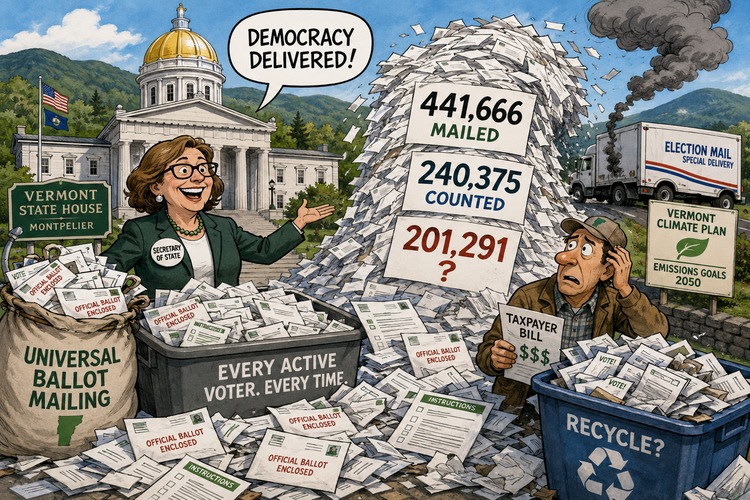
The broadest figure was approximately 522,600 registered voters, per the Vermont Secretary of State's voter-registration data page. Vermont reported 460,415 active registered voters on Election Day to the U.S. Election Assistance Commission, per the 2024 EAVS Vermont Data Brief. Yet the state transmitted only 441,666 mail ballots, according to the same EAVS Vermont Data Brief.
Those figures likely measure different populations. The larger registration total may include challenged or otherwise ineligible-to-vote-without-additional-action records. The Election Day active total may also include people who registered after the universal mailing list was generated.
Still, the differences are substantial.
There were 80,934 fewer ballot mailings than total registrations, and 18,749 fewer mailings than active Election Day voters. The numbers may be reconcilable, but the public-facing reports — including the full 2024 EAVS report and the underlying EAVS survey form and definitions — do not provide one simple total showing precisely how many people qualified for automatic mailing when the ballots were prepared.
That matters because Vermont is arguing that federal verification requirements could prevent eligible voters from receiving ballots. Yet Vermont's own system did not mail ballots to every person included in its published registration totals.
More Than 200,000 Ballots Outside the Absentee Count
The EAC reports that Vermont transmitted 441,666 mail ballots in 2024. Of those, 240,375 were returned and counted through the absentee or mail-ballot process.
That is approximately 54.4 percent.
The difference — 201,291 ballot packages — cannot simply be labeled unused. Vermont allows a voter to bring an unsealed mailed ballot into a polling place, fill it out and place it directly into the tabulator. That voter is recorded as voting in person, even though the physical ballot came from the universal mailing.
Other ballots may have been surrendered, spoiled, replaced, returned as undeliverable, discarded or left untouched.
The honest conclusion is that somewhere between zero and 201,291 mailed ballots may have gone physically unused. Vermont's published statewide summary — including the official 2024 general-election canvass report and the 2024 town-by-town voter-turnout report — does not reveal where within that wide range the actual number falls.
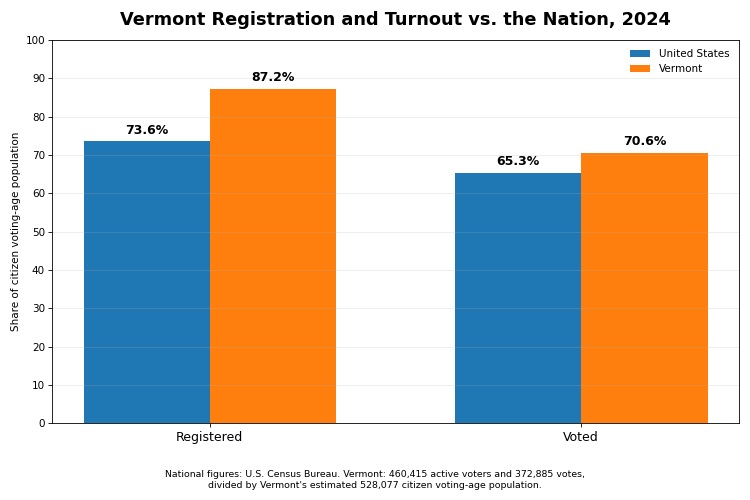
The missing information is notable because Vermont recorded 372,885 total voters in 2024. That means 132,510 voters participated through a method other than the counted absentee-ballot category, even though most had presumably already received a ballot package at home.
Tons of Material, With No Published Carbon Accounting
The physical scale is difficult to ignore.
A Vermont ballot package includes a ballot, instructions and multiple envelopes. Using a rough package weight of one to two ounces, the full 441,666-piece mailing placed approximately 13.8 to 27.6 tons of election material into circulation.
The 201,291 packages outside the counted absentee category alone weighed approximately 6.3 to 12.6 tons under the same napkin-math estimate.
If the contents of those packages were removed and spread flat — using a conservative estimate of 444 square inches for the ballot, instructions and envelopes — they would cover approximately 14 acres, or more than ten regulation football fields.
(Note: the tonnage and acreage figures above are our own napkin-math estimates based on the EAC's transmitted/returned ballot counts, not figures published by the state.)
The estimate is intentionally rough. The state does not appear to publish an exact average package weight, lifecycle emissions analysis, statewide undeliverable total or comprehensive accounting of what happened to every transmitted ballot.
That absence creates an unusual contradiction.
Secretary of State Sarah Copeland Hanzas was a legislative sponsor of H.688, the Global Warming Solutions Act — passed by the Vermont House and Senate and enacted as Act 153 — which converted Vermont's greenhouse-gas goals into legally enforceable emissions requirements.
Her office now administers a program that prints, packages and individually transports hundreds of thousands of ballot packets across Vermont every two years — whether recipients requested them or intended to vote by mail.
Under the previous system, ballots were delivered in bulk to town offices, while voters who actually needed absentee ballots could request them. Universal mailing adds individual printing, packaging, transportation, delivery, return handling and disposal across the entire state.
There may be policy arguments for accepting those costs. Automatic mailing may make voting easier and increase participation. But Vermont appears to have produced no public carbon-footprint analysis comparing universal mailing with centralized polling-place distribution and requested absentee voting.
Vermont is now suing to preserve its authority to operate that system without federal recipient verification.
Before declaring additional verification an intolerable burden, the state might first account clearly for its own voter totals, the final disposition of its mailed ballots, the cost of the program and the tons of paper generated in the name of delivering ballots nobody asked to receive.