

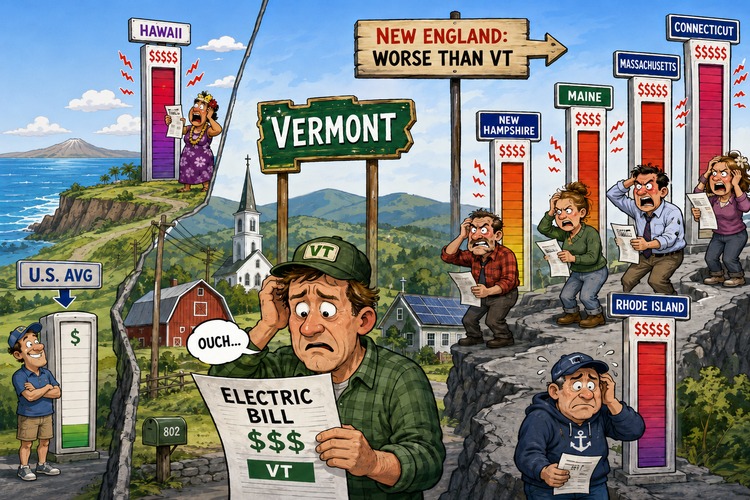
Vermont households paid an average of 24.56 cents per kilowatt-hour for electricity in April, making the state one of the most expensive places in the country to keep the lights on.
The price was about 30 percent higher than the national residential average of 18.83 cents, according to the latest monthly data from the U.S. Energy Information Administration. Among the 50 states and Washington, D.C., Vermont had the tenth-highest residential electricity price.
That sounds bad—and it is.
It also made Vermont the least expensive state in New England.
Expensive Here, Cheap Next Door
Every other New England state posted a higher residential electricity price in April.
Connecticut led the region at 32.24 cents per kilowatt-hour, followed by Massachusetts at 29.45 cents. Maine residents paid 28.42 cents, Rhode Island 28.30 cents and New Hampshire 27.24 cents.
The New England average was 29.49 cents, nearly five cents above Vermont and more than 56 percent above the national average.
That leaves Vermont in an unusual position: nationally expensive, regionally enviable.
A Vermont household using 600 kilowatt-hours in a month would spend about $147 at the statewide average price, before comparing any fixed charges or utility-specific rate structures. The same amount of electricity would cost approximately $113 at the national average and $193 in Connecticut.
Vermont electricity is not cheap. It simply looks cheap inside one of the country's most expensive electric regions.
North Dakota Pays Half as Much
The contrast becomes more dramatic outside the Northeast.
North Dakota had the nation's lowest residential electricity price in April at 12.35 cents per kilowatt-hour—almost exactly half Vermont's price. Idaho followed at 12.70 cents, while Utah and Nebraska were both near 13.3 cents.
At the other end of the scale, Hawaii topped the country at 46.62 cents per kilowatt-hour. California was the most expensive state in the continental United States at 35.25 cents.
The difference between North Dakota and Hawaii approached four-to-one.
For the same 600 kilowatt-hours, a North Dakota household would pay roughly $74 at the statewide average. A Hawaiian household would pay nearly $280. Vermont would land between them at about $147.
Those figures are broad statewide averages, not individual utility tariffs. EIA calculates the average price from residential electricity revenue divided by the amount of electricity sold. Actual bills vary by utility, customer usage, fixed charges, seasonal rates and other adjustments.
Why New England Costs More
Vermont's comparatively favorable position does not isolate it from the forces driving high electric prices throughout New England.
The six states operate within a regional wholesale market administered by ISO New England. Natural gas produced about 55 percent of the electricity generated within the region during 2025, while nuclear power supplied 25 percent. Hydro, other renewables and imported electricity provided much of the remainder.
That dependence on natural gas becomes particularly important during cold weather.
Many New England power plants receive gas through the same constrained pipeline system used to heat homes and businesses. ISO New England says pipeline capacity has expanded only incrementally while demand for natural gas in both heating and electricity generation has grown substantially.
During severe winter weather, heating customers receive priority, leaving some power plants unable to obtain enough fuel. Imported liquefied natural gas can help fill the gap, but deliveries depend on storage capacity, shipping logistics, weather forecasts and international prices.
The region has also retired more than 7,000 megawatts of generating capacity since 2013 or announced retirements expected in coming years. That list includes Vermont Yankee, the 604-megawatt nuclear station that closed in 2014, along with several large coal, oil and nuclear facilities elsewhere in New England.
Meanwhile, each New England state has adopted renewable-energy requirements. Vermont's current standard is scheduled to reach 100 percent renewable electricity for all utilities by 2035, although Vermont uniquely allows large-scale hydropower to count toward that requirement.
Those policies are only part of a retail electric bill. Customers also pay for transmission, distribution, utility operations, power contracts, storm recovery, regulatory programs and other approved costs.
A Statewide Average Hides Local Differences
Vermont's 24.56-cent figure does not represent a universal rate charged to every customer.
The state is served by investor-owned utilities, cooperatives and municipal electric departments, each with its own rates and cost structure. Green Mountain Power serves most Vermont customers, while Burlington Electric Department, Vermont Electric Cooperative, Washington Electric Cooperative and numerous municipal systems serve the remainder.
Some municipal utilities may charge substantially less than the statewide average, while customers elsewhere may pay more. A utility-by-utility comparison would provide a more precise picture of where Vermont electricity is cheapest—and where it is not.
The statewide number nevertheless establishes the larger reality.
Vermonters pay substantially more for residential electricity than the average American. They pay roughly twice what North Dakota residents pay. Yet within New England, Vermont is the bargain.
It is the cheapest expensive electricity in the region.
Comments