

Vermont folklore, modern science, and whether nature really knows what's coming
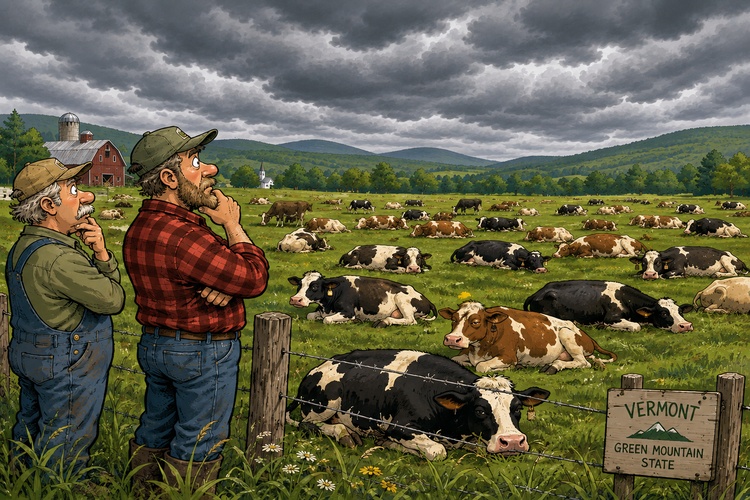
Ask around a Vermont barnyard long enough and someone will give you the rule: when the cows lie down, rain is coming. Eight of ten in the grass, and you can call it 80 percent. It is the kind of forecast that costs nothing, requires no app, and gets repeated with more confidence than most model output. It is also, in the case of the cows, almost certainly wrong — while several of the other tells farmers rely on turn out to have real physics behind them.
The cows are innocent
There is no scientific evidence that cattle lie down because rain is coming. Cows spend up to half their lives lying down to rest and chew cud, which means that at any given moment there is a coin-flip chance of finding a pasture full of reclining animals — storm or sunshine. The Royal Meteorological Society, reviewing the folklore, notes that both events, cows lying down and the sky opening, happen often enough that proving a link between them is nearly impossible.
Herd behavior makes it worse. Cattle copy each other, so when one settles, the rest tend to follow. That produces exactly the all-at-once tableau that looks like a signal. Add a climate where rain is frequent, and a rule with a 50 percent base rate will feel uncanny.
But the animals are not ignoring the weather
That is not the same as saying cattle are indifferent to the atmosphere. They demonstrably are not. Research has found cows tend to stand in hot weather, exposing more skin to cool off more effectively, and their resting patterns shift with humidity and temperature.
Which suggests the folklore is asking the wrong question. The interesting question is not whether cows predict rain. It is whether herd posture tracks a falling barometer — a measurable thing, and one nobody has tested rigorously on a Vermont hillside.
Swallows have physics on their side
If any barn-lore deserves respect, it is the swallows. As pressure falls and humidity climbs ahead of a front, flying insects drop lower to the ground, and insect-eating birds like swallows, swifts and nighthawks follow them down. Birders describe the pattern as one of the more dependable natural signs going, and the mechanism is straightforward: the birds are not forecasting anything, they are chasing dinner.
Watch the field in front of the barn for twenty minutes. If the swallows are skimming the hay, something is changing.
The bugs really do feel the barometer
The insect half of that chain is not folklore at all. It is peer-reviewed. A 2023 paper in Ecology and Evolution found that barometric pressure influences foraging behavior in predatory insects, and other work has documented pressure-driven changes in mating, flight initiation and host-finding across multiple species. Researchers describe the drop as an advance signal of conditions that shorten an insect's life expectancy — so it eats, mates, or shelters accordingly.
Bees do the same thing, which is why beekeepers describe hives going quiet before a storm.
The woolly bear is a fraud
The most famous forecaster in the Northeast is a caterpillar, and it is a fabrication. The legend traces to 1948, when Dr. Howard Curran of the American Museum of Natural History went to Bear Mountain, New York, counted the bands on 15 specimens, and made a winter prediction that ran in the New York Herald Tribune and was picked up nationally. Curran kept at it for eight more years and never confirmed a reliable correlation.
Entomologists now attribute band width to the caterpillar's growth stage, feeding intensity and individual variation — and note that the solid-black ones people panic over are a different species entirely. The National Weather Service files the whole thing under myth.
Red sky is the one that survives
The oldest saying in the book is also the most defensible. In the mid-latitudes, weather systems generally travel west to east, and high pressure loads the low atmosphere with dust and particles that scatter long-wavelength red light. So a red sunset means the sun is shining through clear, dry, high-pressure air to your west — air headed your way. A red sunrise means that high has already passed east of you, with a low potentially behind it.
NOAA's Ocean Prediction Center attaches a caveat: the rule holds only when systems and their clouds are moving west to east, and fails when they track south to north — which happens often enough in Vermont that the sky sometimes lies.
What is actually doing the forecasting
Strip the animals out and a single variable runs through every tell that works. Pressure. The swallows, the insects, the bees, the aching knees, the fish that feed hard ahead of a front — all of it is downstream of the barometer.
Vermont has relatively few automated pressure-reporting stations for a state this mountainous, and conditions in Pittsford routinely diverge from conditions in Burlington. A farmer standing in a field is running a very local sensor network with a sample size of one.
The cows are not predicting anything. The air is. Everything in the pasture, cattle included, is just reading it — some of them better than others.