

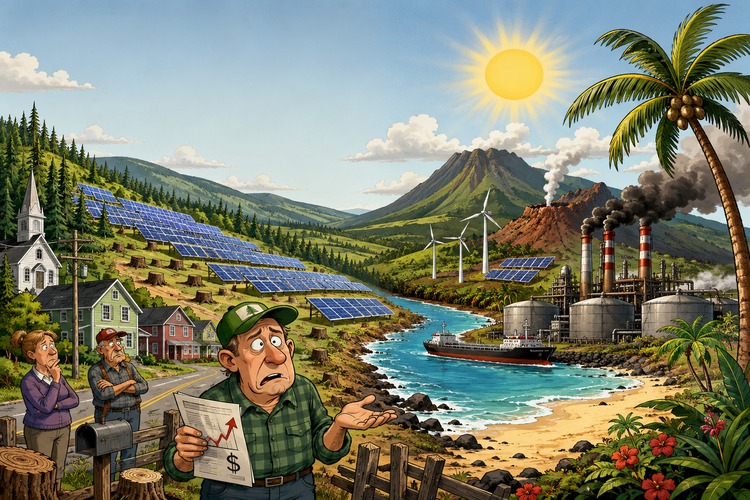
Vermont has a problem.
Residential electricity cost an average of 24.56 cents per kilowatt-hour in April, about 30 percent above the national average of 18.83 cents. That made Vermont the tenth-most-expensive state or district in the country for household electricity.
It was also, remarkably, the cheapest state in New England.
Connecticut residents paid 32.24 cents. Massachusetts and New York were both at 29.45 cents. Maine paid 28.42 cents, Rhode Island 28.30 cents and New Hampshire 27.24 cents. Vermont's painful electric rates therefore manage to look almost reasonable—provided nobody compares them with most of the United States.
North Dakota residents paid just 12.35 cents per kilowatt-hour, roughly half the Vermont price.
And then there is Hawaii.
Sun Above, Wind Around and Fire Below
Hawaii's residential electric price reached 46.62 cents per kilowatt-hour in April—nearly twice Vermont's already-high average and almost four times North Dakota's.
That would be interesting enough by itself. Hawaii, however, may be the most naturally blessed location on Earth for renewable electricity.
It has intense tropical sunlight.
It has steady ocean winds.
It has no dark Vermont winter, no snow-covered solar panels and no heating season resembling anything experienced in northern New England.
It also sits atop volcanic heat.
Hawaii possesses abundant solar energy above it, wind moving around it and geothermal energy beneath it. Yet much of the state's electrical system continues to operate by burning imported petroleum.
The jokes do not require professional assistance.
Petroleum in Paradise
Hawaii has certainly added renewable generation. Solar supplied about 24 percent of the state's electricity in 2025, with roughly two-thirds of that coming from small customer-owned systems. Renewables collectively supplied approximately 34 percent of statewide generation.
Those numbers also mean roughly two-thirds of Hawaii's electricity still came from something else.
Hawaiian Electric's own 2025 figures provide the uncomfortable details. Oil supplied 67.7 percent of electricity on Oahu, 58.5 percent in Maui County and 42.7 percent on Hawaii Island. Across the company's five-island system, renewable resources produced 36.8 percent of generation.
Hawaii's largest population center therefore remains overwhelmingly dependent on oil-fired electricity while sitting beneath some of the finest sunshine in the United States.
Vermont, meanwhile, is covering northern fields with solar installations as state policymakers pursue legally enforceable greenhouse-gas reductions under the Global Warming Solutions Act.
Apparently, Vermont must make solar power work where the sun is low, the days are short and the panels occasionally disappear beneath snow. Hawaii, surrounded by sunlight and trade winds, remains busy unloading petroleum from ships.
Did Anyone Mention the Volcanoes?
Solar and wind have an obvious limitation: they do not necessarily generate electricity when customers need it.
Geothermal power is different. The Hawaii State Energy Office describes it as firm, dispatchable, low-carbon and local. Unlike a solar panel after sunset, geothermal generation can continue operating and help stabilize a grid containing variable wind and solar resources.
Hawaii Island already demonstrates that geothermal is not merely an idea scribbled on a climate consultant's whiteboard. Geothermal supplied 15 percent of that island's Hawaiian Electric generation in 2025. Combined with wind, solar, hydro and biofuels, renewables produced more than half of Hawaii Island's power.
Of course, living on volcanic islands does not mean a power plant can be drilled anywhere someone finds warm dirt. Geothermal development requires suitable underground heat, fluid, permeability, drilling access and transmission. Projects also face environmental, cultural, permitting and community objections.
But Vermont solar projects face land-use fights, transmission limits, local opposition and environmental tradeoffs too. Vermont responds by demanding more solar.
Hawaii responds, in considerable part, by burning more oil.
Vermont's Renewable Bargain
Vermont generates almost all of its in-state electricity from renewable resources, the highest share in the nation. Hydroelectric power is the largest source, while solar accounted for about 18 percent of in-state generation in 2024. Vermont also imports most of the electricity it consumes, much of it Canadian hydropower.
That relatively clean supply has not given Vermont cheap electricity.
It has merely given Vermont the cheapest expensive electricity in New England.
The contradiction matters because Vermont's climate debate routinely treats the construction of additional renewable generation as though it carries an obvious connection to affordability. Hawaii offers a rather large, palm-tree-lined warning against that assumption.
Hawaii enacted the nation's first 100-percent renewable-electricity mandate in 2015, setting a 2045 deadline. More than a decade later, the state has made real renewable progress—but remains heavily dependent on imported petroleum and has the highest residential electricity prices in America.
This does not prove that solar, wind or geothermal power are worthless. It proves something considerably less convenient:
Sunlight may be free. Wind may be free. Volcanic heat may be free.
A reliable electrical system is not.
The Awkward Question
Vermont's Global Warming Solutions Act requires major greenhouse-gas reductions and directs state policy toward increasingly aggressive decarbonization. The law established a 2030 target of 40 percent below 1990 emissions and an 80-percent reduction by 2050.
Those mandates arrive alongside pressure for more electrified vehicles, more electric heating and more renewable generation—all of which place additional importance on the price and reliability of electricity.
The April numbers therefore leave Vermont policymakers with an awkward question.
If Hawaii—with superior sunlight, substantial wind, volcanic geothermal resources and an overwhelming economic incentive to stop importing oil—still produces much of its electricity from petroleum at 46.62 cents per kilowatt-hour, what exactly should Vermonters expect from blanketing a colder, darker and heavily forested state with solar panels?
Vermont's electricity is among the cleanest in America. Its residential rates are also among the highest.
Hawaii has almost every renewable advantage nature can provide. Its rates are the highest of all.
Perhaps the problem is not that governments have failed to issue enough mandates.
Perhaps electrical grids are more complicated than the mandates.